
 Abstract Expressionism
 2008
2008 45.0 x 68.0 cm
博物馆级艺术微喷或帆布版画,制作高效,并提供多种饰面选择。 ( 购买手绘画作 切换至数字图像销售渠道)
从与原作比例一致的预设尺寸中进行选择。

您可以输入自定义尺寸,以适配特定的画框或空间。如果您选择的尺寸与原图比例不符,我们将对作品进行裁剪,或通过镜像填充/纯色填充边缘的方式来扩展图像。在开始制作之前,我们会向您发送一份数字效果图供您确认。
请注意,屏幕上的预览并不能反映实际的裁剪或扩展效果。只有效果图才能准确展示最终的构图。
虽然我们提供定制尺寸,但为了保持原图比例,我们建议您从预设列表中选择尺寸。

Line Fragment #41
复制品尺寸

In the quiet, culturally rich landscape of Kyoto, where tradition and modernity exist in a delicate, perpetual dance, the work of Kohei Nawa emerges as a profound meditation on the boundaries of existence. Born in Osaka in 1975, Nawa has ascended to the forefront of contemporary Japanese art by masterfully navigating the liminal space between the organic and the artificial. His practice is not merely an exploration of sculpture, but a deep, philosophical inquiry into how we perceive reality in an era increasingly defined by digital mediation. To encounter a Nawa piece is to witness a collision of worlds: where the biological cell meets the digital pixel, and where the tangible weight of matter dissolves into a shimmering, illusory haze.
Nawa’s artistic journey was forged through rigorous academic discipline at the Kyoto City University of Arts, where he earned both his Bachelor’s and Ph.D. in Fine Art Sculpture. This deep grounding in classical sculptural techniques provided him with the technical mastery required to manipulate complex materials, yet his spirit remained restless, seeking to transcend the traditional limits of form. His early explorations were marked by a fascination with how individual components—be they biological cells or digital units—aggregate to create a cohesive, living whole. This conceptual preoccupation would eventually evolve into a sophisticated visual language that challenges the viewer to question whether what they see is a physical object or a mere projection of light and data.
Perhaps Nawa’s most iconic contribution to the contemporary canon is his celebrated PixCell series. In these mesmerizing installations, the artist takes ordinary, often found objects and encrusts them with thousands of tiny, translucent glass beads. The effect is nothing short of transformative; the solid geometry of a seashell, a fruit, or an animal sculpture is fractured into a mosaic of light. This technique serves as a brilliant linguistic pun, merging the concept of the 'Pixel'—the fundamental unit of digital imagery—with the 'Cell'—the fundamental unit of biological life. Through this metamorphosis, Nawa creates a sense of "digital flesh," where the texture of the physical world is reinterpreted through the lens of a screen.
This manipulation of texture and light extends far beyond the glass beads of his PixCell works. Nawa has demonstrated an extraordinary ability to work with highly viscous liquids, capturing the ephemeral tension of gravity and motion. In his Ether series, he utilizes 3D modeling to freeze the precise, split-second moment a liquid droplet strikes a surface, turning a transient event into a permanent, sculptural monument. Similarly, his Direction paintings utilize the natural flow of ink pigment on tilted canvases, allowing time and gravity to act as co-creators in the artistic process. In each of these endeavors, Nawa seeks to reveal the hidden rhythms of nature through the precision of technological intervention.
The significance of Kohei Nawa’s oeuvre lies in its ability to provide a visual vocabulary for the 21st-century condition. As we navigate an increasingly virtual existence, his work reflects our collective struggle to maintain a sense of connection to the physical world. His achievements have been recognized on the grandest stages, from solo exhibitions at the prestigious Musée du Louvre in Paris to major presentations at Pace Gallery in New York and Hong Kong. He has been honored with prizes such as the Grand Prize at the 14th Asian Art Biennale Bangladesh, cementing his status as a global cultural figure.
Beyond his individual sculptures, Nawa’s influence extends to his role as a mentor and collaborator. As an Associate Professor at the Kyoto University of Art and Design and the director of SANDWICH—a creative platform designed to foster multidisciplinary production—he actively nurtulates the next generation of innovators. His work remains a testament to the power of synthesis: the belief that by breaking down the barriers between science, technology, and spirituality, we might arrive at a more profound understanding of our place within the vast, complex structure of the universe.

1975 - , Japan

Embark on a sophisticated journey through the history of line drawing. From classical mastery to modern minimalism, explore how the power of the line shapes emotion and space in fine art. Discover expert insights for collectors and enthusiasts of graphic elegance.
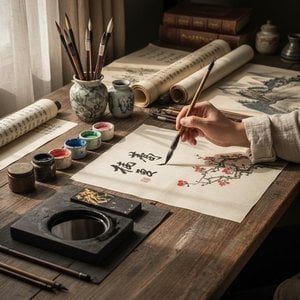
Embark on a sophisticated exploration of ink wash painting and Sumi-e. Uncover the profound historical lineages, Zen philosophies, and technical mastery behind this timeless medium in our authoritative guide for fine art enthusiasts.

Elevate your artistic practice with this expert guide to mastering the line. Discover advanced techniques in graphite, charcoal, and contour drawing designed for art students seeking technical precision and expressive depth in their fine art studies.


 效果预览
效果预览
 分享
分享 分享
分享
 详情
详情 指南
指南

 下载
下载
 相似作品
相似作品 X射线
X射线 幻灯片播放
幻灯片播放 统计数据
统计数据 展开详情
展开详情






































 玻璃选项仅适用于110厘米以下的尺寸。


