由我们的艺术家按需定制,为您提供您所选尺寸及画框的布面手工油画。 ( 切换至版画销售渠道 切换至数字图像销售渠道)





























您可以从与原作比例一致的预设尺寸中进行选择。

您可以输入自定义尺寸,以适配特定的画框或空间。如果所选尺寸与原图比例不符,我们将通过裁剪作品或添加手绘元素来扩展画面。数字样稿将在制作开始前发送给您确认。
请注意,屏幕预览无法准确反映实际的裁剪或扩展效果,只有样稿才能真实呈现最终的构图。
虽然我们提供定制尺寸服务,但为了保留原作比例,建议您从预设列表中选择尺寸。

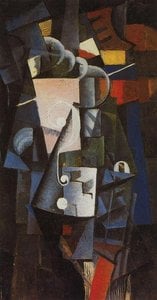
Vanily Case
复刻品尺寸说明
“Vanily Case,” a deceptively simple painting by Kazimir Malevich, offers a profound meditation on form, color, and the very nature of perception. Executed around 1917, this work represents a crucial step in Malevich’s radical journey toward pure abstraction, a movement he would later codify as Suprematism. The image itself – a commonplace scene of cups, spoons, and tables – is rendered with an almost obsessive attention to detail, yet simultaneously stripped down to its most essential elements. The black background acts not merely as a backdrop but as a contained void, intensifying the vibrancy of the red cup and silver spoon, drawing the viewer’s eye into a carefully constructed dialogue between object and space.
‘Vanily Case’ emerged during a period of intense artistic experimentation in Russia, fueled by the influence of European avant-garde movements like Cubism and Futurism. However, Malevich was seeking something beyond mere imitation; he aimed to create a completely new visual language – one that rejected representational illusion entirely. This work anticipates the core tenets of Suprematism, a movement founded by Malevich in 1915, which advocated for art based solely on geometric forms and pure color. The painting’s reductionist approach—focusing on basic shapes and colors—reflects this philosophical shift, moving away from depicting reality to expressing an inner truth.
Malevich’s technique in ‘Vanily Case’ is characterized by meticulous brushwork and a precise rendering of form. The surfaces are built up with thin layers of paint, creating subtle variations in tone and texture that enhance the objects' three-dimensional appearance. The composition itself is deceptively simple, yet carefully balanced. The placement of the cups—one on the left, another towards the top right—creates a dynamic tension within the confined space, guiding the viewer’s eye across the canvas. The use of negative space – the areas around and between the objects – is equally important, contributing to the painting's overall sense of depth and spatial awareness.
Beyond its formal qualities, ‘Vanily Case’ possesses a subtle symbolic resonance. The objects themselves—cups and spoons—represent the everyday rituals of life, yet their isolation within the black void suggests a detachment from worldly concerns. The painting evokes a sense of quiet contemplation and perhaps even melancholy, inviting viewers to reflect on the nature of existence and the search for meaning in a world increasingly dominated by abstraction. This piece is not merely a depiction of objects; it’s an exploration of perception, reality, and the potential of art to transcend the limitations of language and representation.

1878 - 1935 , 乌克兰

Journey through Wassily Kandinsky's 25 most iconic abstract paintings. Explore his revolutionary use of color, form & spiritual expressionism. Find museum-quality Kandinsky reproductions and elevate your home decor with WahooArt.com. Discover all masterpieces on WahooArt.com!

探索马克·罗斯科25幅杰作,感受抽象表现主义的色彩力量与深刻情感。从经典色域绘画到无题系列,了解艺术史上的大师及其作品背后的故事。WahooArt.com提供博物馆级高质量复制品,为您的家居装饰带来艺术灵感!立即探索完整收藏。

探索卡济米尔·马列维奇25幅至上主义杰作!深入了解抽象艺术的起源、黑色正方形背后的故事,以及如何用现代艺术提升您的家居装饰。WahooArt.com提供博物馆级艺术复制品,点亮您的空间。立即在线探索完整系列!

探索几何抽象艺术的十大杰作!康定斯基、蒙德里安等大师作品,色彩构成与非具象之美。WahooArt.com提供博物馆级艺术复制品,为您的家居带来现代艺术灵感。立即在线探索完整系列!

探索抽象表现主义的十幅经典杰作!波洛克、罗斯科等大师作品,揭秘艺术史上的重要瞬间。WahooArt.com为您呈现高品质艺术品复制和精选家居装饰方案,感受现代艺术的力量与魅力。立即浏览全系列!


 实景预览
实景预览
 发送
发送 分享
分享
 详情
详情 指南
指南

 下载图片
下载图片
 相似作品
相似作品 X射线
X射线 幻灯片播放
幻灯片播放 统计数据
统计数据

 阅读全文
阅读全文









 玻璃选项仅适用于110厘米以下的尺寸。