
 Contemporary Realism
 1494
1494 82.0 x 160.0 cm
博物馆级艺术微喷或帆布版画,制作高效,并提供多种饰面选择。 ( 购买手绘画作 切换至数字图像销售渠道)
从与原作比例一致的预设尺寸中进行选择。

您可以输入自定义尺寸,以适配特定的画框或空间。如果您选择的尺寸与原图比例不符,我们将对作品进行裁剪,或通过镜像填充/纯色填充边缘的方式来扩展图像。在开始制作之前,我们会向您发送一份数字效果图供您确认。
请注意,屏幕上的预览并不能反映实际的裁剪或扩展效果。只有效果图才能准确展示最终的构图。
虽然我们提供定制尺寸,但为了保持原图比例,我们建议您从预设列表中选择尺寸。

Jousting Armour (Stechzeug)
复制品尺寸

In the twilight of the fifteenth century, amidst the burgeoning splendor of the Renaissance, a unique form of artistry emerged from the heat of the forge and the rhythmic strike of the hammer. Kaspar Rieder (1452-1499), born in the quiet Austrian town of Mühlau, stands as a monumental figure in this specialized tradition. While many artists of his era sought expression through pigment and canvas, Rieder mastered the language of metal, transforming cold, utilitarian steel into breathtaking works of sculptural elegance. He is most renowned for his creation of stechzeug—the elaborate, highly decorative armor specifically engineered for the high-stakes spectacle of jousting tournaments.
The life of Rieder remains partially shrouded in the mists of history, as the archival records of medieval craftsmen are often as fragmented as the eras they inhabited. However, the brilliance of his surviving work allows us to reconstruct a narrative of profound skill and cultural connection. It is widely believed by scholars that Rieder underwent his formative training within the vibrant artistic hub of Innsbruck, Austria. This apprenticeship likely exposed him to the cutting-scale metallurgical techniques of the period and the sophisticated sculptural aesthetics that defined the late Gothic and early Renaissance transition. His style suggests a deep dialogue with Flemish armorers, reflecting a broader European movement where craftsmanship transcended borders to create a unified language of prestige and power.
To understand Rieder’s contribution to art history, one must look beyond the functional necessity of protection. The stechzeug he produced was not merely a suit of defense; it was a canvas for heraldry and high fashion. Unlike standard field armor designed for the chaos of battle, jousting armor required a level of ornamentation that could withstand the scrutiny of the royal court. Rieder’s mastery lay in his ability to manipulate steel through intricate processes such as:
These techniques allowed Rieder to weave complex narratives of lineage and status directly into the armor itself. A single piece, such as the exquisitely preserved sallet housed in the Kunsthistorisches Museum in Vienna, reveals a meticulous attention to detail where subtle textures and light-reflecting surfaces converge. Through his hands, the heavy weight of steel was visually lightened by the grace of floral patterns and the prestige of noble iconography.
The historical significance of Kaspar Rieder extends far beyond the tournament grounds of the 1400s. He represents a pivotal moment in European history when the artisan rose to the level of the fine artist, blurring the lines between functional weaponry and high sculpture. His work served as a vital instrument of political communication, where a knight's very silhouette announced his wealth, his alliances, and his bravery.
Today, Rieder’s legacy is preserved not in galleries of oil paintings, but in the silent, gleaming halls of museums, where his steel masterpieces continue to command awe. He remains a testament to the ingenuity of the Renaissance spirit—a period defined by the belief that even the most rugged materials could be refined into something transcendent. His ability to marry the strength required for combat with the delicacy required for art ensures his place as one of the most significant master armorers in the annals of European history.

1452 - 1499 , Austria

Embark on a scholarly journey through the sacred beauty of High Medieval art. Discover the profound symbolism, luminous iconography, and spiritual depth of Gothic masterpieces in this expert guide for classical art enthusiasts.
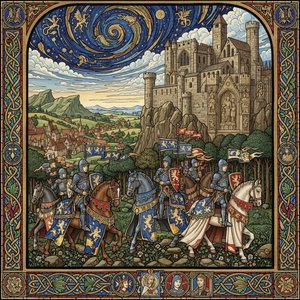
Explore the profound beauty of medieval art through the lens of history. Discover the symbolism of knights, the divine frescoes of Giotto, and how legendary masterpieces continue to inspire modern collectors and lovers of chivalric heritage.

Embark on a visual journey through Early Medieval art. Explore the profound beauty of illuminated manuscripts, sacred symbols, and golden light through an expert historical lens, celebrating the enduring legacy of medieval craftsmanship and divine artistry.

Embark on a scholarly journey through the spiritual grandeur of Late Medieval art. Discover the intricate symbolism, technical mastery, and profound religious narratives that define the Gothic era in this expert-led guide for art enthusiasts and collectors.


 效果预览
效果预览
 分享
分享 分享
分享
 详情
详情 指南
指南

 下载
下载
 相似作品
相似作品 X射线
X射线 幻灯片播放
幻灯片播放 统计数据
统计数据 展开详情
展开详情






































 玻璃选项仅适用于110厘米以下的尺寸。


