
博物馆级艺术微喷或帆布版画,制作高效,并提供多种饰面选择。 ( 购买手绘画作 切换至数字图像销售渠道)
从与原作比例一致的预设尺寸中进行选择。

您可以输入自定义尺寸,以适配特定的画框或空间。如果您选择的尺寸与原图比例不符,我们将对作品进行裁剪,或通过镜像填充/纯色填充边缘的方式来扩展图像。在开始制作之前,我们会向您发送一份数字效果图供您确认。
请注意,屏幕上的预览并不能反映实际的裁剪或扩展效果。只有效果图才能准确展示最终的构图。
虽然我们提供定制尺寸,但为了保持原图比例,我们建议您从预设列表中选择尺寸。

The Amber Seeker
复制品尺寸

In the quiet, salt-misted landscapes of the German coast, the name Karl Lorenz Rettich evokes a profound sense of serenity and atmospheric depth. Born in 1841 in Rosenhagen, near the Bay of Lübeck, Rettich was a child of the Mecklenburg countryside, raised amidst the sprawling manor estates of his family. This early immersion in the unspoiled beauty of the Baltic region did more than merely provide scenery; it planted the seeds of an artistic obsession with light, water, and the ephemeral moods of nature that would define his entire career. While his father initially steered him toward a more pragmatic path—enrolling him to study law at Munich University in 1859—the call of the canvas proved irresistible, leading him to abandon the courtroom for the studio.
Rettich’s artistic evolution was shaped by a series of prestigious encounters with the masters of his era. His transition from law student to dedicated painter began under the tutelage of Adolf Heinrich Lier in Munich, a mentor who helped him navigate the delicate balance between realism and romanticism. Seeking further refinement, Rettich journeyed to the legendary Düsseldorf School of Painting, where he studied alongside luminaries such as Albert Flamm and Theodor Hagen. This period was transformative, as he absorbed the nuances of tonal painting—a technique that emphasized the subtle interplay of light and shadow to create a sense of atmosphere. His thirst for knowledge later led him to Weimar, where he refined his landscape techniques under the guidance of the visionary Arnold Böcklin, an experience that undoubtedly deepened the emotional resonance and symbolic weight of his compositions.
The breadth of Rettich’s oeuvre is a testament to his restless, wandering spirit. He was not merely a painter of local vistas but a chronicler of diverse European terrains. His extensive expeditions through the rugged fjords of Norway and the sweeping landscapes of Sweden allowed him to experiment with grander scales and more dramatic geological forms. Similarly, his travels to Italy introduced a warmth and sun-drenched clarity to his palette, providing a striking contrast to the cool, misty tones of his beloved Baltic scenes. These journeys were not merely for sightseeing; they were essential laboratory sessions where he tested the limits of color and light to capture the very essence of the environments he encountered.
As his career matured, Rettich found a profound sense of homecoming in the coastal communities of Graal-Müritz and Ahrenshoop. It was here that his relationship with the Baltic Sea reached its zenith. His works from this period are characterized by an intimate understanding of the sea's temperament—the rhythmic pulse of waves, the shifting textures of sand, and the way the low northern sun pierces through heavy maritime clouds. He possessed a rare ability to render the "atmospheric" not just as weather, but as a palpable presence that envelops the viewer, inviting them into a state of quiet contemplation.
Rettich’s achievements extended far beyond the borders of Germany, earning him international acclaim during his lifetime. His talent was recognized on prestigious global stages, receiving awards in London (1874), Melbourne (1876), and Munich (1876). These accolades solidified his status as a significant figure within the German Art Cooperative and earned him the esteemed title of professor, appointed by Frederick Francis IV, Grand Duke of Mecklenburg-Schwerin. Even in his later years, he remained a prolific creator, sustaining himself through the sale of postcards that captured the quintessential beauty of the landscape, ensuring his vision reached a wide audience.
The historical significance of Karl Lorenz Rettich lies in his ability to bridge the gap between the structured traditions of the Düsseldorf School and the emotive, atmospheric sensibilities of late nineteenth-century landscape painting. He remains a master of the "painterly" moment—that fleeting second when light hits the water just so, or when a mist begins to lift from a coastal forest. To look upon a Rettich painting is to experience more than a mere depiction of nature; it is to participate in a timeless dialogue with the elements, preserved forever through his masterful use of tone, texture, and light.

1841 - 1904 , Germany
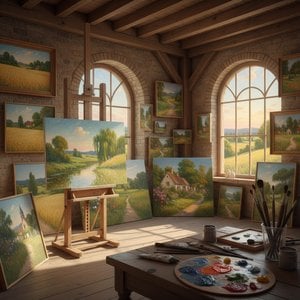
Discover the profound tranquility of rural art through an expert exploration of Impressionist landscapes. From pastoral scenes to textured oil masterpieces, learn how timeless nature-inspired artworks bring enduring elegance and serenity to sophisticated collectors.

Explore the ethereal beauty of Impressionist landscapes. Discover how masters like Monet and Renoir captured light and atmosphere through revolutionary plein air techniques and vibrant brushstrokes in this expert guide to art history's most luminous movement.

Explore the ethereal beauty of Impressionist landscapes. Discover how masters like Monet captured fleeting light through color and texture, and learn to curate these timeless, luminous masterpieces for your home collection.

Embark on a visual journey through history's most iconic landscapes. Discover the mastery of Impressionism and the sublime power of nature through our expert guide to classical landscape art, curated for the discerning collector and fine art enthusiast.

Discover the profound emotional depth of Post-Impressionist landscapes. Explore how masters like Van Gogh revolutionized art through vibrant color, textured impasto, and symbolic expression in this expert guide to the movement that redefined modern art history.


 效果预览
效果预览
 分享
分享 分享
分享
 详情
详情

 下载
下载
 相似作品
相似作品 X射线
X射线 幻灯片播放
幻灯片播放 统计数据
统计数据


 展开详情
展开详情






































 玻璃选项仅适用于110厘米以下的尺寸。


