
 Oil On CanvasWallArtDutch Golden Age
 Early Modern
 84.0 x 70.0 cm
 冬宫博物馆 (Hermitage Museum)
购买高分辨率增强版数字图像,其品质远超在线预览。
每一份文件都由我们的内部专家使用先进工具与专业的后期润色技术精心打造。我们确保每一张图像都具备卓越的清晰度、精准的色彩还原度以及细腻的细节表现。
最终文件将在 72 小时内通过电子邮件交付,并针对专业、编辑及印刷用途进行了优化。其品质与顶级设计工作室、出版社和画廊所信赖的标准完全一致。
选择 WahooArt.com,您获得的不仅仅是一张图像——您收到的是经过专业级增强、精雕细琢的数字艺术作品,并享有满意保证。以下是您的订单中自动包含的所有内容:

您的高分辨率数字图像文件将在下单后 72 小时内通过电子邮件发送给您 —— 即可立即使用。

您的艺术品经过专业优化,结合先进的 AI 技术与人工修饰,确保呈现极致的细节、清晰度与色彩准确度。

不小心删除了文件或找不到了?没关系——我们将随时为您免费重发。

即刻拥有您的艺术作品,无需支付任何关税、税费或运费——数字下载始终免税。

我们通过专业工具与色彩管理技术,确保您的数字图像尽可能真实地还原原作色彩。

如果您对所购数字图像不满意,我们将在100天内为您进行修改或提供100%的全额退款——无需任何理由。

不满意?在收到数字文件后的100天内,您可以申请全额退款——无需任何理由。

购买 3 张图片可享 10% 折扣 - 购买 5 张可享 15% 折扣 - 购买 10+ 张可享 20% 折扣。非常适合创意项目、画廊和机构使用。
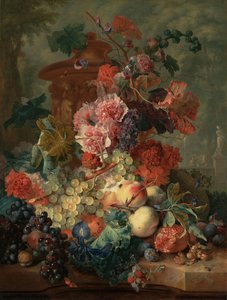
To gaze upon this magnificent depiction of flowers is to step directly into the luminous heart of the Dutch Golden Age. Justus van Huysum, the master whose brushstrokes seemed capable of capturing not just pigment on canvas, but the very ephemeral breath of life itself, presents us with a breathtaking still life. The arrangement is nothing short of opulent; a veritable cascade of blooms gathered in an elegant vase. From the softest blush of pastel petals to the deepest, most saturated hues of crimson and sapphire blue, every flower seems to possess its own unique narrative. It is a celebration of botanical abundance, rendered with a meticulousness that borders on the miraculous.
What elevates this piece beyond mere floral arrangement is the sheer technical virtuosity displayed by Van Huysum. His handling of oil paint allows for an astonishing play between light and shadow. Observe how the light seems to emanate from within the petals themselves, giving them a palpable texture—you can almost feel the velvety nap of a rose or the delicate curve of a lily's edge. The depth achieved in this composition is masterful; the flowers do not simply sit upon a surface but seem to emerge from it, creating an illusion of three-dimensional volume that speaks volumes about his skill as a painter.
Yet, the narrative thread woven through this floral tapestry extends beyond mere botany. Adding a layer of ethereal mystery is the presence of the cherubic figure in the background. This angelic element introduces themes of innocence and the divine connection to nature. The small bird held by this figure acts as a poignant symbol—a delicate emblem representing life's fragility, freedom, or perhaps the soul itself, all framed within the overwhelming beauty of the natural world. It invites the viewer into a contemplative space where art, mythology, and biology converge.
For the contemporary collector or designer, this artwork offers more than just decoration; it offers an atmosphere. The overall mood is one of serene contemplation—a quiet moment stolen from the bustle of modern life. Reproducing such a piece allows one to infuse a room with the historical gravitas and unparalleled beauty of Dutch mastery. It serves as a focal point that whispers tales of 17th-century refinement, making any space feel instantly richer, more cultured, and deeply connected to the enduring celebration of natural perfection.

In the golden light of the Dutch Golden Age, few artists captured the ephemeral splendor of nature with as much devotion and precision as Justus van Huysum. Born in Amsterdam in 1659, he emerged from a lineage of creative excellence, the son of Jan van Huysum I, a decorative painter who had brought his craft from the outskirts of Leeuwarden to the bustling artistic heart of the Netherlands. This familial foundation provided more than just a name; it offered a direct inheritance of technical skill and an intimate connection to the flourishing art market of Amsterdam. Growing up in an environment where visual creativity was a shared language, Justus was destined to refine the art of the still life into something profoundly transcendent.
The trajectory of his talent was shaped significantly by formal mentorship and early exposure to the masters of his era. In 1675, recognizing the exceptional aptitude of his son, Jan van Huysum I dispatched him to study under the renowned Nicolaes Berchem. This period of tutelage was transformative, instilling in Justus a rigorous discipline for detail and an eye for the subtle nuances of light and texture. While he possessed the versatility to explore landscapes, it was within the delicate realm of floral compositions that his true genius blossomed. He did not merely paint flowers; he sought to document their very essence, rendering petals, stems, and dew-kissed foliage with a realism so startling that it bridged the gap between fine art and botanical science.
Justus van Huysum’s work is characterized by an unparalleled ability to breathe life into the static medium of oil on canvas. His compositions often feel like captured moments of perfection, where every bloom is rendered with a meticulousness that borders on the miraculous. He possessed a rare gift for capturing the tactile qualities of his subjects—the velvety softness of a rose petal, the translucent fragility of a tulip, and the vibrant, pulsing energy of a garden in full summer glory. This technical mastery was not merely about imitation but about an emotional engagement with the natural world. His paintings served as a celebration of life's fleeting beauty, inviting viewers into a serene, idealized space where nature exists in eternal, unblemished perfection.
Beyond his individual skill, Justus played a vital role in establishing a stylistic standard that would influence generations of painters. His approach to the still life genre elevated it from mere decorative ornament to a subject worthy of deep scholarly and aesthetic contemplation. By meticulously researching botanical specimens, he ensured that his work possessed an anatomical accuracy that appealed to both the connoisseur and the scientist. This intersection of art and botany allowed his work to resonate within the intellectual circles of the 17th century, where the study of nature was deeply intertwined with the pursuit of knowledge.
The life of Justus van Huysum was also one of profound familial continuity. In 1683, his marriage to Maria Elisabeth van Voorbergen anchored a domestic life that would become a cornerstone of Dutch art history. The legacy of the Van Huysum name was carried forward by his children, most notably his son Jan van Huysum, who would go on to become one of the most celebrated flower painters in history. This lineage ensured that the techniques and the aesthetic values championed by Justus—precision, luminosity, and botanical reverence—would permeate the Dutch art scene well into the 18th century.
Though he passed away in 1716, the historical significance of Justus van Huysum remains undiminished. He stands as a pivotal figure who helped define the zenith of the Dutch floral still life. His ability to weave together technical brilliance with a profound respect for the natural world created a body of work that continues to enchant collectors and historians alike. Through his brush, the fleeting blossoms of the past are preserved forever, offering an enduring testament to the beauty of the earth and the limitless potential of the human hand.
1659 - 1716 , Netherlands


 效果预览
效果预览
 切换至版画销售渠道
 分享
分享 分享
分享
 详情
详情

 下载
下载
 相似作品
相似作品 X射线
X射线 幻灯片播放
幻灯片播放 统计数据
统计数据 展开详情
展开详情


