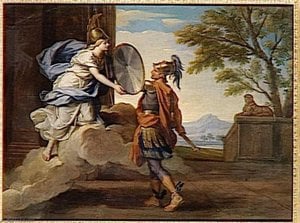
由我们的艺术家按需定制,为您提供您所选尺寸及画框的布面手工油画。 ( 切换至版画销售渠道 切换至数字图像销售渠道)





























从与原作比例一致的预设尺寸中进行选择。

您可以输入自定义尺寸,以适配特定的画框或空间。如果所选尺寸与原图比例不符,我们将通过裁剪作品或添加手绘元素来扩展画面。数字样稿将在制作开始前发送给您确认。
请注意,屏幕预览无法准确反映实际的裁剪或扩展效果,只有样稿才能真实呈现最终的构图。
虽然我们提供定制尺寸服务,但为了保留原作比例,建议您从预设列表中选择尺寸。

UNE GUERILLA
复制品尺寸

In the vibrant, often turbulent landscape of nineteenth-century French art, few names evoke the dramatic tension between classical precision and Romantic passion quite like Jules Jollivet. Born in Paris in 1794, Jollivet emerged from a lineage deeply rooted in the tactile beauty of sculpture, being the son of the renowned Jean-Baptiste Jollivet. This early exposure to the physical weight and structural integrity of form would later become a cornerstone of his painterly style. While his path initially meandered through the disciplined study of architecture under masters like Jacques-Marie Huvé, it was his eventual pivot to the canvas that allowed him to capture the fleeting, emotive essence of history and human drama. His work serves as a bridge between the rigid moralism of Neoclassicism and the sweeping, atmospheric storytelling of the Romantic era.
Jollivet’s artistic evolution was shaped by the prestigious halls of the École des Beaux-Arts de Paris, where he refined his technique under the guidance of influential instructors such as François-Louis Dejuinne and Antoine-Jean Gros. These mentors, masters of historical and genre scenes, instilled in him a profound respect for anatomical accuracy and the power of narrative composition. However, Jollivet was not merely a student of tradition; he was an explorer of light and culture. His journey took him to Spain in 1826, a transformative period where he worked on documenting the royal collections of King Ferdinand VII. This encounter with the Spanish masters, particularly the legendary Diego Velázquez, breathed new life into his palette, infusing his work with a richer, more somber depth and an interest in the gritty realism of genre scenes.
The true brilliance of Jollivet lies in his ability to breathe life into the past, transforming historical chronicles into visceral, lived experiences. He became particularly celebrated for his depictions of military subjects and aristocratic portraits, where he balanced the grandeur of nobility with a keen psychological insight. His oeuvre is marked by an extraordinary versatility, ranging from the intense, localized drama of "Une Guerilla"—a work that captures the raw spirit of resistance—to large-scale historical panels commissioned for the Musée de l’Histoire de France. In these monumental works, such as his depictions of the Battle of Hooglede, Jollivet utilized a meticulous approach to detail to convey the chaos and heroism of conflict, ensuring that every uniform, weapon, and facial expression contributed to the overarching historical narrative.
Beyond the battlefield, Jollivet’s fascination with lithography allowed him to expand his reach, bringing fine art to a broader audience through detailed illustrations. His talent for capturing the essence of a moment was equally evident in his more intimate genre paintings and religious works, such as the haunting "Massacre of the Innocents." In these pieces, the artist moved away from the purely epic to explore themes of tragedy, innocence, and the human condition. Through a masterful use of light and shadow, he could guide the viewer's eye through complex compositions, creating a sense of movement and emotional resonance that remains captivating over a century later.
Though history occasionally places him in the shadow of more radical contemporaries like Gustave Courbet, Jules Jollivet’s significance remains undeniable. He was a painter who refused to abandon the foundational principles of disegno and anatomical truth, even as he embraced the emotive freedom of the Romantic movement. His legacy is found in the meticulous way he documented the spirit of his age—the nobility, the military triumphs, and the cultural textures of both France and Spain. To look upon a Jollivet painting is to witness a master at work, balancing the weight of history with the lightness of artistic inspiration, leaving behind a visual record that continues to resonate with anyone moved by the beauty of classical realism.

1794 - 1871

Discover the enduring legacy of oil on board painting. Explore how historical techniques, rich impasto textures, and structural durability create timeless masterpieces that bridge Renaissance grandeur with modern art collecting excellence.

Explore the profound symbolism of military uniforms in art history. From Victorian portraits to realistic lithographs, discover how artists capture power, identity, and historical legacy through the intricate details of martial regalia and command.

Discover the profound allure of oil on canvas. Explore the mastery of impasto textures, the science of pigment longevity, and expert guides to selecting museum-quality reproductions that elevate your collection with timeless elegance and tactile depth.

Discover the enduring allure of oil on canvas. Explore how master techniques like impasto and glazing create the depth, texture, and emotional resonance found in the world's greatest masterpieces. An essential guide for fine art enthusiasts and discerning collectors.


 效果预览
效果预览
 分享
分享 分享
分享
 详情
详情

 下载
下载
 相似作品
相似作品 X射线
X射线 幻灯片播放
幻灯片播放 统计数据
统计数据

 展开详情
展开详情









 玻璃选项仅适用于110厘米以下的尺寸。