
博物馆级艺术微喷或帆布版画,制作高效,并提供多种饰面选择。 ( 购买手绘画作 切换至数字图像销售渠道)
从与原作比例一致的预设尺寸中进行选择。

您可以输入自定义尺寸,以适配特定的画框或空间。如果您选择的尺寸与原图比例不符,我们将对作品进行裁剪,或通过镜像填充/纯色填充边缘的方式来扩展图像。在开始制作之前,我们会向您发送一份数字效果图供您确认。
请注意,屏幕上的预览并不能反映实际的裁剪或扩展效果。只有效果图才能准确展示最终的构图。
虽然我们提供定制尺寸,但为了保持原图比例,我们建议您从预设列表中选择尺寸。

Límite Sud
复制品尺寸
Born in Ontario, Canada in 1948, Peter Sculthorpe’s artistic journey began with a quiet intensity that blossomed fully during his final year of high school. This early spark ignited a lifelong exploration into the realms of process and material, ultimately leading him to develop a uniquely innovative approach that defied easy categorization. While initially rooted in painting, Sculthorpe’s practice dramatically shifted in 1985, moving towards a sculptural vocabulary centered on drawing and three-dimensional objects – a transformation driven by his desire to expand the very possibilities of seeing and experiencing space.
Sculptthorpe wasn't simply constructing physical forms; he was crafting “tools for vision,” as he himself described them. These weren’t traditional sculptures intended to be admired from a distance, but rather intricate devices designed to engage the viewer in a dynamic, almost tactile relationship with the artwork. His materials were often humble – wire, cardboard, wood scraps, and even discarded household items like pet stain removers – elevated through careful manipulation and imbued with unexpected significance. This deliberate use of the commonplace spoke to a broader interest in revealing hidden structures and inviting viewers to participate actively in deciphering the work’s meaning.
Sculptthorpe's artistic philosophy was deeply informed by his understanding of perspective, a concept he carried over from his earlier painting practice. However, rather than replicating traditional visual cues, he sought to create a sense of “looking around,” as he put it – an immersive experience where the viewer’s eye could traverse multiple angles simultaneously. This ambition led him to develop complex systems of interlocking lines and planes within his drawings and sculptures, creating what resembled intricate pools or layered landscapes.
His work was influenced by a diverse range of sources, including the geometric precision of Piet Mondrian and the playful experimentation of Sol LeWitt. Yet, Sculthorpe’s approach transcended mere imitation; he synthesized these influences into something entirely his own – a distinctly contemplative and often humorous exploration of spatial relationships.
Sculptthorpe's work gained increasing recognition throughout the 1990s, culminating in solo exhibitions at prestigious venues like the Kunsthalle Bern in Switzerland (1992) and the Kunstmuseum Luzern (1999). A posthumous retrospective organized by the Staatliche Graphische Sammlung at the Pinakothek der Moderne in Munich in 2006 provided a comprehensive overview of his career, showcasing the breadth and depth of his artistic vision. Subsequent exhibitions have continued to illuminate his unique approach, including focused surveys at the High Museum of Art in Atlanta (2017-2018) and The Morgan Library & Museum in New York (2020).
His work is now represented in significant public collections worldwide, including the British Museum, Musée National d’Art Moderne, Centre Georges Pompidou, Glenstone Museum, and numerous museums across North America. These institutions attest to the enduring value and critical acclaim of his innovative practice.
Sculptthorpe's legacy lies in his radical reimagining of drawing and sculpture. He demonstrated a remarkable ability to transform ordinary materials into objects of profound visual and conceptual complexity. His “tools for vision” invite viewers to engage with art not as passive observers, but as active participants in the process of interpretation.
His work continues to be studied and admired for its intellectual rigor, playful experimentation, and deeply considered exploration of space and perception. Peter Sculthorpe’s contribution to contemporary art lies not just in his individual creations, but in his willingness to challenge conventional boundaries and redefine what is possible within the realms of drawing and sculpture.

1948 - , Argentina

探索几何抽象艺术的十大杰作!康定斯基、蒙德里安等大师作品,色彩构成与非具象之美。WahooArt.com提供博物馆级艺术复制品,为您的家居带来现代艺术灵感。立即在线探索完整系列!

探索戈雅大师的25幅杰作!深入了解西班牙绘画巨匠Francisco Goya的艺术世界,从洛可可到浪漫主义风格,感受黑加仑时代的情感力量。WahooArt.com提供高品质油画复制品和家居装饰灵感。立即在线发现所有名画!

Explore the profound history and emotional depth of Color Field painting. From Mark Rothko to Barnett Newman, discover how pure color redefined modern art through our expert-led guide for students and collectors alike.

探索抽象表现主义的十幅经典杰作!波洛克、罗斯科等大师作品,揭秘艺术史上的重要瞬间。WahooArt.com为您呈现高品质艺术品复制和精选家居装饰方案,感受现代艺术的力量与魅力。立即浏览全系列!
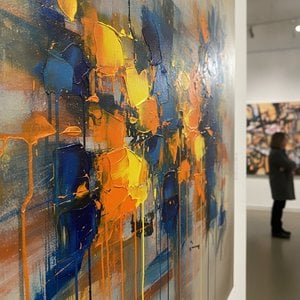
Master the high-impact world of contemporary abstraction. Discover how bold colors, textures, and modern movements like Abstract Expressionism can transform your space with premium, high-energy art curated for the design-conscious professional.


 效果预览
效果预览
 分享
分享 分享
分享
 详情
详情 指南
指南

 下载
下载
 相似作品
相似作品 X射线
X射线 幻灯片播放
幻灯片播放 统计数据
统计数据


 展开详情
展开详情






































 玻璃选项仅适用于110厘米以下的尺寸。


