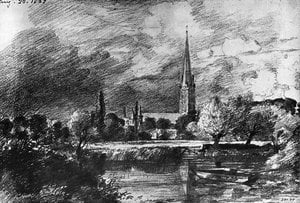
A Vision of Ancient Majesty: Constable’s Stonehenge
John Constable's depiction of Stonehenge transcends mere representation; it embodies a profound connection to the English landscape and a masterful exploration of Romantic artistic principles. Painted in 1835, this watercolor captures not just the physical grandeur of the stone circle but also its atmospheric presence—a testament to Constable’s ability to convey emotion through observation and meticulous detail. The painting isn't simply a record of a place; it’s an attempt to distill its spirit into visual form.
The Landscape as Soul
Constable’s formative years spent amidst the fertile Vale of Dedham instilled in him an unwavering devotion to capturing the essence of rural England. This dedication is palpable in Stonehenge, where the muted tones of the sky and earth dominate the composition. Unlike the idealized landscapes favored by earlier Romantic painters like Claude Lorrain, Constable eschews theatrical grandeur for a quiet contemplation of nature’s rhythms. Instead of striving for dramatic vistas, he focuses on subtle shifts in light and shadow—elements that contribute significantly to the painting's emotive power. The artist skillfully utilizes watercolor techniques to achieve this effect, layering washes of pigment to create an illusion of depth and texture that mimics the weathered surfaces of the stones themselves.
Technical Brilliance: Watercolor’s Delicate Dance
Constable’s mastery lies in his masterful manipulation of watercolor—a medium notoriously difficult to control yet exquisitely suited for conveying atmospheric conditions. The artist employs a technique known as glazing, applying thin layers of translucent color over previously painted areas. This process builds up tonal richness and luminosity gradually, allowing for nuanced gradations that capture the ethereal quality of Stonehenge’s surroundings. Notice how Constable renders the overcast sky—a crucial element in establishing the painting's mood—with delicate washes of grey and pale blue. These subtle hues subtly illuminate the stones and create a sense of diffused light, mirroring the experience of witnessing Stonehenge on a misty day.
Symbolism Rooted in Myth and Memory
Stonehenge’s enduring fascination stems from its enigmatic origins and its association with ancient rituals and beliefs. Constable doesn't explicitly address these themes within his painting; rather, he invites viewers to contemplate them silently. The positioning of the figures—one centrally placed near the stones and another on the periphery—suggests a human presence dwarfed by the immensity of time and space. This compositional choice reinforces the painting’s overarching message: humanity's insignificance against the backdrop of geological history, yet simultaneously its capacity for awe and wonder. The stones themselves stand as symbols of permanence and mystery, reminding us of civilizations past and hinting at forces beyond human comprehension.
Emotional Resonance: A Moment Frozen in Time
Ultimately, Constable’s Stonehenge succeeds in transporting the viewer to a place of profound stillness and contemplation. It's more than just a depiction of a monument; it’s an embodiment of Romantic idealism—a belief that art could capture not only what is seen but also what is felt. The painting evokes a sense of melancholy beauty, mirroring the sublime experience of encountering something vast and awe-inspiring. Consider how Constable captures the stillness of the scene—the quiet dignity of the stones and the contemplative gaze of the figures. This careful attention to detail contributes to an emotional impact that lingers long after viewing the artwork. It’s a piece that speaks to our deepest yearning for connection with nature and with the enduring mysteries of human history.
问答详情
康斯塔勃尔 的《Stonehenge》 的版权是否允许进行复制?
馆藏于 维多利亚和阿尔伯特博物馆 的 康斯塔勃尔 的《Stonehenge》 属于 属于公有领域 —— 其版权已过期。这一状态决定了该图像是否可以进行复制。
"Stonehenge" 的规格与尺寸是多少?
"Stonehenge" 的形式为 Landscape,原件尺寸为 387 x 591 cm。这两项信息在规划复制品时都非常有用。
"Stonehenge" 的材质是什么,采用了哪种风格?
在“Stonehenge”中,Acrylic On Canvas技法与Romantic Landscape运动完美融合。
康斯塔勃尔 的《Stonehenge》 为室内空间增添了怎样的氛围?
康斯塔勃尔 的《Stonehenge》 营造出 Dramatic 的氛围,与推荐的陈设空间——Living Room 完美契合。
我能否更详细地查看“Stonehenge”?
康斯塔勃尔 的《Stonehenge》 的 X 光视图可在作品的 X射线检测 页面查看:通过十一层光学图层对图像进行交互式深度解析。
如何以幻灯片形式查看康斯塔勃尔 的《Stonehenge》?
您可以在作品的幻灯片播放页面上观看“Stonehenge”的幻灯片展示。
“Stonehenge”背后的艺术家与艺术风格是哪些?
康斯塔勃尔 在 Romantic Landscape 运动时期创作了《Stonehenge》。
康斯塔勃尔 的《Stonehenge》展现了怎样的色彩和谐感?
康斯塔勃尔 的《Stonehenge》 的色彩呈现出一种 Softly Mixed Palette 的和谐感。这种和谐感描述了色彩之间的相互关系。