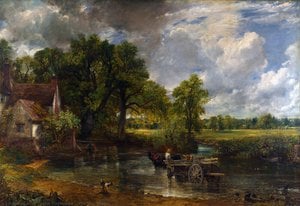
The Captivating Charm of Constable’s Chain Pier
John Constable's “Chain Pier, Brighton” isn’t merely a depiction of a seaside structure; it’s a masterful distillation of light, atmosphere, and the very essence of Romanticism. Completed between 1826 and 1827, this painting transports us to the bustling shores of Brighton in the early 19th century, capturing a fleeting moment of serene activity against a dramatic sky. The scene unfolds with remarkable immediacy – a few figures strolling along the newly constructed pier, their forms dissolving into the hazy distance, while a distant ship sails gracefully across the shimmering expanse of the sea. Constable’s genius lies not just in his technical skill but in his ability to imbue this everyday subject with an extraordinary emotional resonance.

A Window into the Romantic Landscape
Constable was a pivotal figure in the English Romantic movement, and “Chain Pier” exemplifies his unique approach to landscape painting. Unlike earlier artists who focused on dramatic mountainscapes or heroic historical scenes, Constable sought to capture the subtle beauty of the English countryside – particularly the light and atmosphere of familiar places like Dedham Vale. He prioritized observation over idealized representation, striving to convey the *feeling* of a scene rather than its literal appearance. This painting is deeply rooted in this philosophy; it’s not about accurately rendering the pier itself but about evoking the mood of a summer afternoon by the sea – the warmth of the sunlight, the gentle breeze, and the sense of peaceful contemplation.
The painting's context is crucial to understanding its significance. Brighton was undergoing rapid transformation in the 1820s, emerging as a fashionable seaside resort thanks to improved transportation links with London. The construction of the Chain Pier itself represented a bold statement of progress and leisure. Constable’s depiction captures this moment of transition – a blend of traditional rural life and burgeoning modernity.
Technique and Light: Constable's Signature Style
Constable’s technique is characterized by his loose, expressive brushstrokes and his masterful use of light. He employed a ‘broken colour’ method, applying thin layers of paint in small, distinct strokes to create a shimmering effect that mimics the way sunlight interacts with water and air. Notice how he captures the diffused glow filtering through the clouds – it's not a sharp, defined light but rather a hazy, atmospheric illumination that imbues the scene with warmth and tranquility. The use of complementary colours—the blues and greens of the sea and sky against the white of the pier—further enhances the sense of vibrancy and depth.
The composition is carefully balanced, drawing the eye towards the distant ship and creating a sense of spaciousness. Constable’s attention to detail is evident in the rendering of the figures on the pier, their forms subtly suggested rather than precisely defined, contributing to the painting's overall feeling of immediacy and spontaneity.
Symbolism and Emotional Resonance
Beyond its visual beauty, “Chain Pier” carries a subtle symbolic weight. The pier itself can be interpreted as a symbol of connection – linking land and sea, past and present, reality and imagination. The figures strolling along the shore represent human interaction with nature, suggesting a sense of belonging and harmony. The distant ship evokes a feeling of journey and possibility. Ultimately, Constable’s painting is an invitation to slow down, appreciate the beauty of the natural world, and find solace in its timeless rhythms.
At WahooArt, we are proud to offer a meticulously crafted reproduction of this iconic work, allowing you to bring Constable's evocative vision into your own home. Explore our collection of John Constable paintings – including “Dedham Lock” and “Dedham Vale” – and discover the enduring power of his art.



 效果预览
效果预览
 购买印刷品
购买印刷品 分享
分享 分享
分享
 详情
详情

 下载
下载
 相似作品
相似作品 X射线
X射线 幻灯片播放
幻灯片播放

 展开详情
展开详情






































 玻璃选项仅适用于110厘米以下的尺寸。