作品详情
A Window into English Pastoralism
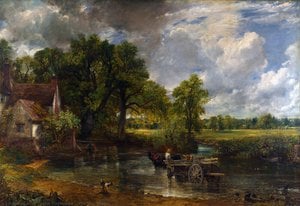
John Constable’s A Water Mill is far more than a mere landscape; it is a profound meditation on the enduring peace of the English countryside. Within this celebrated composition from his Water Meadows series, the viewer is invited to step into a world where time seems to slow, captured in the soft, diffused light of a day circa 1820. The scene unfolds with an intimate familiarity, presenting a modest brick farmhouse that stands as a silent witness to the rhythmic life of the riverbank. As the water churns through the mill, there is a palpable sense of industry harmonizing with the natural world. Figures move with quiet purpose near the water’s edge, tending to livestock and engaging in the gentle domesticity of rural life, while a lone horse and a drifting boat add layers of narrative depth to this idyllic tableau. It is a moment frozen in time, where the pulse of human activity beats in perfect synchronicity with the flow of the stream.
The Mastery of Atmosphere and Technique
To observe Constable’s technique is to witness the birth of a new way of seeing. Eschewing the rigid, idealized forms of Neoclassicism, Constable embraced an earthy, organic palette—a spectrum of deep greens, rich browns, and tranquil blues derived directly from the very landscapes he loved. His brushwork is remarkably expressive; rather than seeking photographic perfection, he employs loose, textured strokes to capture the ephemeral quality of sunlight filtering through foliage and the shimmering movement of the water. This approach, which heavily influenced the Barbizon School, utilizes subtle tonal gradation and atmospheric perspective to create a sense of depth that pulls the observer into the scene. The painting does not just show us a mill; it allows us to feel the humidity in the air and the cool mist rising from the river, making the landscape feel vibrantly alive.
A Timeless Addition to the Curated Interior
For the discerning collector or interior designer, A Water Mill offers an unparalleled emotional resonance. In an era of rapid change and digital noise, this artwork serves as a sanctuary of tranquility and nostalgia. Its historical significance—representing a pivotal shift toward Romanticism and a reverence for the unadorned beauty of nature—makes it a cornerstone piece for any serious collection. When integrated into a room, the painting provides a focal point that breathes life, history, and a sense of groundedness into modern living environments. Whether placed in a sunlit study or a grand living space, a high-quality reproduction of this masterpiece acts as an invitation to reconnect with the pastoral roots of our shared heritage, infusing any interior with a sense of grace, permanence, and enduring charm.



 效果预览
效果预览
 购买印刷品
购买印刷品 分享
分享 分享
分享
 详情
详情

 下载
下载
 相似作品
相似作品 X射线
X射线 幻灯片播放
幻灯片播放

 展开详情
展开详情






































 玻璃选项仅适用于110厘米以下的尺寸。