

获取远超网页预览效果的印刷级文件。我们销售的每一张数字图像均源自库存数据库中的高分辨率母版——宽度通常在 5,000 至 15,000 像素之间——因此您可以放心地进行大幅打印、局部裁剪或还原细腻的细节。
每一件作品在离开我们的工作室前都经过了精心的处理。数字影像专家会对照原作核对色彩,并在必要时进行校正,随后利用专业修图工具提升清晰度与细节表现——且始终忠实于艺术家的笔触与风格。最终呈现的图像宛如原作本身,而非仅仅是一张加了滤镜的扫描件。
您可以在最终定稿前进行审核:我们的专家将在 72 小时内通过电子邮件向您发送图像以供审阅。如果不满意?您可以要求改进或修正;若质量未达预期,亦可申请退款。
这也是出版商、设计工作室、画廊及印刷厂所信赖的品质。
选择 WahooArt.com,您获得的不仅仅是一张图像——您收到的是经过专业级增强、精雕细琢的数字艺术作品,并享有满意保证。以下是您的订单中自动包含的所有内容:
您的高分辨率数字图像文件将在下单后 72 小时内通过电子邮件发送给您 —— 即可立即使用。
您的艺术品经过专业优化,结合先进的 AI 技术与人工修饰,确保呈现极致的细节、清晰度与色彩准确度。
不小心删除了文件或找不到了?没关系——我们将随时为您免费重发。
即刻拥有您的艺术作品,无需支付任何关税、税费或运费——数字下载始终免税。
我们通过专业工具与色彩管理技术,确保您的数字图像尽可能真实地还原原作色彩。
如果您对所购数字图像不满意,我们将在100天内为您进行修改或提供100%的全额退款——无需任何理由。
不满意?在收到数字文件后的100天内,您可以申请全额退款——无需任何理由。
购买 3 张享 10% 折扣 - 购买 5 张享 15% 折扣 - 购买 10 张以上享 20% 折扣。非常适合创意项目、画廊及机构使用。
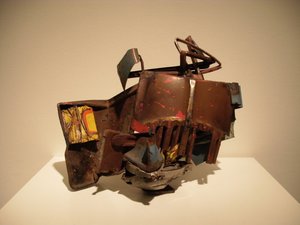
"Fancy" 的色彩基调由以 灰泥色 (#d6d7d7) 为主的 中性色 色系构成。
John Angus Chamberlain 的《Fancy》 的材质为 青铜雕塑,尺寸为 133 x 114 cm。
John Angus Chamberlain 的《Fancy》 的整体基调为 典雅,这种基调传达了作品的整体氛围。

In the intersection of industrial decay and high art, few figures loom as large or as provocatively as John Angus Chamberlain. Born in 1927 in Rochester, Indiana, Chamberlain did not merely create sculpture; he orchestrated a metamorphosis of the discarded. To look upon his work is to witness a violent yet poetic dialogue between the mechanical past and the abstract present. He possessed a singular vision that allowed him to see not just rusted scrap, but a vocabulary of form, color, and texture. His journey from the son of a saloonkeeper in the American Midwest to a titan of the Neo-Dada movement is a testament to an unyielding creative impulse that sought to find beauty within the crushed and the broken.
Chamberlain’s artistic consciousness was forged through a diverse and rigorous educational odyssey. After serving in the United States Navy during the pivotal years of World War II, he utilized the GI Bill to immerse himself in the burgeoning avant-garde scenes of America. His time at the Art Institute of of Chicago provided him with a foundational mastery of form, but it was his tenure at the legendary Black Mountain College that truly expanded his intellectual horizons. At Black Mountain, he moved beyond the purely visual, studying under influential poets such as Charles Olson and Robert Creeley. This literary immersion profoundly shaped his sculptural language; he famously viewed his collection of automotive fragments as a reservoir of words, where the act of welding was akin to composing a stanza, seeking the perfect placement of one jagged edge against another to achieve a rhythmic, poetic resonance.
The hallmark of Chamberlain’s oeuvre lies in his revolutionary technique of assemblage. While many of his contemporaries were exploring the flat planes of Abstract Expressionist painting, Chamberlain sought to bring that same gestural energy into three-dimensional space. He became a master of the "crushed" aesthetic, meticulously dismantling abandoned automobiles and extracting their vibrant, enamel-coated metal components. Through the intense processes of welding, bending, and compressing, he transformed these industrial remnants into monumental forms that pulsed with an almost organic vitality.
His work defies easy categorization, existing in a fluid state between several major movements:
There is a palpable tension in his sculptures, a sense of captured motion and compressed energy. The bright flashes of Cadillac red or Chevrolet blue, often peeking through layers of rust and grime, create a chromatic intensity that mirrors the dynamism of urban life. He did not seek to represent the car, but rather to capture the spirit of its movement and the inevitable entropy of its decay.
Throughout his prolific career, Chamberlain’s presence was felt across the most significant art hubs of the world, from Manhattan and Los Angeles to Shelter Island and even Belgium. His ability to disrupt the boundaries between sculpture and painting left an indelible mark on the trajectory of modern art. He proved that the debris of the industrial revolution could serve as the medium for a profound spiritual and aesthetic inquiry. Critics often noted that while his materials were cold and hard, the emotional impact of his work was deeply visceral, aiming—as he himself desired—to "make the viewer’s heart beat."
As we reflect on his life, which concluded in 2011, Chamberlain remains a pivotal figure who bridged the gap between the mechanical and the lyrical. He taught us that art is not merely about the creation of something new, but about the radical reimagining of what already exists. His legacy lives on in every artist who looks at the wreckage of the world and sees the potential for a masterpiece, reminding us that even in the crushed and the discarded, there is an eternal, unyielding beauty waiting to be welded back together.
1927 - 2011 , United States of America

 切换至版画销售渠道
 分享
分享 分享
分享
 详情
详情 指南
指南

 下载作品
下载作品
 相似作品
相似作品 幻灯片播放
幻灯片播放 问答
问答
 统计数据
统计数据

 展开全文
展开全文


