免费艺术咨询

x
定制手绘复刻品 定制手绘复刻品购买高清图片 购买高清图片 分享分享
详情详情 加入收藏 加入收藏 下载下载 相似作品相似作品 X射线检测X射线检测 幻灯片播放幻灯片播放

Mètamorphose

Inspired by Gaudí’s architectural forms and Miró's father’s goldsmithing craft, this piece reflects a profound connection to Catalan identity. Discover more about Joan Miró at WahooArt!

米罗是一位充满活力的艺术家,他的作品融合了超现实主义和抽象艺术风格。他创作了许多标志性画作,如《农场》、《荷兰室内设计》,以及《绘画》,展现了对内心世界的独特探索与诗意表达。他是现代艺术的重要先驱者!

艺术微喷/版画

博物馆级艺术微喷或帆布版画,制作高效,并提供多种饰面选择。

P118B $10
P118H $10
P118W $10
P438Z $10
P508JH $12
P508YH $12
P805H $10
P805Z $10
P919BZ $10
P919G $10
P919XJ $10
P959ZH $10
P968JZ $12
W106C $8
W218G $10
W218JH $8
W218Y $10
W307PJ $10
W316G $10
W316PJ $8
W316Y $10
W398PJ $8
W4111J $10
W500HY $15
W500JH $15
W692G $12
W849H $8
W940BG $15
W953PJ $8

Standard
custom
CM
INCH

从与原作比例一致的预设尺寸中进行选择。

宽度
高度

您可以输入自定义尺寸,以适配特定的画框或空间。如果您选择的尺寸与原图比例不符,我们将对作品进行裁剪,或通过镜像填充/纯色填充边缘的方式来扩展图像。在开始制作之前,我们会向您发送一份数字效果图供您确认。
请注意,屏幕上的预览并不能反映实际的裁剪或扩展效果。只有效果图才能准确展示最终的构图。
虽然我们提供定制尺寸,但为了保持原图比例,我们建议您从预设列表中选择尺寸。

全球配送(),仅需 2 周即可送达,无需等待标准流程的 4/5 周。(6 July)

why_choose_icon
全球免费特快专递服务
why_choose_icon
优质亚麻画布
why_choose_icon
全程运输保险
why_choose_icon
关税退款保证
why_choose_icon
色彩还原度保证
why_choose_icon
60天退货政策(仅限制造缺陷)
why_choose_icon
100%退款保证
why_choose_icon
多件购买优惠

总计金额

-

reproduction

Mètamorphose

艺术微喷/版画

复制品尺寸

-

最终总价

-

作品概览

  • Influences: Gaudí
  • Artist: Joan Miró
  • Movement: Surrealism
  • Year: 1935–1936
  • Medium: Gouache
  • Notable elements or techniques: Fluid application; Organic shapes
  • Artistic style: Abstract Surrealism

藏品详情

Mètamorphose: A Surreal Echo of Catalan Identity

Joan Miró’s *Mètamorphose*, created between 1935 and 1936, stands as a cornerstone of Surrealist art—a testament to the artist's profound engagement with dreams, memory, and the spirit of Catalonia. More than just an aesthetically pleasing composition, it embodies a complex tapestry of symbolic references interwoven within a deceptively simple visual language. The artwork’s genesis lies in Miró’s formative years, marked by illness and initial familial reservations regarding his artistic ambitions—a backdrop that instilled in him a tenacious determination to translate intangible concepts onto canvas. Influenced subtly by the architectural grandeur of Antoni Gaudí – whose organic forms would resonate throughout Miró's later explorations – *Mètamorphose* captures a moment of creative fervor, reflecting both personal introspection and cultural heritage.

Composition & Technique: Fluid Forms Amidst Pale Light

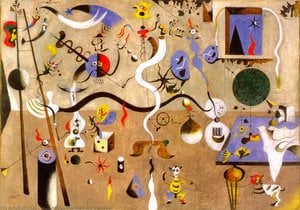
The image presents a loose and asymmetrical arrangement where figures are scattered across the canvas without adhering to strict spatial conventions. Lines flow freely, connecting elements in unexpected ways—a deliberate tactic mirroring Miró’s favored technique of gouache or watercolor applied to paper or canvas. The medium lends itself beautifully to achieving soft edges and blending colors seamlessly, resulting in an ethereal quality that enhances the dreamlike atmosphere. Notably absent is traditional perspective; shapes appear on a flat plane, fostering a shallow sense of depth—a stylistic choice characteristic of Surrealism’s rejection of realism and embrace of subconscious exploration. Careful observation reveals subtle textural variations beneath the surface, hinting at a controlled application of paint rather than visible brushstrokes.

Symbolic Resonance: Mannequin, Foliage & The Quest for Transformation

The artwork's subject matter centers around abstracted human figures—represented as simplified mannequins—intertwined with symbolic shapes and objects like foliage. These elements aren’t merely decorative; they operate as potent conveyors of meaning, reflecting Miró’s preoccupation with themes of metamorphosis and the subconscious mind. The palette is dominated by muted tones accented by splashes of orange, black, and touches of green – colors that evoke both melancholy and wonder—further amplifying the artwork's emotional impact. The repetition of circular forms contributes to a sense of cyclical time and reinforces the notion of transformation—a core concept within Surrealist thought.

Historical Context & Artistic Influence

Born in Barcelona in 1893, Miró’s artistic trajectory was shaped by the intellectual currents of his era. He emerged from a milieu steeped in Catalan traditions yet propelled forward by European avant-garde movements like Cubism and Futurism. *Mètamorphose* exemplifies Surrealist principles—a deliberate departure from rational thought—and stands as a direct response to the anxieties of the interwar period. Its visual vocabulary anticipates developments in Abstract Expressionism, demonstrating Miró’s enduring legacy as a pioneer of modern art and his profound contribution to the artistic dialogue of the 20th century.

A Window into the Surrealist Imagination

Ultimately, *Mètamorphose* invites contemplation—a journey into the realm of dreams and intuition. Its playful juxtaposition of forms and colors stimulates imaginative interpretation, prompting viewers to consider the hidden depths beneath appearances. Like all Miró’s masterpieces, it transcends mere representation, communicating an emotional resonance that speaks to universal human experiences – a captivating reminder of the transformative power of art.

艺术家简介

卡達拉尼亞的幻象:米罗的一生与艺术

若昂·米罗·伊·费尔拉(Joan Miró i Ferrà),1893 年出生于巴塞罗那,是 20 世纪最具影响力的艺术家之一。他的旅程并非仅仅是风格的演变,而是对内心世界的探索,将梦想、记忆和加泰罗尼亚认同转化为画布上独具诗意的视觉语言。从最初因疾病和父母对其艺术追求的犹豫而带来的谦逊开端,米罗坚持不懈,由衷地需要表达难以捉摸的东西——潜藏于现实表象之下的情感、感觉和潜意识流。他早年的生活深深扎根于巴塞罗那的传统之中,这座城市拥有安东尼·高迪的建筑奇迹,而这些有机形态将微妙地影响米罗后来的抽象作品。他父亲是一位金匠,这培养了他对精湛工艺的欣赏,而崎岖的加泰罗尼亚景观则成为了他职业生涯中反复出现的主题和灵感来源。

从早期影响到超现实主义之路

米罗正式的艺术训练始于巴塞罗那的拉洛蒂亚学院(La Llotja),在那里他磨练了传统技巧。然而,是接触到席卷巴黎的前卫运动真正点燃了他的创造性进化。 Fauvism 的鲜艳色彩和立体主义的分裂形式深深地引起了他的共鸣,促使他于 1920 年迁居巴黎。这一时期至关重要,因为他遇到了像巴勃罗·毕加索这样的艺术家,并开始尝试越来越抽象的构图。然而,米罗并非简单地采用这些风格;他将它们综合起来,开辟了他自己的独特美学之路。他力求提炼形式的本质,放弃表现性细节,转而使用象征性的形状和富有表现力的色彩。这种探索使他走上了超现实主义道路,于 1924 年加入了超现实主义团体,与马克·埃尔内斯特(Max Ernst)和萨尔瓦多·达利(Salvador Dalí)等艺术家结盟。虽然他拥抱了超现实主义对潜意识的兴趣,但米罗保持了一种独特的敏锐性——他的作品并非关于令人震惊的图像或弗洛伊德式的象征意义,而是关于创造一个充满趣味形式和诗意暗示的世界。

符号语言:主要作品与艺术创新

在 1920 年代和 30 年代,米罗发展了他独特的视觉词汇——一个充满生物形态形状、漂浮形式和鲜艳色彩的世界。《农场》(1922)通常被认为是他的代表作之一,体现了这种转变。它不仅仅是对乡村生活的描绘,更是对加泰罗尼亚认同的唤起以及对自然世界的象征性表达。他与超现实主义艺术家合作,开创了诸如grattage等创新技术,该技术于 1926 年为谢尔盖·迪亚吉列夫(Sergei Diaghilev)的芭蕾舞剧设计服务,通过在画布上刮擦油漆来揭示纹理。荷兰内景(1928)系列展示了他以一种独特的现代视角重新诠释大师画作的能力,将家庭场景转化为梦幻般的抽象作品。《绘画》(1933)以其大胆的色彩和简化的形式,体现了米罗对潜意识的探索以及他对传统艺术边界的拒绝。除了绘画之外,米罗还勇敢地尝试雕塑、陶瓷和版画,拓展了他的创作视野,并展示了他非凡的多才多艺。

遗产与持久的影响

若昂·米罗对 20 世纪艺术的影响是不可否认的。他不仅仅是一位画家;他还是一个挑战了艺术表达本身的定义的先驱者。他的作品为抽象表现主义铺平了道路,并继续激励着各个领域的艺术家。 他创建了两家基金会——巴塞罗那的若昂·米罗基金会(1975)和帕尔马德马拉加的皮拉尔·伊·若昂·米罗基金会(1981),确保了他的遗产将世代相传,为艺术探索和教育提供场所。 纵观他漫长的职业生涯,他始终致力于突破界限、质疑惯例并探索人类想象力的深度。 米罗的艺术是对抽象、象征意义和诗意表达力量的证明——对生活、梦想和加泰罗尼亚文化持久精神的充满活力的庆祝。他的作品继续引起世界各地观众的共鸣,邀请我们进入一个一切皆有可能的世界,现实与幻想之间的界限模糊成一种迷人的色彩和形式之舞。
米罗

米罗

1893 - 1983 , 西班牙

艺术家简介

  • Artistic Movement Or Style: 超现实主义,抽象艺术
  • Artists Or Movements Influenced By This Artist:
    • 超现实主义
    • 抽象表现主义
  • Artists Who Influenced This Artist:
    • 梵高
    • 塞尚
  • Date Of Birth: 1893年4月20日
  • Date Of Death: 1983年12月25日
  • Full Name: 胡安·米罗
  • Nationality: 西班牙国籍
  • Notable Artworks:
    • 《农场》
    • 《荷兰内景》
    • 《绘画》
  • Place Of Birth: 巴塞罗那, 西班牙
探索按主题、风格和特征分类的艺术作品。