
博物馆级艺术微喷或帆布版画,制作高效,并提供多种饰面选择。 ( 购买手绘画作 切换至数字图像销售渠道)
从与原作比例一致的预设尺寸中进行选择。

您可以输入自定义尺寸,以适配特定的画框或空间。如果您选择的尺寸与原图比例不符,我们将对作品进行裁剪,或通过镜像填充/纯色填充边缘的方式来扩展图像。在开始制作之前,我们会向您发送一份数字效果图供您确认。
请注意,屏幕上的预览并不能反映实际的裁剪或扩展效果。只有效果图才能准确展示最终的构图。
虽然我们提供定制尺寸,但为了保持原图比例,我们建议您从预设列表中选择尺寸。

Study armchair
复制品尺寸

In the vibrant cultural tapestry of 18th-century France, few figures possess a legacy as strikingly multifaceted as Jean-René Nadal the Elder. Born in Paris in 1733, during the opulent reign of Louis XV, Nadal occupied a unique space in European history, simultaneously commanding respect as a master of the decorative arts and achieving renown as one of the most formidable tennis players of his era. To study his life is to witness the intersection of physical prowess and meticulous craftsmanship, a duality that mirrors the Enlightenment's fascination with both the natural vigor of man and the refined elegance of human creation.
Nadal’s artistic journey was deeply rooted in the prestigious workshops of Paris, where the air was thick with the scent of fine wood and the pursuit of aesthetic perfection. It is widely believed that he underwent a transformative apprenticeship under Jean Bérain the Elder, a legendary designer whose influence shaped the very essence of French decorative style. Under Bérain’s tutelage, Nadal absorbed the principles of classical form, learning to manipulate materials with a precision that would later define his career as an ébéniste. This training instilled in him a profound reverence for symmetry and detail, providing the technical foundation necessary to navigate the complex demands of the Rococo movement.
As a furniture maker, Nadal’s work became a definitive expression of the Rococo aesthetic. His creations were not merely functional objects but sculptural triumphs characterized by an embrace of playful asymmetry, flowing curvilinear lines, and a delicate palette of pastel hues. He possessed an unparalleled command over carving and upholstery, often integrating intricate floral motifs and gilded accents that breathed life into heavy hardwoods. His ability to balance the weight of structural design with the lightness of ornamental flourish allowed his pieces to embody the very spirit of 18th-century French luxury.
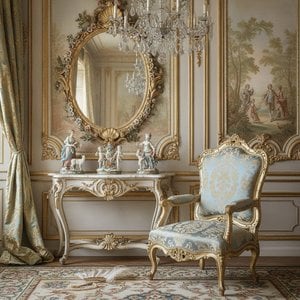
One of the most breathtaking examples of his skill is the Study Armchair, a masterpiece dating from approximately 1775. This piece serves as a testament to his ability to serve the highest echelons of society; it was crafted specifically for the apartments of the Comte d’Artois at the Château de Versailles. The chair features:
The provenance of such works often links Nadal directly to the royal court, as his pieces were frequently branded with the marks of the garde-meuble of the French monarchy. This connection underscores his significance not just as a craftsman, but as an architect of the visual environment inhabited by the French aristocracy.
Though his life was relatively short, ending in 1783, the impact of Jean-René Nadal the Elder resonates through the centuries. He represents a period when the boundaries between different forms of excellence—be it the athletic discipline of the tennis court or the delicate chisel work of the workshop—were fluid and celebrated. His ability to navigate the transition from the exuberant Rococo to the more structured influences of his time ensures his place in the annals of design history.
Today, collectors and historians look back at Nadal’s oeuvre as a window into the soul of Enlightenment France. His work remains a vital touchstone for understanding the evolution of French furniture design and the sophisticated craftsmanship that defined an age of unparalleled elegance. Through his hands, wood was transformed into poetry, leaving behind a legacy of beauty that continues to captivate the modern imagination.

1733 - 1783 , France

Immerse yourself in the splendor of Rococo art. Discover the era of elegance through masterworks by Watteau and Fragonard. Explore themes of romance, aristocratic leisure, and gilded ornamentation in this definitive guide to 18th-century French opulence.

Discover the breathtaking elegance of Rococo portraiture. Explore an expert guide to 18th-century mastery, from pastel palettes to aristocratic grandeur, and learn how to bring this era of opulence into your home through museum-quality oil reproductions.
Discover the exquisite allure of Rococo art. Explore a curated guide to 18th-century French masterpieces, from Watteau to Fragonard, and learn how hand-painted oil reproductions can bring timeless elegance and luxury to your sophisticated interior design collection.


 效果预览
效果预览
 分享
分享 分享
分享
 详情
详情 指南
指南

 下载
下载
 相似作品
相似作品 X射线
X射线 幻灯片播放
幻灯片播放 统计数据
统计数据


 展开详情
展开详情






































 玻璃选项仅适用于110厘米以下的尺寸。


![Three Studies Of A Woman's Head And A Study Of Hands [recto], — 瓦托, Rococo Style](/media/artworks/images-thumb/65/73/65730255a762c06e3235059db7ffcb5f.jpg)


