
博物馆级艺术微喷或帆布版画,制作高效,并提供多种饰面选择。 ( 购买手绘画作 Switch to Digital Image)





























从与原作比例一致的预设尺寸中进行选择。

您可以输入自定义尺寸,以适配特定的画框或空间。如果您选择的尺寸与原图比例不符,我们将对作品进行裁剪,或通过镜像填充/纯色填充边缘的方式来扩展图像。在开始制作之前,我们会向您发送一份数字效果图供您确认。
请注意,屏幕上的预览并不能反映实际的裁剪或扩展效果。只有效果图才能准确展示最终的构图。
虽然我们提供定制尺寸,但为了保持原图比例,我们建议您从预设列表中选择尺寸。

untitled (6401)
复制品尺寸
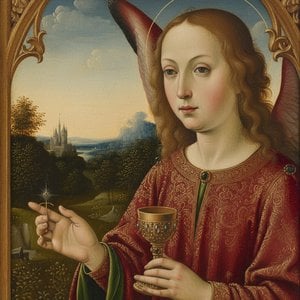
This captivating portrait, tentatively titled “Untitled (6401),” offers a profound glimpse into the world of early 15th-century Flanders. Attributed to the revolutionary artist Jan van Eyck – a master whose techniques fundamentally reshaped Western painting – the work transcends mere representation, becoming a meticulously constructed meditation on status, piety, and perhaps even a subtle expression of marital intent. Painted around 1432-1439, during his tenure as court painter to Philip the Good, Duke of Burgundy, this piece exemplifies Van Eyck’s unparalleled skill in rendering detail and capturing the psychological depth of his subjects.
The central figure, a man clad in a rich crimson robe with a concealing hood, commands immediate attention. His stern expression – a carefully controlled severity – suggests authority and contemplation. He holds a book open in one hand, its pages likely filled with scripture or legal texts, while his other hand gestures towards a sheet of parchment, possibly containing instructions or a document of importance. The presence of two secondary figures—a man standing behind the primary subject and another to the right—adds layers of narrative complexity, hinting at a scene unfolding within a courtly setting. A small, cruciform object positioned in the upper left corner introduces an element of religious symbolism, potentially alluding to faith, sacrifice, or divine judgment.
What immediately distinguishes this portrait is Van Eyck’s masterful deployment of oil paint – a medium he essentially pioneered. Unlike the tempera paints favored by his predecessors, oil allowed for unprecedented levels of detail, luminosity, and subtle gradations of color. Observe how the light catches on the folds of the robe, revealing intricate textures and creating an almost tactile quality. The meticulous rendering of each individual hair, the sheen of the fabric, and the delicate details of the parchment all testify to Van Eyck’s obsessive attention to realism – a hallmark of his style.
Van Eyck's technique wasn’t simply about replicating reality; it was about *illuminating* it. He employed glazing techniques—thin layers of translucent paint applied over dry underlayers—to build up color and depth, achieving an astonishing level of luminosity that seems to emanate from the canvas itself. This careful layering also allowed for incredible precision in rendering textures and surfaces, a characteristic that would become synonymous with the Early Netherlandish school.
The portrait’s symbolism has been the subject of intense scholarly debate. While often interpreted as a simple depiction of a wealthy man, many believe it carries deeper layers of meaning rooted in the conventions of marriage portraits popular during the period. The book held by the central figure could represent knowledge and wisdom, while the parchment might symbolize legal documents related to inheritance or property. The presence of two figures adds another layer – one behind the primary subject may be a servant or attendant, while the other on the right could be his wife, observing from a distance.
Interestingly, some scholars suggest that this portrait may have functioned as a memorial rather than a purely celebratory depiction. The stern expression of the central figure and the somber atmosphere contribute to this interpretation. Considering the context of Van Eyck’s life – his brother Hubert died in 1426 – it's possible that this work was commissioned to commemorate a deceased loved one, with the central figure representing the departed soul.
Jan van Eyck’s “Untitled (6401)” stands as a testament to his genius and a pivotal moment in art history. His innovations with oil paint not only revolutionized artistic technique but also paved the way for future generations of painters, influencing artists from Leonardo da Vinci to Rembrandt. This portrait, with its remarkable detail, psychological depth, and subtle symbolism, offers a rare opportunity to connect with one of the most influential figures in Western art – a master who illuminated the world through his brush.


1390 - 1441 , 荷兰

Delve into the luminous revolution of Early Netherlandish painting. Unveil how Jan van Eyck and Flemish masters pioneered oil techniques to achieve unparalleled depth, sacred symbolism, and breathtaking realism, forever shaping the legacy of Western art history.
Embark on a journey through the luminous world of Early Netherlandish art. Discover the revolutionary oil techniques, microscopic realism, and sacred symbolism used by masters like Jan van Eyck to redefine Western art history in this expert-led guide.


 效果预览
效果预览
 分享
分享 分享
分享
 详情
详情

 下载
下载
 相似作品
相似作品 X射线
X射线 幻灯片播放
幻灯片播放 Stats
Stats
 展开详情
展开详情









 玻璃选项仅适用于110厘米以下的尺寸。


