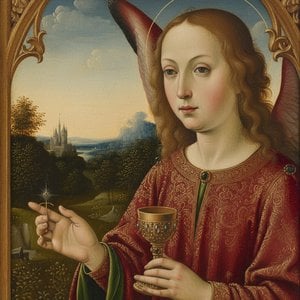
A Vision of Courage: The Dramatic World of Jan Massys
In the heart of the sixteenth-century Flemish Renaissance, few images command the viewer's attention with as much visceral intensity as Jan Massys’s Judith. This monumental oil on wood panel, painted around 1559, serves as a breathtaking window into an era where religious devotion and artistic innovation collided. The scene captures the climactic moment of a biblical legend: the heroine Judith, driven by divine purpose, stands resolute over the fallen King Holofernes. It is not merely a depiction of a historical or religious event, but a profound visual meditation on the triumph of faith over tyranny, rendered with a mastery that continues to captivate the modern eye.
Massys’s technique reveals a sophisticated command of the Fontainebleau School’s influence, moving away from the exaggerated distortions of Mannerism toward a more luminous and idealized aesthetic. Through the expert application of chiaroscuro, the artist orchestrates a dramatic interplay between deep, swallowing shadows and brilliant, focused light. This contrast does more than just illuminate the scene; it sculpts the very flesh of Judith and the heavy, textured fabrics of her attire, lending a tactile reality to the violence of the moment. For the discerning collector or interior designer, this painting offers a profound sense of depth and movement, making it a centerpiece capable of anchoring a room with its dramatic weight and classical elegance.
Symbolism and the Spirit of Antwerp
Beyond the immediate shock of the narrative, Judith is layered with the complex symbolism characteristic of the Antwerp Renaissance. The figure of Judith herself stands as an enduring icon of feminine strength, resilience, and unwavering determination. In her hands, the sword is not just a weapon of war, but a tool of divine providence, used to safeguard her people from the encroaching darkness of pagan arrogance embodied by Holofernes. Every detail, from the meticulous rendering of the metallic sheen on the blade to the somber atmosphere surrounding the fallen king, contributes to a larger dialogue about morality, courage, and the protection of the innocent.
The historical context of this work is equally compelling. During Massys’s lifetime, Antwerp was a thriving cosmopolitan hub, a melting pot of ideas where the Habsburg court championed humanist ideals. This painting reflects that cultural zeitgeist—a period where biblical narratives were frequently used to communicate complex political and moral lessons. To possess a reproduction of such a piece is to invite a fragment of this rich history into one's space, offering an intellectual and emotional resonance that transcends mere decoration. It is an invitation to contemplate the eternal struggle between light and shadow, strength and cruelty, presented through the lens of a Flemish master.
常见问题与解答
扬·马西斯 的《Judith》 是油画、素描还是版画?
在目录中,扬·马西斯 的《Judith》 被归类为 WallArt。该类别有助于查找相似作品。
扬·马西斯 的《Judith》 为室内空间增添了怎样的氛围?
扬·马西斯 的《Judith》 营造出 Dramatic 的氛围,与推荐的陈设空间——Living Room 完美契合。
在哪里可以下载扬·马西斯 的《Judith》?
您可以在作品的下载数字图像页面下载扬·马西斯 的《Judith》的数字图像:高分辨率数字图像下载。