
x
29.0 x 44.0 cm
South Shields Museum And Art Gallery从与原作比例一致的预设尺寸中进行选择。
您可以输入自定义尺寸,以适配特定的画框或空间。如果所选尺寸与原图比例不符,我们将通过裁剪作品或添加手绘元素来扩展画面。数字样稿将在制作开始前发送给您确认。
请注意,屏幕预览无法准确反映实际的裁剪或扩展效果,只有样稿才能真实呈现最终的构图。
虽然我们提供定制尺寸服务,但为了保留原作比例,建议您从预设列表中选择尺寸。
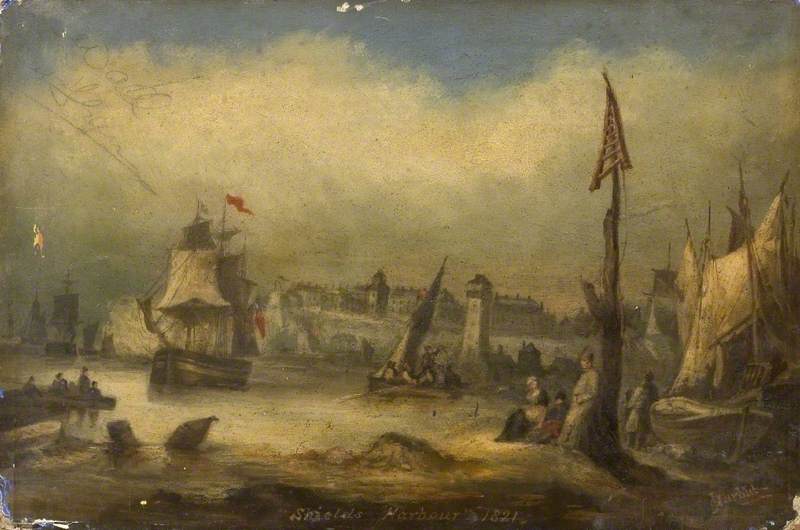
Shields Harbour, 1821
复制品尺寸
Born in the industrial heart of South Shields, Northumberland, in 1815, James Putty Garbutt emerged as a profound voice within the British landscape tradition. His life and artistry were inextricably linked to the rugged, salt-sprayed edges of the English coastline, a region where the meeting of land and sea provides a constant, dramatic spectacle. Growing up in the Victorian era—a period defined by a dual fascination with scientific precision and Romantic idealism—Garbutt developed a way of seeing that balanced meticulous observation with deep emotional resonance. His early years were shaped significantly by his father, William GarBT, a painter specializing in marine subjects, who provided the foundational training that would allow James to master the complex interplay of light, water, and atmosphere.
The development of Garbutt’s style was a journey of capturing the ephemeral. While his roots were firmly planted in the classical traditions of his upbringing, his brushwork often leaned toward the Impressionistic, utilizing loose, expressive strokes to convey the movement of waves and the shifting textures of the sky. He possessed a rare ability to employ tonal modulation, using a palette dominated by muted blues, deep greens, and earthy ochres to evoke the serene yet powerful grandeur of the Northumberland coast. His work was never merely a topographical record; rather, it was an attempt to translate the very soul of the maritime environment onto canvas, capturing the way light pierces through heavy clouds or how the tide transforms a familiar harbor into something otherworldly.
Garbutt’s most enduring achievements lie in his ability to render the atmospheric weight of the British seaside. His celebrated works, such as 'Shields Harbour' (1879), serve as masterclasses in composition and light. In this monumental piece, one can witness the artist's skill in creating a sense of depth through the use of an orange-hued, cloudy sky that casts a warm, dramatic glow over the bustling maritime activity below. By integrating small, dynamic details—such as birds in flight or the subtle movement of boats—he breathed life into his scenes, ensuring they felt like living, breathing moments captured in time rather than static images.
His artistic lineage is clearly visible in the way he navigated the influences of the great masters. The sweeping, emotive power of J.M.W. Turner and the grounded, naturalistic observations of John Constable acted as guiding stars for his technique. From Turner, he inherited a fascination with the sublime and the transformative power of light; from Constable, he drew a commitment to the authentic character of the landscape. This synthesis allowed him to create works that were both technically sophisticated and deeply evocative, cementing his reputation as a master of atmospheric perspective.
The historical significance of James Putty Garbutt extends beyond the mere beauty of his paintings; he remains a vital link to the maritime identity of North East England. His oeuvre serves as a visual archive of a bygone era, documenting the vitality of harbors like Shields during the height of the Victorian period. Through his eyes, we see not just landscapes, but the pulse of coastal commerce and the quiet dignity of the sea.
Today, Garbutt’s legacy is preserved in esteemed collections, including the South Shields Museum and Art Gallery, where his works continue to inspire awe. His contribution to British landscape art remains a testament to the power of observing one's surroundings with both a scientific eye and a romantic heart. To study Garbutt is to rediscover the timeless allure of the coast, rendered with a sensitivity that transcends the century in which he lived.
向我们介绍您的项目需求,我们的艺术专家将为您提供 3 个个性化的艺术品推荐。
由我们的专家为您精选 3 款心仪之作 —— 完全免费!



































