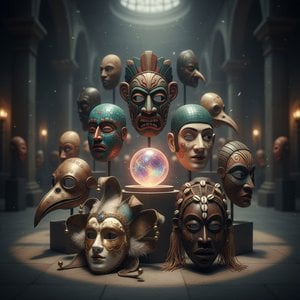
James Ensor’s Unsettling Vision of Ritual and Decay
James Ensor (1860-1949), a Belgian painter whose legacy extends far beyond his lifetime, stands as a pivotal figure in the transition from Symbolism to Expressionism. “La ballet faserique,” painted around 1923, exemplifies Ensor’s distinctive approach—a deliberate rejection of academic conventions in favor of confronting uncomfortable truths about human psychology and societal anxieties.
The artwork depicts a disconcerting tableau: figures gathered on the shoreline of a murky body of water, engaged in an activity that defies easy categorization. There's no discernible narrative drive; instead, Ensor presents us with a scene steeped in atmosphere and imbued with unsettling ambiguity. The muted palette—dominated by blues, greens, whites, punctuated by splashes of pink and brown—creates a dreamlike haze that underscores the painting’s emotional resonance.
Stylistic Innovation: Embracing Distortion and Flattened Perspective
Ensor's stylistic choices are revolutionary for his time. He abandons realistic representation, opting instead for simplified forms and deliberate distortions. Shapes lack sharp edges, contributing to a sense of unease and disorientation. Lines are fluid and imprecise, mirroring the subconscious mind’s unpredictable movements. Notably, Ensor employs flattened perspective—a technique that diminishes depth, prioritizing surface texture and emphasizing the canvas's flatness.
Technique: Layered Paintwork and Visible Brushstrokes – A Symphony of Texture
The painting’s execution is characterized by meticulous layering of paint, a hallmark of Ensor’s method. Thick brushstrokes are visible throughout the composition, revealing the artist’s tactile engagement with the medium. These strokes blend seamlessly together, creating a velvety surface that enhances the artwork's textural quality and contributes to its overall mood. Oil paints were undoubtedly utilized, reflecting the prevailing artistic practices of the era.
Symbolic Resonance: Masks, Ritual, and the Shadowed Psyche
“La ballet faserique” is rife with symbolic imagery. The figures themselves are rendered in shadowy hues, concealing their identities and hinting at hidden anxieties. They appear to participate in a ritualistic gathering—a gesture that speaks to Ensor’s preoccupation with themes of disguise and concealment. Recurring motifs like masks – a prominent feature in Ensor's oeuvre – serve as visual metaphors for the masks we wear in everyday life, obscuring our true selves and reflecting the darker aspects of human nature.
Emotional Impact: Confronting Darkness Within Light
Ultimately, “La ballet faserique” compels viewers to confront uncomfortable truths about existence. Ensor’s masterful manipulation of color and form generates a palpable sense of dread—a feeling that transcends mere visual observation. The painting's unsettling beauty lies in its ability to capture the pervasive influence of darkness within moments of apparent serenity. It remains a testament to Ensor’s unwavering commitment to exploring the complexities of human psychology and his profound understanding of the power of art to provoke contemplation.
常见问题与解答
"La ballet faserique" 属于 詹姆斯·恩索尔 艺术生涯中的哪个时期?
“La ballet faserique”创作于詹姆斯·恩索尔艺术生涯的Mature Period时期。这一时期标志着该作品与艺术家艺术风格演进的紧密关联。
詹姆斯·恩索尔 的《La ballet faserique》 融合了怎样的主题与氛围?
詹姆斯·恩索尔 的《La ballet faserique》 描绘了 symbols, music,营造出 Ethereal 的意境。其主题与氛围共同构成了这件作品的精髓。
在哪里可以找到关于詹姆斯·恩索尔 的《La ballet faserique》的数据统计?
"La ballet faserique" 拥有专属的 访问统计 页面。该页面通过国家和语言维度的细分,展示了该作品及艺术家其他作品的每月访问量趋势图。