A World Woven in Masks and Melancholy: James Ensor’s *Choux rouges et oignons*
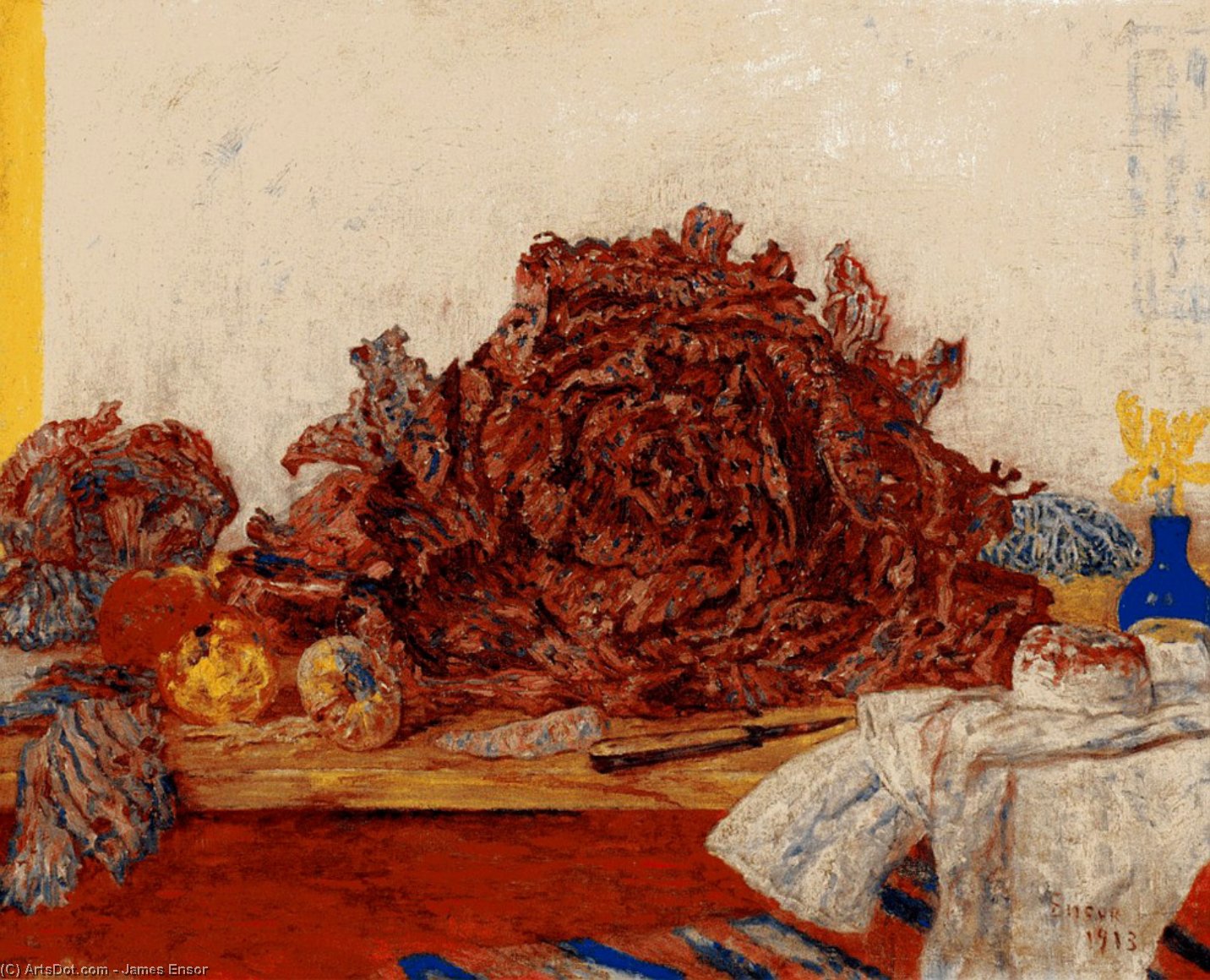
James Ensor's 1896 painting, *Choux rouges et oignons*, isn’t merely a still life; it’s a carefully constructed tableau of unsettling beauty, a window into the artist’s uniquely shadowed psyche. Born in Ostend, Belgium, to an English father and a Belgian mother – a heritage that perpetually positioned him between two worlds – Ensor developed a profound fascination with duality, disguise, and the hidden anxieties simmering beneath the surface of everyday life. This preoccupation manifests powerfully in *Choux rouges et oignons*, where familiar objects are rendered with deliberate distortion and imbued with an atmosphere of quiet unease. The painting’s power lies not just in its visual elements but in the palpable sense of melancholy that clings to it, a feeling rooted in Ensor's own complex personal history and his broader engagement with the burgeoning Expressionist movement.
The Language of Distortion: Style and Technique
Ensor’s technique is immediately arresting. He employs bold, almost jarring colors – vibrant reds and yellows dominate the composition, contrasted against darker greens and browns – to create a sense of heightened emotional intensity. The forms themselves are deliberately distorted; the cabbages appear bulbous and misshapen, the onions seem to swell with an unsettling vitality, and even the table itself possesses a subtly warped quality. This isn’t a faithful representation of reality but rather a deliberate manipulation of form designed to evoke feeling. Ensor masterfully utilizes impasto – applying paint thickly – particularly in the rendering of the fruits and vegetables, adding texture and emphasizing their physicality while simultaneously contributing to the painting's overall sense of unease. The brushstrokes are visible, energetic, and imbued with a raw immediacy that speaks directly to the artist’s emotional state.
Symbolism Beneath the Surface: Apples, Bottles, and Cycles
*Choux rouges et oignons* is rich in symbolic potential. The prominent red cabbages and onions are frequently interpreted as representations of mortality and the cyclical nature of life and death – a common motif in Ensor’s work. The scattered apples, often associated with temptation and decay, further reinforce this theme. Notice also the carefully positioned objects: two bottles flanking the table, perhaps symbolizing duality or confinement; a vase, suggesting fragility and beauty; and a bowl resting on the surface, hinting at nourishment and sustenance. These seemingly simple elements coalesce to create a complex visual narrative that invites contemplation and interpretation. It’s important to remember Ensor's context within Symbolism – a movement concerned with exploring inner psychological states through evocative imagery – which informs this layering of meaning.
A Bridge Between Traditions: Ensor, Kuhn, and the Still Life
While *Choux rouges et oignons* firmly establishes Ensor’s unique Expressionist voice, it also reveals connections to earlier artistic traditions. The still life genre has a long history in art, dating back to Renaissance masters like Leonardo da Vinci. Ensor's work shares similarities with the Apple Basket series created by Walt Kuhn, another prominent figure of the early 20th century who similarly employed still life arrangements to explore themes of mortality and human experience. However, Ensor transcends mere imitation; he infuses the traditional still life with his own intensely personal vision, transforming it into a powerful expression of psychological turmoil. The painting’s placement within this lineage highlights both Ensor's originality and his engagement with the broader artistic landscape of his time.
At WahooArt.com, we offer meticulously crafted hand-painted reproductions of *Choux rouges et oignons*, allowing you to experience the full impact of Ensor’s masterful vision in stunning detail. Whether for your personal collection or as a striking addition to your interior design scheme, our reproductions capture the painting's haunting beauty and emotional depth with unparalleled fidelity. Explore our selection today and bring this captivating work of art into your world.**



 效果预览
效果预览
 购买手绘画作
 分享
分享 分享
分享
 详情
详情

 下载
下载
 相似作品
相似作品 X射线
X射线 幻灯片播放
幻灯片播放
 展开详情
展开详情






































 玻璃选项仅适用于110厘米以下的尺寸。