A Window into the Soul: Exploring James Ensor’s “Children Washing”
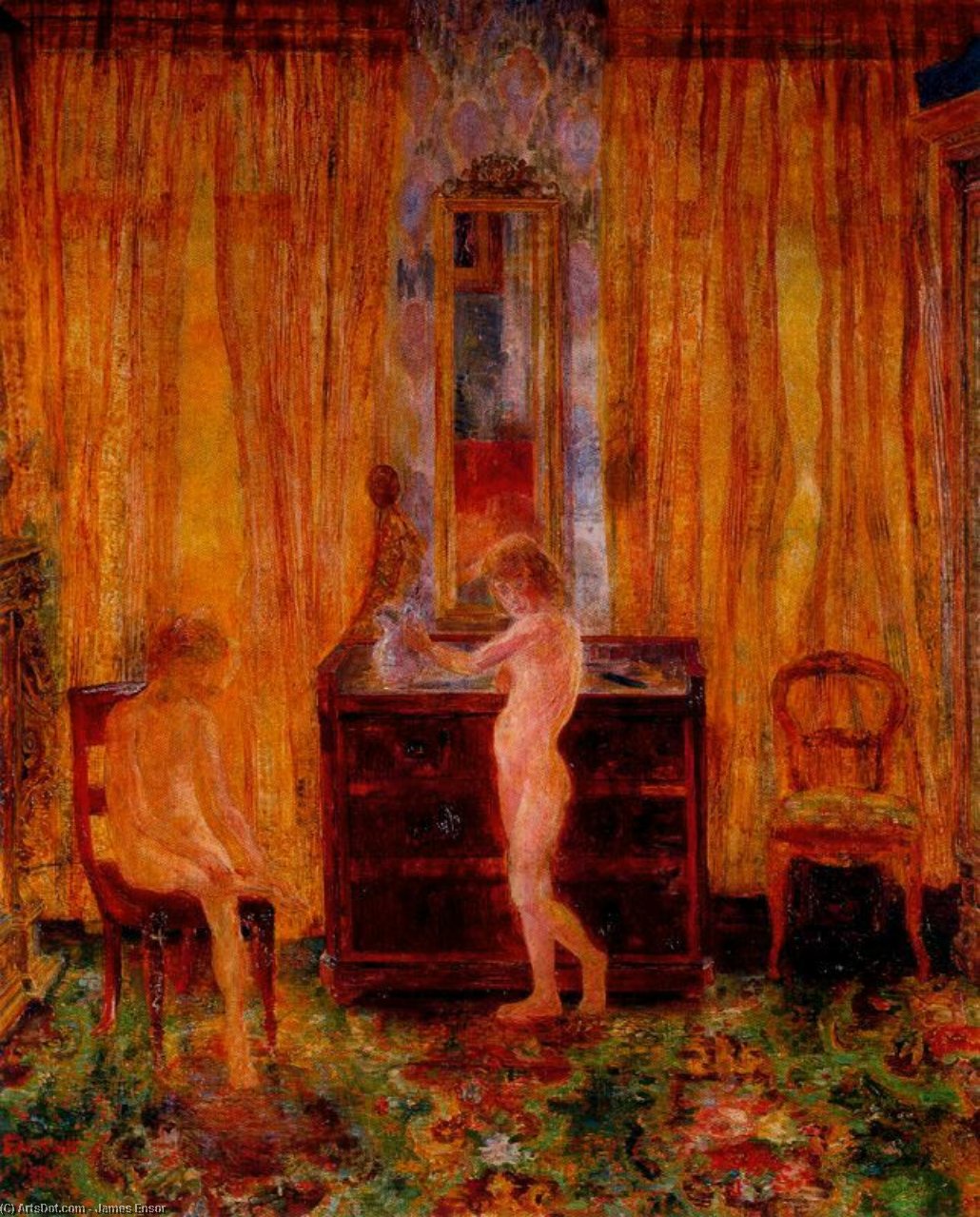
James Ensor’s “Children Washing,” completed in 1886, stands as a cornerstone of Belgian Expressionism and a testament to the artist's singular vision. More than just a depiction of two children engaged in morning ablutions—a seemingly simple domestic scene—the painting delves into profound psychological complexities and embodies Ensor’s characteristic preoccupation with unsettling imagery and emotional intensity.
Painted in oil on canvas, “Children Washing” immediately captivates viewers with its bold color palette dominated by yellows and muted greens. These hues aren't merely decorative; they contribute to the painting’s oppressive atmosphere, mirroring the anxieties of the era and reflecting Ensor’s masterful manipulation of tonal values.
Composition and Style: Distortion as Revelation
Ensor employs a deliberately distorted perspective—a technique prevalent in Expressionist art—to heighten the emotional impact. The figures are rendered with simplified forms, emphasizing their vulnerability and stripping away any semblance of idealized beauty. Notably, the mirror reflects the children’s faces, creating a disconcerting symmetry that underscores the painting's thematic concerns about identity and perception.
Comparing “Children Washing” to works by Walt Kuhn—another influential Expressionist artist known for his use of jarring color combinations and fractured compositions—reveals Ensor’s kinship with fellow innovators who sought to convey inner turmoil through visual representation. Like Kuhn's "Apple Basket," Ensor utilizes distortion not merely as stylistic flourish but as a conduit for expressing psychological unease.
Meaning Beyond the Surface: Symbolism and Interpretation
The painting’s interpretation remains open to debate among art historians, sparking discussions about its significance. Some argue that “Children Washing” represents an idealized portrayal of innocence—a fleeting moment of purity amidst the encroaching darkness of adulthood. Others contend that Ensor deliberately confronts viewers with uncomfortable truths about human nature, utilizing nudity as a symbol of vulnerability and exposing the anxieties inherent in confronting mortality.
Ensor’s stylistic choices resonate with broader artistic currents of his time, mirroring the influence of Vincent van Gogh—whose expressive brushstrokes and vibrant colors similarly aimed to capture emotional experience. The Expressionist movement's exploration of subjective feeling aligns perfectly with Ensor’s ambition to communicate profound psychological states through visual language.
A Legacy Preserved: Exploring Ensor’s Artistic Vision
To gain a deeper understanding of James Ensor and his artistic legacy, visitors can explore the Mu.ZEE museum in Ostend, Belgium—a repository of Belgian art spanning from 1830 onwards. This institution houses an impressive collection showcasing Ensor's oeuvre alongside other prominent artists of the period.
Furthermore, delving into the history of painting on Wikipedia offers valuable insights into the artistic context surrounding “Children Washing,” illuminating the broader intellectual and cultural landscape that shaped Ensor’s creative endeavors.
Finally, you can acquire a stunning hand-painted reproduction of “Children Washing” through WahooArt—allowing art enthusiasts to experience the beauty and emotional depth of this iconic masterpiece firsthand.



 效果预览
效果预览
 购买手绘画作
 分享
分享 分享
分享
 详情
详情

 下载
下载
 相似作品
相似作品 X射线
X射线 幻灯片播放
幻灯片播放
 展开详情
展开详情






































 玻璃选项仅适用于110厘米以下的尺寸。