
博物馆级艺术微喷或帆布版画,制作高效,并提供多种饰面选择。 ( 订购此收藏品的纯手工复刻画作 切换至数字图像销售渠道)





























您可以从与原作比例一致的预设尺寸中进行选择。

请输入您所需的宽度和高度,以适配您的画框或墙面。由于印刷品只能进行裁剪,无法超出原图尺寸,因此若比例不一致,画面的一部分将会被裁切。在正式印刷之前,我们会为您发送一份数字效果图供您确认。本页面显示的图片并非最终裁剪后的效果——只有效果图才能展示真实的裁剪情况。
Hurdy-Gurdy Player
复刻品尺寸说明
Jacques Bellange's "Hurdy-Gurdy Player," etched in the early 17th century, is more than a simple depiction of a street musician; it’s a hauntingly intimate study of human character and a masterful demonstration of Northern Mannerist aesthetics. Born in Bâse-les-Vosges around 1575, Bellange carved an extraordinary path as a printmaker, leaving behind no paintings but producing works that resonate with a profound psychological intensity rarely seen outside of the most accomplished Renaissance masters. This particular etching, rendered in stark monochrome, immediately draws the viewer into its world – a world of shadowed streets and solitary figures, reflecting the anxieties and complexities of early modern life.
Bellange's work firmly places him within the Northern Mannerist movement – a style characterized by its deliberate distortions, heightened emotions, and an intense focus on psychological realism. Unlike the idealized forms favored by earlier Renaissance artists, Bellange’s figures are rendered with a palpable sense of unease and vulnerability. The hurdy-gurdy player himself embodies this characteristic; his hunched posture and somewhat grotesque facial features suggest a character study rather than a flattering portrait – a deliberate departure from conventional artistic norms.
The monochromatic palette, achieved solely through variations in line density, further amplifies the work’s dramatic effect. The absence of color intensifies the focus on form and texture, forcing the viewer to confront the subject with unflinching honesty. This restraint is characteristic of Mannerist aesthetics, which sought to evoke a deeper emotional response than mere visual representation.
Beyond its technical brilliance and stylistic merits, “Hurdy-Gurdy Player” carries significant symbolic weight. The hurdy-gurdy itself – a medieval instrument powered by hand rotation – represents music, entertainment, and perhaps most powerfully, the wandering life. It’s a symbol of itinerant musicians who traveled from town to town, offering their services for coin. This image likely depicts a street performer from the early 17th century, a common sight in European urban centers.
Considering Bellange's origins in the Bassigny region, tragically destroyed during the siege of Lorraine in 1645, adds another layer of poignancy to the work. The image may be interpreted as a meditation on loss, displacement, and the precariousness of human existence – themes that resonate deeply within the context of Bellange’s life and times.
"Hurdy-Gurdy Player" is more than just an etching; it's a portal to a lost world—a glimpse into the artistic sensibilities of Jacques Bellange, one of Northern Mannerism’s most compelling figures. Its enduring appeal lies in its ability to evoke a powerful emotional response and to remind us of the timeless human themes that continue to resonate across centuries. WahooArt offers meticulously crafted hand-painted reproductions of this remarkable artwork, allowing you to bring its haunting beauty into your own space.
“Hurdy-Gurdy Player”是一件Northern Mannerism时期的作品。该艺术流派指明了作品所属的艺术传统。
"Hurdy-Gurdy Player" 由 Jacques Bellange 以 Northern Mannerism 流派风格创作而成。艺术家与艺术流派共同定义了作品的传承。
您可以在 Jacques Bellange 的《Hurdy-Gurdy Player》 的 数字图像 页面购买其数字图像:高分辨率数字图像下载。

Jacques Bellange remains one of the most enigmatic and captivating figures in the history of European printmaking. A master of the Northern Mannerist style, his life was lived in the twilight of the late Renaissance, a period defined by elongated forms, theatrical tension, and an almost feverish psychological intensity. Though much of his personal biography remains shrouded in the mists of the early 17th century, his artistic legacy is vibrantly clear through the intricate lines of his etchings. Born around 1575 in the Bâse-les-Vosges region of France, Bellange emerged from a landscape of shifting borders and intense religious fervor, eventually finding his creative home within the sophisticated courtly circles of Nancy.
The traces of his early life are as delicate and elusive as his etchings. While historical records regarding his family origins are sparse, scholars often point to his rapid ascent within the Duchy of Lorraine as evidence of a significant, perhaps even noble, connection. There is much speculation that he may have been the illegitimate son of a high-ranking patron, a theory supported by the prestigious title of "knight" attributed to him and his seamless integration into the court of the Dukes of Lorraine. By 1595, he was already established in La Mothe, honing a craft that would soon transform the medium of printmaking into a vehicle for profound emotional expression.
Bellange’s career reached its zenith under the patronage of Henri II and Philippe III, the Dukes of Lorraine. This period of courtly stability provided him with the luxury of time and resources, allowing him to refine a technique that was uniquely his own. Unlike many of his contemporaries who focused on the clarity of the High Renaissance, Bellange embraced the complexities of Mannerism. His work is characterized by a restless energy, where figures seem to twist and writhe with an almost supernatural grace. In the halls of Nancy, he developed a visual language that blended the sacred with the profane, creating works that were as much about the human psyche as they were about religious devotion.
His mastery of the etching needle allowed him to manipulate light and shadow with unprecedented drama. Through the meticulous use of hatching and cross-hatching, he could conjure textures ranging from the heavy folds of ancient drapery to the weathered skin of a street performer. This technical prowess is perhaps most evident in his ability to imbue even the simplest subject with a sense of profound mystery. Whether depicting a noble figure or a common musician, Bellange’s hand is unmistakable, leaving behind a trail of silvery, luminous lines that seem to vibrate with life.
The true significance of Jacques Bellange lies in his ability to capture the ephemeral. His oeuvre serves as a window into a world of intense spiritual struggle and theatrical beauty. Some of his most enduring works demonstrate this range:
Though his life was cut short in 1616, Bellange’s influence endured far beyond the borders of Lorraine. His rediscovery in the 20th century brought a renewed appreciation for the expressive potential of the etched line and the enduring power of the Mannerist aesthetic. Today, he is celebrated not merely as a court artist, but as a pioneer who pushed the boundaries of printmaking, leaving an indelible mark on the history of Western art through his hauntingly beautiful, shadow-drenched visions.

1575 - 1616 , France
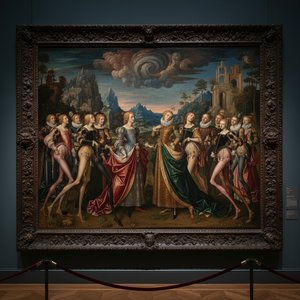
Explore the dramatic evolution of Northern Mannerism. Discover how masters like Bosch and Grünewald transitioned from Renaissance harmony to profound, elegant distortion through an expert analysis of symbolism, emotional intensity, and artistic innovation.
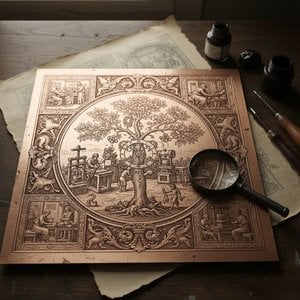
Explore the intricate world of etching and intaglio printmaking. Discover how masters use acid and metal to create profound textures and lines, from Romanticism to modern era, through an expert lens of art history and technical mastery.


 实景预览
实景预览
 发送
发送 分享
分享
 详情
详情 指南
指南

 下载图片
下载图片
 相似作品
相似作品 X射线
X射线 幻灯片播放
幻灯片播放 统计数据
统计数据


 阅读全文
阅读全文









 玻璃选项仅适用于110厘米以下的尺寸。


