
由我们的艺术家按需定制,为您提供您所选尺寸及画框的布面手工油画。 ( 切换至版画销售渠道 切换至数字图像销售渠道)
从与原作比例一致的预设尺寸中进行选择。

您可以输入自定义尺寸,以适配特定的画框或空间。如果所选尺寸与原图比例不符,我们将通过裁剪作品或添加手绘元素来扩展画面。数字样稿将在制作开始前发送给您确认。
请注意,屏幕预览无法准确反映实际的裁剪或扩展效果,只有样稿才能真实呈现最终的构图。
虽然我们提供定制尺寸服务,但为了保留原作比例,建议您从预设列表中选择尺寸。

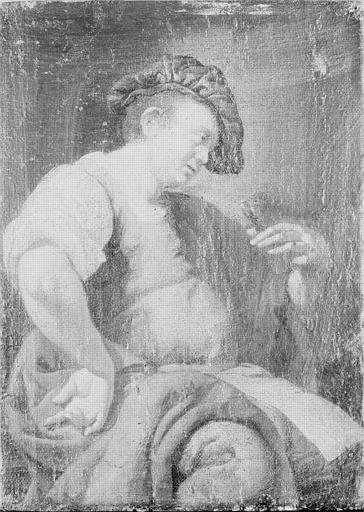
BUVEUR
复制品尺寸

In the golden era of Dutch painting, few traditions captured the quiet intimacy of human existence as exquisitely as the Leiden School. At the heart of this movement stood Jacob Toorenvliet (1640–1719), a master whose brushwork served as a vital bridge between the legendary precision of Gerrit Dou and the evolving sensibilities of the late seventeenth century. Born into a lineage of artistic excellence in Leiden, Toorenvliet was the son of Abraham Toorenvliet, a respected glass painter and drawing instructor. This upbringing provided him with more than just a name; it gifted him an early immersion in the meticulous observation and technical rigor that would become the hallmark of his career.
Toorenvliet’s artistic journey was far from a solitary path within the borders of the Netherlands. His formative training under masters such as Frans van Mieris the Elder, Matthijs Naeveu, and the incomparable Gerrit Dou instilled in him the principles of fijnschilderij—the art of fine painting. This style demanded an almost superhuman level of detail, where every texture, from the sheen of silk to the glint of a copper vessel, was rendered with breathtaking clarity. However, it was his Grand Tour of Europe, beginning in 1659, that truly expanded his artistic horizon. Traveling through Italy and witnessing the dramatic light of Rome and the vibrant atmosphere of Venice, Toorenvliet absorbed the influence of Caravaggio and Rembrandt, blending Northern precision with a newfound Southern warmth and atmospheric depth.
As Toorenvliet traversed the continent, his work began to reflect a sophisticated synthesis of cultures. During his time in Italy, he became a member of the Bentvueghels, an eccentric guild of Northern artists sketching in Rome, adopting the nickname Jazon. This period of wandering allowed him to document not only the human condition but also the architectural splendor of the Mediterranean. His depictions of Venetian vistas and Florentine landscapes demonstrate a remarkable ability to capture light and space, moving beyond the enclosed domesticity of his Dutch roots to embrace a more expansive, panoramic vision.
Upon returning to the Netherlands, Toorenvliet’s repertoire flourished with genre scenes that resonated deeply with the contemporary appetite for narrative realism. His subjects were often found in moments of quiet contemplation or everyday industry:
The choice of medium was as crucial as his subject matter. Toorenvliet frequently worked on copper plates, a surface that allowed for unparalleled smoothness and tonal subtlety. This technique enabled him to execute the fine details required by the fijnschilderij tradition while maintaining a luminous quality that made his portraits and interiors appear almost tactile.
As the seventeenth century drew to a close, Toorenvliet remained a steadfast guardian of the Leiden tradition. Following the deaths of his mentors, he became one of the last great representatives of the school, ensuring that the meticulous standards of Dou and Mieris were passed down to subsequent generations. His leadership within the Guild of Saint Luke in Leiden and his role as a co-founder of the Leiden Drawing Academy in 1694 underscore his commitment to the institutionalization of artistic excellence.
The historical significance of Jacob Toorenvliet lies in his ability to harmonize the disparate worlds of Northern European detail and Southern European light. He did not merely imitate the masters who came before him; rather, he infused their technical rigor with a cosmopolitan spirit born of his travels. Today, his works stand as windows into a vanished world—a world of quiet domesticity, bustling markets, and the enduring pursuit of beauty through the lens of absolute precision.

1640 - 1719 , Netherlands

 效果预览
效果预览
 分享
分享 分享
分享
 详情
详情 指南
指南

 下载
下载
 相似作品
相似作品 X射线
X射线 幻灯片播放
幻灯片播放 统计数据
统计数据 展开详情
展开详情






































 玻璃选项仅适用于110厘米以下的尺寸。


