购买高分辨率增强版数字图像,其品质远超在线预览。
每一份文件都由我们的内部专家使用先进工具与专业的后期润色技术精心打造。我们确保每一张图像都具备卓越的清晰度、精准的色彩还原度以及细腻的细节表现。
最终文件将在 72 小时内通过电子邮件交付,并针对专业、编辑及印刷用途进行了优化。其品质与顶级设计工作室、出版社和画廊所信赖的标准完全一致。
选择 WahooArt.com,您获得的不仅仅是一张图像——您收到的是经过专业级增强、精雕细琢的数字艺术作品,并享有满意保证。以下是您的订单中自动包含的所有内容:

您的高分辨率数字图像文件将在下单后 72 小时内通过电子邮件发送给您 —— 即可立即使用。

您的艺术品经过专业优化,结合先进的 AI 技术与人工修饰,确保呈现极致的细节、清晰度与色彩准确度。

不小心删除了文件或找不到了?没关系——我们将随时为您免费重发。

即刻拥有您的艺术作品,无需支付任何关税、税费或运费——数字下载始终免税。

我们通过专业工具与色彩管理技术,确保您的数字图像尽可能真实地还原原作色彩。

如果您对所购数字图像不满意,我们将在100天内为您进行修改或提供100%的全额退款——无需任何理由。

不满意?在收到数字文件后的100天内,您可以申请全额退款——无需任何理由。

购买 3 张图片可享 10% 折扣 - 购买 5 张可享 15% 折扣 - 购买 10+ 张可享 20% 折扣。非常适合创意项目、画廊和机构使用。

In the quiet, sun-dappled corners of the Dutch countryside, where the rhythm of rural life once dictated the passage of time, the works of Jacob Simon Hendrik Kever—affectionately known as Hein—resonate with a profound, enduring stillness. Born in 1854 into a prosperous Amsterdam family, Kever’s journey was far from the predictable path of his social class. While his upbringing suggested a life of practical commerce, it was the gentle, persistent encouragement of his mother that steered him toward the easel. Through her close friendship with the legendary Jozef Israëls, Kever was introduced to a world where light and shadow held more value than gold, setting the stage for a career defined by an intimate connection to the human condition and the natural landscape.
Kever’s early artistic formation was a tapestry of mentorship and classical rigor. Following the death of Petrus Franciscus Greive, Kever found guidance in the hands of Johan Conrad Greive, whose influence helped shape his initial technical precision. His thirst for mastery eventually led him to the Royal Academy of Fine Arts in Antwerp, where he studied under Charles Verlat. This period of academic refinement provided him with the tools to translate the textures of reality onto canvas, yet Kever’s heart remained tethered to the Laren School movement. This artistic community, centered around the Gooi region, championed a humanist aesthetic that eschewed the grandiosity of historical painting in favor of the sincere, the humble, and the everyday.
The true essence of Kever’s artistry lies in his ability to transform the mundane into the monumental. He was a master of the genre scene, possessing a rare sensitivity for capturing the quiet dignity found within peasant interiors and farmstead life. His early works often reflected the influence of Impressionism, utilizing loose brushstrokes to capture the fleeting atmospheric conditions of the Dutch landscape. However, as his confidence grew, so too did the luminosity of his palette. The muted, earthy tones that characterized his early period gradually gave way to a more vibrant and confident use of light, imbuing his later canvases with a newfound warmth and vitality.
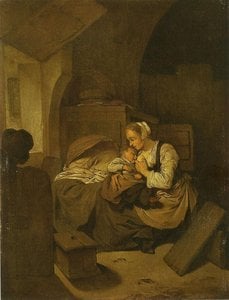
Kever’s technical approach was often born of necessity and a deep respect for his subjects. To avoid the logistical burdens of arranging models, he frequently painted interiors without figures, focusing instead on the evocative power of empty rooms, sunlight streaming through windows, and the silent stories told by inanimate objects. This focus on still life allowed him to explore the interplay of texture and light with surgical precision. When figures did appear—such as in his poignant depictions of mothers and children—they were never mere decorations but central participants in a larger narrative of domestic peace and rural resilience.
Though Kever lived a relatively quiet life, largely confined to the regions of Eemnes, Blaricum, and Laren, his artistic footprint remains significant. He was an artist who found greatness in the small, a painter who understood that the most profound emotions are often found in the most silent moments. His ability to balance the heavy, tonal traditions of the Dutch masters with the emerging light-filled sensibilities of the late 19th century makes his body of work a vital bridge in art history.
Today, the legacy of Hein Kever is preserved in prestigious collections, including the Norton Simon Museum, where his ability to evoke nostalgia and empathy continues to captivate modern viewers. His life serves as a testament to the power of following one's true calling, and his paintings remain enduring windows into a vanished era of Dutch pastoral life. To look upon a Kever painting is to step into a world of:

1880 - 1920 , United States of America


 效果预览
效果预览
 切换至版画销售渠道
 分享
分享 分享
分享
 详情
详情

 下载
下载
 相似作品
相似作品 X射线
X射线 幻灯片播放
幻灯片播放 统计数据
统计数据 展开详情
展开详情