
 Social Realism
 1980
1980 76.0 x 121.0 cm
 Ben Uri Gallery and Museum
由我们的艺术家按需定制,为您提供您所选尺寸及画框的布面手工油画。 ( 切换至版画销售渠道 切换至数字图像销售渠道)
从与原作比例一致的预设尺寸中进行选择。

您可以输入自定义尺寸,以适配特定的画框或空间。如果所选尺寸与原图比例不符,我们将通过裁剪作品或添加手绘元素来扩展画面。数字样稿将在制作开始前发送给您确认。
请注意,屏幕预览无法准确反映实际的裁剪或扩展效果,只有样稿才能真实呈现最终的构图。
虽然我们提供定制尺寸服务,但为了保留原作比例,建议您从预设列表中选择尺寸。

Four Card Players
复制品尺寸
Born in Limoges, France, in 1841, Pierre-Auguste Renoir emerged as one of the most celebrated figures of the Impressionist movement. His life was a testament to artistic dedication, marked by both personal challenges and an unwavering pursuit of capturing the ephemeral beauty of everyday moments. From humble beginnings, Renoir’s career blossomed through relentless experimentation with color, light, and brushstroke—transforming ordinary scenes into vibrant celebrations of human experience.
Renoir's early artistic training was somewhat unconventional. Initially apprenticed to his father, Charles Renoir, a porcelain manufacturer, he developed a keen eye for detail and an understanding of craftsmanship. However, it was the École des Beaux-Arts in Paris that provided him with formal instruction, though he quickly chafed against its rigid academic standards. He found himself drawn to the burgeoning circle of artists experimenting with new approaches—a group that would ultimately define the Impressionist movement. Influenced by Eugène Boudin’s plein air painting and the revolutionary work of Claude Monet, Renoir began to prioritize capturing fleeting impressions over precise representation.
The 1870s proved pivotal for Renoir's artistic development. He joined Monet and Alfred Sisley in establishing a studio known as “Le Studium,” where they shared ideas, critiqued each other’s work, and tirelessly painted outdoors—a practice central to the Impressionist philosophy. Early works like "The Loge" (1876) and "Bathers at Asnières" (1877) demonstrate this shift towards capturing the effects of light and atmosphere. These paintings were revolutionary for their loose brushwork, vibrant color palettes, and focus on depicting scenes from modern Parisian life—a departure from the traditional subjects favored by the Salon.
Renoir's artistic output flourished during the 1880s, a period often referred to as the “golden age” of Impressionism. He became increasingly interested in depicting scenes of social life—particularly those centered around pleasure and leisure. His paintings of dance halls, cafes, and outdoor gatherings captured the vibrant energy and joie de vivre of Parisian society. "Dance at Le Moulin de la Galette" (1876) is perhaps his most famous work from this period, a dazzling depiction of a bustling dance hall filled with elegantly dressed figures bathed in dappled sunlight.
However, Renoir’s personal life was marked by both joy and sorrow. In 1885, he married Anna Cloëte Guillaumin, a talented artist herself. They had four children together—Pierre-Auguste Jr., Gustave, Martine, and Isabelle—who became frequent models for his paintings. Tragedy struck in 1919 when Pierre-Auguste Jr. died suddenly, plunging Renoir into deep grief. This loss profoundly impacted his work, leading him to explore themes of memory, nostalgia, and the passage of time.
As Renoir aged, his style underwent a subtle but significant transformation. While he continued to employ his characteristic vibrant colors and loose brushwork, his compositions became more structured and refined. He developed a greater interest in portraiture, producing numerous captivating portraits of friends, family members, and fellow artists—including Monet, Sisley, and Edgar Degas. His later works, such as “Luncheon of the Boating Party” (1880) and "Portrait of Madame Renoir" (1919), demonstrate a mastery of form and an exquisite sensitivity to color and light.
Renoir’s exploration of memory and nostalgia became increasingly prominent in his later paintings. He often depicted scenes from his past—particularly those associated with his youth in Limoges—infused with a sense of wistful longing. These works, characterized by their soft colors and hazy atmosphere, offer a poignant reflection on the passage of time and the enduring power of memory.
Pierre-Auguste Renoir died in Cagnes-sur-Mer, France, in 1919, leaving behind a vast and influential body of work. His paintings are celebrated for their joyous depictions of everyday life, their masterful use of color and light, and their profound emotional resonance. Renoir’s contributions to the Impressionist movement were immense, helping to establish it as one of the most important artistic movements in history.
His influence extends far beyond the realm of painting. Renoir's emphasis on capturing fleeting moments and celebrating the beauty of ordinary life has resonated with artists across a wide range of disciplines—from photography and film to literature and music. Today, his work continues to inspire and delight audiences around the world, serving as a testament to the enduring power of art to capture the essence of human experience.

1919 - 1986 , United Kingdom
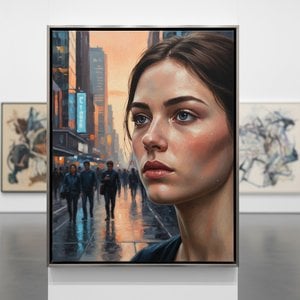
Explore the profound depth of Contemporary Realism. Discover how hyper-realistic art captures modern emotion through technical mastery, offering collectors a sophisticated way to preserve the soul of human experience through exquisite, museum-quality oil paintings and fine art.


 效果预览
效果预览
 分享
分享 分享
分享
 详情
详情

 下载
下载
 相似作品
相似作品 X射线
X射线 幻灯片播放
幻灯片播放 统计数据
统计数据 展开详情
展开详情






































 玻璃选项仅适用于110厘米以下的尺寸。


