
博物馆级艺术微喷或帆布版画,制作高效,并提供多种饰面选择。 ( 订购此收藏品的纯手工复刻画作 切换至数字图像销售渠道)
您可以从与原作比例一致的预设尺寸中进行选择。

您可以输入自定义尺寸,以适配特定的画框或空间。如果您选择的尺寸与原图比例不符,我们将对作品进行裁剪,或通过镜像填充/纯色填充边缘的方式来扩展图像。在开始制作之前,我们会向您发送一份数字效果图供您确认。
请注意,屏幕上的预览并不能反映实际的裁剪或扩展效果。只有效果图才能准确展示最终的构图。
虽然我们提供定制尺寸,但为了保持原图比例,我们建议您从预设列表中选择尺寸。

Untitled #204
复刻品尺寸说明
In the quiet, sweeping expanses of Il Lee’s work, one finds a profound dialogue between the meticulous and the infinite. Born in Seoul in 1952, Lee emerged from a South Korea that was navigating the turbulent waters of postwar reconstruction and rapid modernization. This era, defined by a tension between deep-seated Eastern traditions and an encroaching Western modernity, would become the foundational crucible for his artistic identity. His early life was shaped by a heritage rooted in the mountains of North Korea, a lineage that instilled in him a subtle appreciation for the organic textures of the natural world—a theme that would later manifest in his vast, atmospheric abstractions.
Lee’s formal education provided the technical scaffolding for his eventual rebellion against convention. At Hongik University, he studied within a landscape of Western-oriented painting, earning his B.F.A. in 1976. This period was marked by an engagement with geometric abstraction and oil on canvas, works that were often labor-intensive and structurally rigid. However, it was his move to the United States and his subsequent studies at the Pratt Institute in New York that catalyzed a radical metamorphosis. Immersed in the vibrant, experimental energy of the New York art scene, Lee began to seek a medium that could bridge the gap between the precision of his training and the fluid, meditative qualities of his Korean roots.
The true breakthrough of Il Lee arrived in the early 1980s through an unlikely and humble instrument: the ballpoint pen. While many artists viewed this tool as a mere utilitarian object for sketching, Lee saw it as a vehicle for profound textural exploration. By abandoning the traditional brush in favor of repetitive, rhythmic scribbling motions, he began to build up dense, luminous fields of ink. This technique—a deliberate act of negation against the established hierarchies of fine art media—allowed him to create works that possess an almost geological depth. Through the use of bamboo sticks and other unconventional tools, he layered ink until the paper or canvas seemed to vibrate with a life of its and.
To witness a Lee masterpiece is to experience a sense of arrested motion. The New York Times famously described his ballpoint works as "deceptively casual; sweeping, rhythmical abstractions in blue." Beneath this perceived ease lies an incredible discipline. His process mirrors the meditative practice of Sumukhwa, the traditional Korean monochrome ink wash painting, yet it is translated into a contemporary, global language. The resulting imagery often evokes the grandeur of misty mountain ranges or the shifting currents of water, achieving a sense of timelessness that transcends the specificities of his medium.
As his career progressed, Lee did not remain tethered solely to the ballpoint pen. He expanded his vocabulary to include acrylic and oil on canvas, utilizing these more traditional media to offer a counterpoint to his ink-based explorations. In these later works, he continues to investigate the duality of the positive and the negative, the line and the form, and the tension between what is rendered and what remains unseen. His oeuvre has become a cohesive universe that expands in all directions, much like the very abstractions he creates.
The historical significance of Il Lee lies in his ability to act as a cultural bridge. He has successfully synthesized the minimalist rigor of Western modernism with the spiritual, calligraphic essence of Korean tradition. His achievements have been recognized on the world stage, with major exhibitions spanning from Seoul and Tokyo to Paris, Mexico City, and New Delhi. Through his singular vision, Lee has proven that the most profound artistic truths can be found in the repetitive, humble motion of a pen, turning a simple tool into a gateway to the sublime.

1952 - , South Korea

探索几何抽象艺术的十大杰作!康定斯基、蒙德里安等大师作品,色彩构成与非具象之美。WahooArt.com提供博物馆级艺术复制品,为您的家居带来现代艺术灵感。立即在线探索完整系列!

Journey through Wassily Kandinsky's 25 most iconic abstract paintings. Explore his revolutionary use of color, form & spiritual expressionism. Find museum-quality Kandinsky reproductions and elevate your home decor with WahooArt.com. Discover all masterpieces on WahooArt.com!
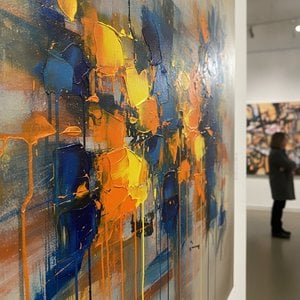
Master the high-impact world of contemporary abstraction. Discover how bold colors, textures, and modern movements like Abstract Expressionism can transform your space with premium, high-energy art curated for the design-conscious professional.

Explore the captivating world of tactile abstraction! Discover impasto techniques, influential artists like Richter & Hoyland, and expert insights for collecting textured art. Elevate your space with museum-quality pieces.

探索抽象表现主义的十幅经典杰作!波洛克、罗斯科等大师作品,揭秘艺术史上的重要瞬间。WahooArt.com为您呈现高品质艺术品复制和精选家居装饰方案,感受现代艺术的力量与魅力。立即浏览全系列!


 实景预览
实景预览
 发送
发送 分享
分享
 详情
详情 指南
指南

 下载图片
下载图片
 相似作品
相似作品 X射线
X射线 幻灯片播放
幻灯片播放 统计数据
统计数据


 阅读全文
阅读全文






































 玻璃选项仅适用于110厘米以下的尺寸。


![Abstract Composition [triptych] — Vaclav Vytlacil, Abstract Expressionism](/media/artworks/images-thumb/08/3c/083c0675045645fd42d4e6c6d63f1ced.jpg)


