
 Abstract Art
 1927Modern
 14.0 x 13.0 cm
 Bauhaus Dessau 美術館
博物馆级艺术微喷或帆布版画,制作高效,并提供多种饰面选择。 ( 购买手绘画作 切换至数字图像销售渠道)





























从与原作比例一致的预设尺寸中进行选择。

您可以输入自定义尺寸,以适配特定的画框或空间。如果您选择的尺寸与原图比例不符,我们将对作品进行裁剪,或通过镜像填充/纯色填充边缘的方式来扩展图像。在开始制作之前,我们会向您发送一份数字效果图供您确认。
请注意,屏幕上的预览并不能反映实际的裁剪或扩展效果。只有效果图才能准确展示最终的构图。
虽然我们提供定制尺寸,但为了保持原图比例,我们建议您从预设列表中选择尺寸。

(Design exercise, from Paul Klee
复制品尺寸
In the quiet intersection of legal precision and avant-garde experimentation lies a captivating piece of history titled (Design exercise, from Paul Klee). Created in 1927 by Hugo Lafayette Black, this work serves as a profound testament to the unexpected creative impulses that can exist within a mind otherwise dedicated to the rigors of law and jurisprudence. While history remembers Black as a formidable figure of the American Supreme Court, this specific composition reveals a different facet of his soul—one deeply attuned to the rhythmic, geometric language of the early 20th-century modernists. The piece is not merely an arrangement of shapes; it is a deliberate exploration of balance, structure, and the visual tension between order and abstraction.
The artwork presents a meticulously structured square composition that draws the eye into a labyrinth of form. Through a sophisticated interplay of shapes—ranging from sharp angles to soft intersections—the artist engages in a silent dialogue with the spirit of Paul Klee. The technique, though captured here in a striking black and white photographic medium, suggests a rich, hidden palette of yellows, grays, and deep blacks that dance across the surface. This monochromatic lens emphasizes the structural integrity of the piece, highlighting how each element supports its neighbor to create a cohesive, architectural whole. For the discerning collector, this work offers a masterclass in how simplicity can achieve profound complexity.
Beyond its formal qualities, the painting carries an evocative emotional weight that resonates with the era of its creation. The year 1927 was a period of immense cultural shifting, where the boundaries of traditional representation were being dismantled by the rise of abstraction. In this design exercise, we feel the pulse of that movement—the desire to strip away the superficial and find truth in the fundamental building blocks of vision. There is a sense of meditative focus within the borders, an invitation for the viewer to lose themselves in the rhythmic patterns and find peace in the mathematical harmony of the composition.
For interior designers and lovers of fine art, this reproduction offers a sophisticated focal point that transcends mere decoration. Its geometric rigor makes it an ideal centerpiece for modern, minimalist, or mid-century contemporary spaces, where it can act as a bridge between historical gravity and avant-garde lightness. To hang this piece is to invite a conversation about the duality of human nature—the capacity for both structured logic and boundless, abstract imagination. It remains a timeless treasure, perfect for those seeking to infuse their surroundings with intellectual depth and an enduring sense of artistic wonder.

To contemplate the life of Hugo Lafayette Black is to navigate a complex intersection of American jurisprudence and a singular, abstract creative impulse. While history primarily remembers him as a formidable figure within the halls of the United States Supreme Court, there exists a fascinating, often overlooked dimension to his persona: a profound engagement with the visual language of abstraction. Born in 1886 in the rugged landscape of Kentucky and raised in Alabama, Black’s early life was defined by the rigorous intellectual discipline required for a career in law. Yet, beneath the stoic exterior of the Senator and the Jurist, there resided an eye attuned to the rhythmic complexities of form and color, much like the masters of the European avant-garde.
His professional ascent was nothing short of meteoric. From his early legal practice in Birmingham to his tenure as a U.S. Senator from Alabama, Black became a central pillar of the New Deal era. His judicial philosophy was famously characterized by an absolutist devotion to the First Amendment, a stance that echoed the uncompromising nature of certain abstract art movements. He believed in the sanctity of the text and the unyielding protection of liberty, often stating that "no law" meant truly no law at all. This same precision and structural integrity can be seen reflected in his artistic explorations, where he engaged in what he termed design exercises—works that sought to distill complex ideas into fundamental geometric truths.
The artistic output of Hugo Black is most strikingly characterized by its dialogue with the principles of Paul Klee. Much like Klee, who viewed drawing as a way of making visible the invisible forces of nature, Black utilized abstract compositions to explore balance, tension, and spatial relationships. His work does not seek to replicate the physical world but rather to construct a new reality through deliberate arrangement. These pieces serve as a visual manifestation of his legal mind: structured, intentional, and deeply concerned with the underlying architecture of meaning.
In examining his creative development, one observes several key elements that define his aesthetic contribution:
The legacy of Hugo Lafayette Black remains a subject of intense historical debate, particularly regarding his controversial roles in landmark cases such as Korematsu v. United States. However, when viewed through the lens of an art historian, his life presents a unique study in duality. He was a man who operated within the most rigid structures of American power while simultaneously seeking liberation through the fluid, unbounded realms of abstract design. His ability to maintain a rigorous legal intellect while nurturing a sensitive artistic temperament offers a rare glimpse into the multifaceted nature of 20th-century intellectual life.
Ultimately, Black’s significance transcends the courtroom. He stands as a testament to the idea that the analytical and the creative are not opposing forces, but rather two sides of the same human endeavor to understand and organize the world. Whether through a landmark judicial opinion or a meticulously balanced abstract composition, his work remains an enduring exploration of the boundaries of freedom, structure, and the human spirit.

1886 - 1971 , United States of America

Discover the breathtaking allure of Art Deco. Explore the era's iconic geometry, legendary designers like Erté, and timeless glamour. Perfect for discerning collectors seeking to infuse their spaces with sophisticated modernist elegance and historical prestige.
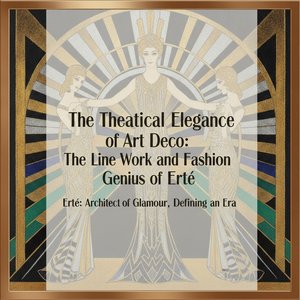
Discover the unparalleled elegance of Art Deco through the lens of Erté. Explore a masterclass in linear precision, theatrical costume design, and high-fashion illustration that continues to define modern luxury and sophisticated interior aesthetics.
Discover the allure of Art Deco through a curated guide to its most iconic masterpieces. Explore the elegance of Erté and the innovation of Jean Dunand, perfect for collectors seeking timeless glamour and sophisticated design inspiration.

Discover the allure of Art Deco style with our expert guide to luxury interiors. Explore iconic influences from Erté to Jean Dunand and learn to curate a sophisticated space filled with timeless glamour and geometric elegance.


 效果预览
效果预览
 分享
分享 分享
分享
 详情
详情 指南
指南

 下载
下载
 相似作品
相似作品 X射线
X射线 幻灯片播放
幻灯片播放 统计数据
统计数据 展开详情
展开详情









 玻璃选项仅适用于110厘米以下的尺寸。


