
购买高分辨率增强版数字图像,其品质远超在线预览。
每一份文件都由我们的内部专家使用先进工具与专业的后期润色技术精心打造。我们确保每一张图像都具备卓越的清晰度、精准的色彩还原度以及细腻的细节表现。
最终文件将在 72 小时内通过电子邮件交付,并针对专业、编辑及印刷用途进行了优化。其品质与顶级设计工作室、出版社和画廊所信赖的标准完全一致。
选择 WahooArt.com,您获得的不仅仅是一张图像——您收到的是经过专业级增强、精雕细琢的数字艺术作品,并享有满意保证。以下是您的订单中自动包含的所有内容:

您的高分辨率数字图像文件将在下单后 72 小时内通过电子邮件发送给您 —— 即可立即使用。

您的艺术品经过专业优化,结合先进的 AI 技术与人工修饰,确保呈现极致的细节、清晰度与色彩准确度。

不小心删除了文件或找不到了?没关系——我们将随时为您免费重发。

即刻拥有您的艺术作品,无需支付任何关税、税费或运费——数字下载始终免税。

我们通过专业工具与色彩管理技术,确保您的数字图像尽可能真实地还原原作色彩。

如果您对所购数字图像不满意,我们将在100天内为您进行修改或提供100%的全额退款——无需任何理由。

不满意?在收到数字文件后的100天内,您可以申请全额退款——无需任何理由。

购买 3 张图片可享 10% 折扣 - 购买 5 张可享 15% 折扣 - 购买 10+ 张可享 20% 折扣。非常适合创意项目、画廊和机构使用。

In the quiet, mist-shrouded landscapes of the early fifteenth century, a revolution was quietly unfolding within the workshops of Flanders. At the heart of this transformation stood Hubert van Eyck, a figure whose very name is etched into the foundation of Northern Renaissance art. Though much of his individual biography remains veiled by the passage of centuries, Hubert emerges from history not merely as a painter, but as a pioneer who helped bridge the gap between the stylized traditions of the Middle Ages and the breathtaking, luminous realism that would define the Early Netherlandish school. Born in Maasik around 1385 or 1390, he was part of a formidable artistic dynasty; his family connections, including his renowned brother Jan and siblings Lambert and Margaret, created a crucible of creativity that would forever alter the trajectory of European painting.
To understand Hubert is to understand the dawn of a new way of seeing. While the era of tempera was still transitioning toward more versatile mediums, Hubert’s early career—marked by commissions for religious panels in Tongeren—revealed an burgeoning mastery over light and texture. He was a man of his time and his guild, officially entering Ghent’s Artisten Gilded in 1413, a testament to his professional standing and his integration into the vibrant, wealthy urban culture of Flanders. His work began to move away from the flat, symbolic representations of the past, leaning instead toward an almost tactile observation of the world, where every fold of heavy fabric and every glint of divine light held profound theological significance.
The most enduring shadow cast by Hubert van Eyck is undoubtedly that of the Ghent Altarpiece. This monumental polyptych, a masterpiece of unparalleled complexity, serves as the primary vessel for his artistic spirit. While scholars have long debated the exact division of labor between Hubert and his brother Jan, it is widely accepted that Hubert laid the essential groundwork for this sacred narrative. He is credited with initiating the grand design, infusing the work with a structural majesty and a spiritual depth that provided the canvas upon which Jan would later apply his legendary, microscopic detail. The altarpiece is not merely a collection of panels; it is a cosmic vision, a window into the divine that utilizes the burgeoning potential of oil painting to create an immersive, devotional experience.
Beyond the grand scale of the Ghent Altarpiece, other works attributed to his hand, such as The Three Marys at the Tomb, offer glimpses into his ability to command dramatic lighting and emotional gravity. In these compositions, one can sense the precursor to the Northern Renaissance's obsession with naturalism. His influence is felt in the way he utilized the medium to capture the weight of human sorrow and the ethereal glow of the miraculous. Through his hands, the religious subject matter ceased to be a distant icon and became a tangible, breathing reality for the faithful.
The historical significance of Hubert van Eyck lies in his role as a foundational architect of style. He was part of a movement that redefined the boundaries of what paint could achieve. His contributions can be summarized through several key artistic shifts:
Though he passed away in 1426, leaving behind a legacy that is often inextricably linked with the more documented achievements of his brother, Hubert van Eyck remains an indispensable figure. He was the silent force behind the Flemish revolution, a master who helped transform the wooden panels of the fifteenth century into windows of infinite light and profound human truth. His life serves as a testament to the power of collaborative genius and the enduring impact of those who dare to innovate at the very threshold of a new era.
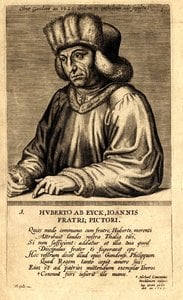
1370 - 1426


 效果预览
效果预览
 切换至版画销售渠道
 分享
分享 分享
分享
 详情
详情

 下载
下载
 相似作品
相似作品 X射线
X射线 幻灯片播放
幻灯片播放 统计数据
统计数据 展开详情
展开详情


![圣方济受洗]}(shèng Fāngjì Shòu Xǐ) — 鲁本斯, Baroque](/media/artworks/images-thumb/7e/0e/7e0ede02284d5bab903fef519cdd4a6c.jpg)


