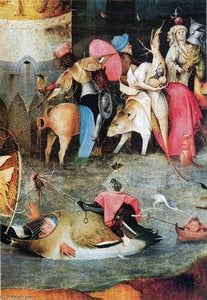
A Descent Into Darkness: Exploring Hieronymus Bosch’s “Moorish Battle Two”
The artwork "Moorish Battle Two," attributed to the enigmatic Netherlandish painter Hieronymus Bosch (1450-1516), stands as a chilling testament to the anxieties of its time and an astonishing achievement in artistic expression. More than just a depiction of combat, it’s a psychological landscape rendered in meticulous detail—a visual distillation of fear, violence, and the unsettling confrontation between faith and pagan impulses that characterized Renaissance Europe. Bosch's oeuvre is notoriously difficult to interpret, fueled by cryptic symbolism and a penchant for disturbing imagery, yet “Moorish Battle Two” offers a particularly potent glimpse into his artistic worldview.
The Canvas of Anxiety: Historical Context
Bosch’s work emerged during the turbulent period following Gutenberg’s invention of movable type—a time when humanist ideals clashed with deeply ingrained religious dogma. The Hussite Wars raged across Bohemia, challenging papal authority and sparking sectarian violence. Simultaneously, anxieties about demonic influence permeated European society, fueled by outbreaks of plague and a pervasive belief in witchcraft. Bosch's art reflects this climate of uncertainty; it’s not merely concerned with portraying physical action but delving into the inner turmoil of human experience—the struggle between good and evil, reason and instinct. The battle scene itself is likely inspired by accounts of Moorish raids on Christian territories during Bosch’s lifetime, highlighting anxieties about external threats and internal moral decay.
A Symphony of Line: Technique and Style
Bosch's distinctive style is instantly recognizable—characterized by an unparalleled mastery of linework and a breathtaking level of detail. “Moorish Battle Two” exemplifies this technique perfectly. Executed in monochrome ink on paper, the drawing utilizes hatching and cross-hatching with astonishing precision to sculpt volume and texture. Fine lines delineate every muscle, wrinkle, and fold of clothing, conveying an almost obsessive attention to anatomical accuracy—a departure from idealized representations prevalent during the Renaissance. Bosch’s approach isn't about capturing a fleeting moment; it’s about constructing a carefully orchestrated tableau that communicates profound psychological states. The swirling, energetic lines dominate the composition, mirroring the chaotic energy of the battlefield and amplifying the sense of impending doom.
Decoding the Disturbing Vision: Symbolism and Imagery
The artwork is rife with symbolic imagery—elements designed to provoke contemplation and unsettle the viewer’s sensibilities. The two figures engaged in combat represent opposing forces – good versus evil, faith versus paganism – mirroring broader theological debates of the era. The fallen warrior symbolizes defeat and vulnerability, while the attacking figure embodies aggression and dominance. Bosch employs grotesque distortions and fantastical creatures—a hallmark of his style—to heighten the emotional impact of the scene. Recurring motifs such as severed limbs and decaying flesh underscore themes of mortality and corruption, reminding us that even in moments of heroic struggle, human beings are ultimately susceptible to decay and destruction. The angled plane on which the figures stand contributes to a sense of instability and disorientation, mirroring the psychological turmoil depicted within the artwork.
Emotional Resonance: A Portrait of Humanity’s Dark Side
“Moorish Battle Two” transcends mere visual representation; it aspires to evoke an emotional response—a visceral confrontation with humanity's darker impulses. Bosch doesn’t shy away from depicting suffering and violence, but he presents them not as gratuitous spectacle but as expressions of profound psychological distress. The figures’ faces are rendered in stylized form, conveying a palpable sense of pain, fear, and desperation. This unflinching portrayal aligns with Bosch’s broader artistic mission—to confront viewers with uncomfortable truths about human nature and to explore the complexities of moral conscience. Ultimately, “Moorish Battle Two” remains a haunting reminder that beauty can coexist with terror—a masterpiece that continues to fascinate and disturb audiences centuries after its creation.

 购买手绘画作


 效果预览
效果预览
 分享
分享 分享
分享
 详情
详情

 下载
下载
 相似作品
相似作品 X射线
X射线 幻灯片播放
幻灯片播放 统计数据
统计数据
 展开详情
展开详情






































 玻璃选项仅适用于110厘米以下的尺寸。