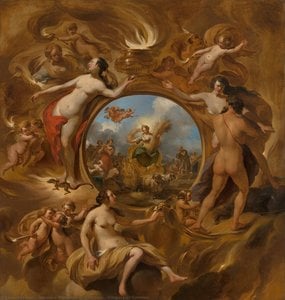
1905
1905 89.0 x 109.0 cm
由我们的艺术家按需定制,为您提供您所选尺寸及画框的布面手工油画。 ( 切换至版画销售渠道 切换至数字图像销售渠道)
从与原作比例一致的预设尺寸中进行选择。

您可以输入自定义尺寸,以适配特定的画框或空间。如果所选尺寸与原图比例不符,我们将通过裁剪作品或添加手绘元素来扩展画面。数字样稿将在制作开始前发送给您确认。
请注意,屏幕预览无法准确反映实际的裁剪或扩展效果,只有样稿才能真实呈现最终的构图。
虽然我们提供定制尺寸服务,但为了保留原作比例,建议您从预设列表中选择尺寸。

The Dodo and Given
复制品尺寸

In the grand tapestry of late nineteenth-century art, few figures possess the dual mastery of scientific precision and poetic sensibility found in Henrik Grø.nvold. Born in Præstø, Denmark, in 1858, Grønvold was a man whose soul was inextricably bound to the rhythms of the natural world. While many of his contemporaries sought the abstract or the purely emotive, Grønvold found his muse in the delicate plumage of a songbird and the shifting light over a Nordic fjord. His life was a continuous dialogue with nature, a pursuit that saw him transition from a student of machine drawing in Copenhagen to one of the most respected natural history illustrators of his era.
Grønvold’s artistic journey was shaped by a rigorous academic foundation and an insatiable curiosity. After honing his technical skills at the Copenhagen Technical College, he sought further refinement at the Königliche Kunstakademie Düsseldorf. It was here, under the guidance of the master Wilhelm Leibl, that Grønvold encountered the nuances of German Impressionism. This pivotal influence infused his work with a luminous quality, teaching him to use color not merely as a descriptive tool, but as a means to capture the very atmosphere of the Scandinavian landscape. His technique became a sophisticated blend of meticulous anatomical accuracy and a loose, expressive brushwork that breathed life into every subject he touched.
What truly distinguishes Grønvold from the traditional landscape painters of his time was his profound ornithological obsession. He did not merely observe birds; he studied them with the intensity of a scientist and the reverence of a devotee. This passion led him on extensive expeditions across Denmark, Norway, and Sweden, where he painstakingly documented avian life in its most authentic habitats. His work as an illustrator for the Biological Research Station of Copenhagen and his later tenure at the Natural History Museum in London allowed him to merge the worlds of taxidermy, anatomy, and fine art. He was among the final generation of natural history illustrators to master the delicate art of lithography, ensuring that his scientific contributions were as visually breathtaking as they were biologically accurate.
His oeuvre is a testament to this duality, ranging from sweeping oil paintings to intimate watercolor studies:
As the twentieth century dawned, Grønvold’s work stood at a unique crossroads between the era of classical naturalism and the rising tide of modernism. While his commitment to scientific truth remained steadfast, his ability to embrace the light-filled aesthetics of Post-Impressionism allowed his art to remain relevant in a changing artistic landscape. He lived through a period of immense transition, yet he remained anchored by his devotion to the organic world. Even when his travels took him far from his Danish roots—including a significant period in London where he worked alongside renowned naturalists—his heart remained tethered to the landscapes of Scandinavia.
Today, the legacy of Henrik Grønvold resides in the quiet beauty of his subjects and the enduring accuracy of his observations. He remains a singular figure who proved that the line between the scientist’s ledger and the artist’s canvas is beautifully thin. To look upon a Grønvold painting is to experience a moment of profound stillness, an invitation to witness the intricate, often overlooked wonders of the natural world through the eyes of a true master of light and life.

1858 - 1940


 效果预览
效果预览
 分享
分享 分享
分享
 详情
详情

 下载
下载
 相似作品
相似作品 X射线
X射线 幻灯片播放
幻灯片播放 统计数据
统计数据 展开详情
展开详情






































 玻璃选项仅适用于110厘米以下的尺寸。