
x































从与原作比例一致的预设尺寸中进行选择。

您可以输入自定义尺寸,以适配特定的画框或空间。如果您选择的尺寸与原图比例不符,我们将对作品进行裁剪,或通过镜像填充/纯色填充边缘的方式来扩展图像。在开始制作之前,我们会向您发送一份数字效果图供您确认。
请注意,屏幕上的预览并不能反映实际的裁剪或扩展效果。只有效果图才能准确展示最终的构图。
虽然我们提供定制尺寸,但为了保持原图比例,我们建议您从预设列表中选择尺寸。

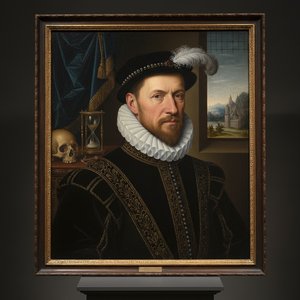
untitled (951)
复制品尺寸
The untitled portrait attributed to Hans Holbein the Younger—identified as “951” within WahooArt's collection—offers a compelling window into the world of 16th-century nobility and the burgeoning artistry of the Northern Renaissance. The painting immediately draws the eye with its central figure: a man of evident status, cloaked in dark attire and distinguished by a striking black hat. He is not merely *wearing* his finery; he embodies it, radiating an air of quiet authority and contemplative power. The most captivating element, however, is undoubtedly the hawk perched upon his gloved hand. This isn’t simply a decorative addition; it's a carefully considered symbol deeply rooted in the aristocratic culture of the time.
To understand the significance of this portrait, one must consider the practice of falconry itself. In Holbein’s era, falconry was not merely a sport; it was an exclusive privilege reserved for the upper echelons of society. Owning and expertly handling a bird of prey—particularly a hawk, known for its keen eyesight and swiftness—demonstrated wealth, skill, and noble lineage. The man's confident grip on the bird speaks volumes about his social standing and mastery over both nature and his own domain. The hawk, therefore, becomes an emblem of power, control, and refined taste. Holbein was a master of imbuing his portraits with such subtle yet potent symbolism, elevating them beyond mere likenesses to become complex statements about the sitter’s identity and place in the world. The ring on his finger further emphasizes this status, hinting at family connections or perhaps a significant alliance.
Holbein’s technical prowess is readily apparent even in reproductions of this work. He was renowned for his meticulous attention to detail—a hallmark of the Northern Renaissance style—and his ability to capture not just physical resemblance, but also a sense of inner character. The textures of the man's clothing, from the rich folds of his robe or coat to the smooth leather of his glove, are rendered with remarkable precision. This dedication to realism wasn’t simply about technical skill; it was about conveying the sitter’s presence and personality with unwavering accuracy. The deep blue background serves not as a mere backdrop but as a complementary element that enhances the colors of the man's attire and the bird, creating a harmonious visual balance. Holbein’s use of light and shadow is also masterful, subtly modeling the face and hands to create a sense of depth and volume.
Hans Holbein the Younger (1497-1543) stands as one of the most significant portraitists of his time. Born in Augsburg, Germany, he honed his skills within his father’s artistic workshop before embarking on a career that would take him across Switzerland and ultimately to England. His arrival at the court of Henry VIII proved pivotal, establishing him as the King's Painter and securing his place in history. Holbein’s portraits of Henry VIII and other members of the Tudor dynasty are iconic representations of power and authority. While this particular work—untitled (951)—may not depict a royal figure, it embodies the same level of artistry and attention to detail that defined Holbein's oeuvre. It offers a fascinating glimpse into the broader world of Renaissance nobility and the cultural values of the era.


1497 - 1543 , 意大利
Explore the breathtaking precision of Hans Holbein the Younger. From Tudor royal portraits to intricate Northern Renaissance details, discover the mastery behind his legendary works and learn how to bring this historical grandeur into your collection with museum-quality reproductions.

Unveil the intricate mastery of Northern Renaissance Art. Explore the luminous oil techniques, hidden symbolism, and breathtaking realism of Flemish masters through an expert lens of art history and technical precision.

Explore the dramatic evolution of Northern Mannerism. Discover how masters like Bosch and Grünewald transitioned from Renaissance harmony to profound, elegant distortion through an expert analysis of symbolism, emotional intensity, and artistic innovation.

Explore the intricate beauty of Northern Renaissance art. Discover the revolutionary oil techniques, profound symbolism, and microscopic realism of the Franco-Flemish masters in this expert guide for classical art enthusiasts.


第一时间获取最新的艺术新闻、独家优惠及装饰灵感。
向我们介绍您的项目需求,我们的艺术专家将为您提供 3 个个性化的艺术品推荐。
由我们的专家为您精选 3 款心仪之作 —— 完全免费!


 效果预览
效果预览
 购买手绘画作
 分享
分享 分享
分享
 详情
详情

 下载
下载
 相似作品
相似作品 X射线
X射线 幻灯片播放
幻灯片播放

 展开详情
展开详情









 玻璃选项仅适用于110厘米以下的尺寸。


![让·德·丹特维尔与乔治·德·塞尔双人肖像(又名《大使们》)[细节]](/media/artworks/images-thumb/bb/ab/bbab7ce77b7dd15d23d21114a63b51a4.jpg)

![让·德·丹特维尔与乔治·德·塞勒的双人肖像(又名《大使们》)[细节]](/media/artworks/images-thumb/42/81/42813dc49b2f72bce897aaf8b747ad5b.jpg)


