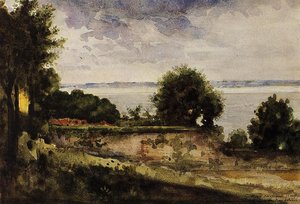
A Vision of Nature’s Divinity: Unveiling Gustave Moreau's *Erigone*
Gustave Moreau’s *Erigone* is a captivating example of Symbolist painting, immersing the viewer in a world where mythology and nature intertwine. This evocative work presents a nude female figure – Erigone herself – seated upon a massive tree trunk, draped with flowing fabric, accompanied by a youthful boy. The scene isn't merely a depiction; it’s an *experience* of lushness, mystery, and profound emotional resonance.
Style & Historical Context
Moreau (1826-1898) was a pivotal figure in the Symbolist movement, which arose as a reaction against the realism and materialism prevalent in 19th-century art. Rejecting straightforward representation, Symbolists sought to express subjective emotions, ideas, and spiritual truths through evocative imagery and suggestive forms. *Erigone* embodies this perfectly. Painted during a period where artists were increasingly drawn to mythological subjects and exploring inner worlds, the work reflects a fascination with ancient Greek stories and their allegorical potential. Moreau’s style is characterized by meticulous detail alongside an almost dreamlike quality – a hallmark of Symbolism that would later influence artists like Matisse and Rouault.
Subject & Symbolism
The painting draws upon the Greek myth of Erigone, daughter of King Icarius and Erigone, who mourned her father’s death so deeply that she hanged herself. The gods, moved by their devotion, transformed them into constellations. While Moreau doesn't depict the tragic event directly, he captures the *essence* of Erigone as a goddess intrinsically linked to nature and fertility.
- The Goddess: Represents abundance, growth, and the life-giving power of the natural world.
- The Boy: Often interpreted as representing youthful vitality or perhaps a symbol of burgeoning life and renewal.
- The Tree Trunk: Serves as Erigone’s throne – a powerful emblem of nature's strength, resilience, and enduring presence. It grounds the ethereal figure in earthly reality.
- Foliage & Fruit: Reinforce themes of fertility, abundance, and the cyclical nature of life and death.
Technique & Visual Impact
Moreau’s technique is immediately striking. He employs a loose, expressive brushstroke that creates a rich texture and atmospheric depth. The dramatic lighting – with highlights illuminating Erigone's form and deep shadows enveloping the surrounding foliage – heightens the sense of mystery and emotional intensity. While lines define forms, they aren’t rigid; instead, they contribute to the painting’s overall fluidity and organic quality. The color palette is dominated by muted earth tones, punctuated by strategically placed brighter hues that draw the eye and emphasize key elements. The composition feels dense and layered, inviting prolonged contemplation.
Emotional Resonance & Interior Design
*Erigone* isn’t simply a beautiful image; it's an invitation to connect with primal emotions – reverence for nature, longing for the divine, and contemplation of life’s mysteries. The painting evokes a sense of tranquility mixed with melancholy, creating a captivating atmosphere.
For interior design, a high-quality reproduction of *Erigone* would serve as a stunning focal point in a living room, library, or bedroom. Its rich colors and evocative imagery complement both classic and contemporary décor styles, adding a touch of sophistication and intellectual depth to any space. The painting’s themes of nature and renewal make it particularly well-suited for spaces designed to promote relaxation and contemplation.