
博物馆级艺术微喷或帆布版画,制作高效,并提供多种饰面选择。 ( 购买手绘画作 切换至数字图像销售渠道)





























从与原作比例一致的预设尺寸中进行选择。

您可以输入自定义尺寸,以适配特定的画框或空间。如果您选择的尺寸与原图比例不符,我们将对作品进行裁剪,或通过镜像填充/纯色填充边缘的方式来扩展图像。在开始制作之前,我们会向您发送一份数字效果图供您确认。
请注意,屏幕上的预览并不能反映实际的裁剪或扩展效果。只有效果图才能准确展示最终的构图。
虽然我们提供定制尺寸,但为了保持原图比例,我们建议您从预设列表中选择尺寸。

Water (detail)
复制品尺寸
Giuseppe Arcimboldo's "Water," painted in 1566, isn’t merely a portrait; it’s an immersive experience, a meticulously constructed microcosm teeming with symbolism and reflecting the intellectual currents of the Renaissance. This remarkable work, now housed within the Kunsthistorisches Museum in Vienna, transcends the boundaries of traditional portraiture, transforming into a vibrant allegory of nature's cycles, human ingenuity, and perhaps even a subtle commentary on the era’s fascination with the interconnectedness of all things. Arcimboldo, already renowned for his audacious composite heads – the “Four Seasons,” “The Pale Horseman,” and countless others – here presents us with an astonishingly detailed tableau of aquatic life, rendered entirely from carefully arranged fruits, vegetables, fish, and even a hint of avian grace.
The painting’s immediate impact is one of controlled chaos. A vast, dark background—a deliberate choice by Arcimboldo—serves to amplify the brilliance and intricate detail of the assembled elements. Within this shadowed space, a colossal fish dominates the composition, its scales painstakingly recreated from an array of meticulously chosen objects: plump pears mimicking the texture of shimmering scales, vibrant cherries forming the rosy hues, and delicate grapes clustered together as if caught mid-plunge. Beneath the central fish, a rich tapestry unfolds – crabs scuttling across mossy banks, miniature fish darting amongst reeds, and fragments of what appear to be seashells and coral add layers of texture and depth. The inclusion of these diverse elements isn’t random; it speaks volumes about Arcimboldo's understanding of natural forms and his ability to translate them into a cohesive, visually arresting whole.
To fully appreciate “Water,” one must consider the intellectual landscape in which Arcimboldo worked. The late 16th century was a period of intense philosophical debate, fueled by the rediscovery of classical texts and a renewed interest in Neo-Platonism – a philosophy that sought to reconcile Christian theology with ancient Greek thought. Neo-Platonism emphasized the interconnectedness of all things, viewing the material world as a reflection of an underlying spiritual reality. Arcimboldo’s work perfectly embodies this worldview. The assembled objects aren't simply decorative; they are symbolic representations of deeper concepts – the cyclical nature of life and death, the harmony between humanity and the natural world, and perhaps even the fleeting beauty of existence itself.
The fish, as the central figure, can be interpreted as a symbol of abundance, fertility, and transformation. Its construction from diverse elements mirrors the Neo-Platonic idea that all things are ultimately derived from a single source – the divine. The careful arrangement of these objects suggests a deliberate attempt to create order out of apparent chaos, reflecting the Renaissance fascination with puzzles, riddles, and the pursuit of hidden meanings. Furthermore, the inclusion of elements like seaweed and reeds hints at the mysteries and dangers lurking beneath the surface of seemingly tranquil waters.
Arcimboldo’s technical skill is truly astonishing. He didn't merely glue objects onto a canvas; he sculpted them, manipulated their forms, and arranged them with an almost obsessive attention to detail. The pear scales are not uniformly shaped; they vary in size and texture, creating a sense of realism and depth. The cherries are meticulously positioned to mimic the sheen of fish scales, while the grapes appear to be suspended in mid-plunge, capturing a fleeting moment of movement. The artist’s mastery lies not only in his ability to assemble these disparate elements but also in his understanding of how light and shadow interact with their surfaces.
The dark background serves as a crucial element in highlighting the vibrant colors and intricate details of the composition. It creates a sense of drama and emphasizes the sheer abundance of life depicted within the painting. Arcimboldo’s use of color is particularly noteworthy – he employs a rich palette of reds, greens, yellows, and blues to create a visually stimulating and emotionally resonant experience. The overall effect is one of breathtaking beauty and technical virtuosity.
"Water" remains a testament to Giuseppe Arcimboldo’s unique artistic vision and his profound understanding of the Renaissance worldview. It's more than just a painting; it’s an invitation to contemplate the mysteries of nature, the complexities of human existence, and the enduring power of art to transcend the boundaries of language and representation. Reproductions of this iconic work continue to captivate audiences today, offering a glimpse into the mind of one of history's most imaginative and innovative artists – a true master of visual allegory.


1527 - 1593
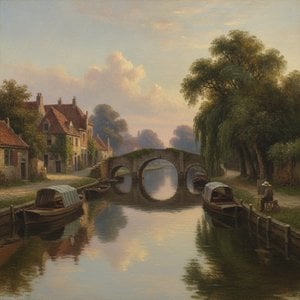
Embark on a visual journey through the tranquil beauty of canal scenes in fine art. Discover how master painters capture light, reflection, and serenity through impressionistic landscapes and timeless maritime masterpieces.

Explore the dramatic evolution of Northern Mannerism. Discover how masters like Bosch and Grünewald transitioned from Renaissance harmony to profound, elegant distortion through an expert analysis of symbolism, emotional intensity, and artistic innovation.

Embark on a visual journey through the serene mastery of lake scene landscapes. Explore the profound beauty of Impressionist, Romantic, and Luminist oil paintings, curated for the sophisticated collector seeking timeless tranquility and artistic excellence.

Embark on a visual journey through Claude Monet's most iconic water lily masterpieces. Discover the profound beauty of Impressionism, explore the evolution of Giverny's light, and learn how to bring these serene, museum-quality landscapes into your private collection.


 效果预览
效果预览
 分享
分享 分享
分享
 详情
详情

 下载
下载
 相似作品
相似作品 X射线
X射线 幻灯片播放
幻灯片播放 统计数据
统计数据


 展开详情
展开详情









 玻璃选项仅适用于110厘米以下的尺寸。


