
博物馆级艺术微喷或帆布版画,制作高效,并提供多种饰面选择。 ( 购买手绘画作 切换至数字图像销售渠道)





























从与原作比例一致的预设尺寸中进行选择。

您可以输入自定义尺寸,以适配特定的画框或空间。如果您选择的尺寸与原图比例不符,我们将对作品进行裁剪,或通过镜像填充/纯色填充边缘的方式来扩展图像。在开始制作之前,我们会向您发送一份数字效果图供您确认。
请注意,屏幕上的预览并不能反映实际的裁剪或扩展效果。只有效果图才能准确展示最终的构图。
虽然我们提供定制尺寸,但为了保持原图比例,我们建议您从预设列表中选择尺寸。

Self Portrait (8)
复制品尺寸
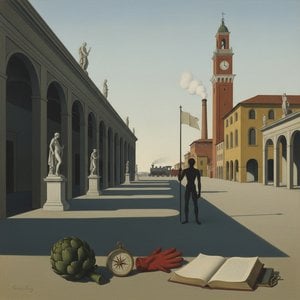
Giorgio de Chirico's "Self Portrait (8)," painted in 1967, isn’t merely a depiction of an artist; it’s a meticulously constructed fragment of the subconscious, a distilled essence of the anxieties and intellectual currents that defined his entire oeuvre. This particular iteration, created later in his career, leans heavily into the neo-baroque style he embraced during this period, offering a glimpse into a mind grappling with memory, alienation, and the unsettling beauty of the familiar transformed. The painting immediately draws the viewer in with its stark simplicity – a solitary figure, rendered in muted tones against a backdrop that simultaneously evokes classical Roman architecture and an unnerving sense of emptiness. It’s a portrait not just of a man, but of a state of being.
De Chirico's technique in this self-portrait is deliberately restrained, almost austere. The brushwork is visible, lending the painting a tactile quality that contrasts sharply with the dreamlike atmosphere. He employs a flattened perspective, reminiscent of Byzantine icons, creating an illusion of depth that simultaneously draws the eye inward and reinforces the feeling of confinement. Notice the careful attention to detail in the figure’s face – the slightly furrowed brow, the intense gaze directed squarely at the viewer—a direct challenge to the observer's presence within this carefully constructed space. The use of dark clothing against a lighter background further emphasizes the figure’s isolation and creates a dramatic interplay of light and shadow that contributes significantly to the painting’s overall mood.
To understand “Self Portrait (8),” one must delve into the philosophical landscape that profoundly shaped de Chirico's artistic vision. Heavily influenced by Arthur Schopenhauer’s philosophy of pessimism and Friedrich Nietzsche’s exploration of nihilism and the will to power, de Chirico sought to capture the unsettling feeling of reality as a deceptive illusion—a “veil” concealing an underlying chaos. The painting embodies this concept perfectly. The Roman-inspired background, with its echoing arches and distant water, is not a genuine place but rather a construct of memory and imagination, imbued with a sense of longing and loss. The mannequins, often present in his earlier works, subtly hint at the artificiality of human relationships and the inherent loneliness of existence—a recurring motif reflecting his engagement with Schopenhauer’s ideas about the will as a relentless striving for satisfaction ultimately leading to suffering.
Beyond the philosophical influences, several symbolic elements contribute to the painting's layered meaning. The two birds—one perched near the top left corner, another in the lower right—represent fleeting moments of beauty or perhaps even a sense of escape within an otherwise desolate landscape. The illogical perspective, a hallmark of de Chirico’s metaphysical style, further destabilizes our perception and creates a feeling of disorientation. Most importantly, the direct gaze of the self-portrait is profoundly unsettling. It forces the viewer to confront their own reflection in this strange, dreamlike world—a silent acknowledgment of shared isolation and the inherent mystery of human consciousness. “Self Portrait (8)” isn’t simply a portrait; it's an invitation to contemplate the complexities of the inner life and the enduring power of art to capture the elusive nature of reality.
WahooArt offers meticulously hand-painted reproductions of “Self Portrait (8),” allowing you to bring this iconic work into your own space. Our artists recreate de Chirico’s distinctive style and evocative atmosphere with exceptional skill, ensuring that every detail—from the subtle brushstrokes to the nuanced color palette—is faithfully reproduced. This is more than just a print; it's an authentic artistic experience, a window into the mind of one of the 20th century’s most enigmatic artists. Consider this reproduction not as a mere decoration, but as a conversation starter, a meditation on themes of isolation, memory, and the enduring power of art to illuminate the human condition.

1888 - 1978 , 希腊

探索巴洛克艺术的辉煌!本文精选十部巨作,带您领略卡拉瓦乔、伦勃朗等大师的光影魔法与戏剧张力。从黄金时代到宗教绘画,感受奢华与精致。WahooArt.com为您提供博物馆品质的艺术复制品和家居装饰灵感。尽在WahooArt.com!

深入探索乔治·德·基里科形而上绘画的起源、哲学影响与对超现实主义的深远启示。专业艺术解读,助您理解经典作品背后的神秘世界,提升艺术鉴赏力。

Discover our story! We bring world-class art into your life through expert curation, personalized creations, and free previews. Trusted by individuals and businesses since 2000.

探索戈雅大师的25幅杰作!深入了解西班牙绘画巨匠Francisco Goya的艺术世界,从洛可可到浪漫主义风格,感受黑加仑时代的情感力量。WahooArt.com提供高品质油画复制品和家居装饰灵感。立即在线发现所有名画!
Explore the captivating world of Giorgio de Chirico and his groundbreaking Metaphysical painting movement. Discover the philosophical depths & surreal imagery that influenced generations of artists. Learn more at WahooArt.


 效果预览
效果预览
 分享
分享 分享
分享
 详情
详情

 下载
下载
 相似作品
相似作品 X射线
X射线 幻灯片播放
幻灯片播放 统计数据
统计数据

 展开详情
展开详情









 玻璃选项仅适用于110厘米以下的尺寸。


