A Glimpse into Romantic Elegance
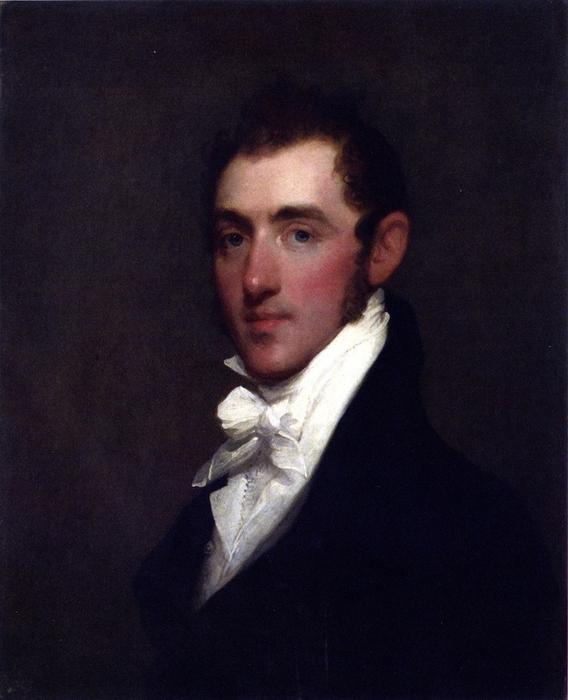
In the quiet, commanding presence of Gilbert Stuart’s 1815 portrait, Henry Rice, one finds much more than a mere historical record; it is an intimate window into the soul of the Romantic era. The painting presents us with Newton Henry Rice, a man whose very countenance seems to bridge the gap between the structured dignity of the past and the burgeoning emotional depth of a new American identity. As we gaze upon his face, we are met with a directness that is both unsettling and deeply captivating. Stuart does not merely capture a likeness; he orchestrates an encounter. The subject’s steady gaze, framed by a meticulously rendered beard and mustache, invites the viewer into a silent dialogue, suggesting a character forged in the crucible of leadership and thoughtful reflection.
The composition of the work possesses a subtle, layered complexity that rewards the lingering eye. While Rice stands as the undeniable protagonist, the presence of figures receding into the soft-focus background hints at a larger narrative of lineage and social connection. This arrangement creates a sense of depth that transcends the two-dimensional plane, suggesting the weight of family and the interconnectedness of the Rhode Island elite during this transformative period. For the collector or the interior designer, this piece offers a profound sense of gravity, making it an ideal centerpiece for spaces that demand a touch of historical prestige and intellectual weight.
The Mastery of Light and Shadow
Technically, Henry Rice is a masterclass in the use of chiaroscuro. Stuart, a titan of American portraiture, employs the dramatic interplay of light and shadow to sculpt the subject’s features with breathtaking realism. The way the light catches the texture of the clothing and the subtle contours of the face creates an illusion of three-dimensional vitality that feels almost tactile. This technique does more than just define form; it imbues the portrait with a luminous, ethereal quality, as if the subject were emerging from the shadows of history into the light of the present moment.
Though Stuart’s roots are firmly planted in the Neoclassical tradition—characterized by order, clarity, and restraint—this particular work whispers of the Romantic movement's arrival. There is a palpable emotional resonance found in the tonal gradations and the soft, expressive lighting that moves away from the austere rigidity of earlier decades. The artist’s brushwork, though smooth and refined, possesses an underlying energy that breathes life into the oil on wood, ensuring that the painting remains vibrant and emotionally accessible even centuries after its completion.
A Legacy for the Discerning Collector
To possess a reproduction of such a significant work is to bring a piece of American heritage into one's personal environment. Henry Rice serves as an evocative symbol of transition—a moment when the old world’s formal structures began to merge with the raw, expressive spirit of the new. It is a work that speaks of strength, stability, and the enduring power of character. Whether placed in a sophisticated study, a grand hallway, or a curated gallery wall, this portrait provides an anchor of timeless elegance.
For those seeking to inspire others through art, this piece offers a rich tapestry of historical context and aesthetic beauty. It is not merely a decoration; it is a conversation starter, a testament to the skill of Gilbert Stuart, and a profound tribute to the dignity of the human spirit. In every stroke of the brush, there is an invitation to contemplate the legacies we leave behind and the enduring grace of a well-lived life.



 效果预览
效果预览
 购买手绘画作
 分享
分享 分享
分享
 详情
详情

 下载
下载
 相似作品
相似作品 X射线
X射线 幻灯片播放
幻灯片播放


 展开详情
展开详情






































 玻璃选项仅适用于110厘米以下的尺寸。





