

获取远超网页预览效果的印刷级文件。我们销售的每一张数字图像均源自库存数据库中的高分辨率母版——宽度通常在 5,000 至 15,000 像素之间——因此您可以放心地进行大幅打印、局部裁剪或还原细腻的细节。
每一件作品在离开我们的工作室前都经过了精心的处理。数字影像专家会对照原作核对色彩,并在必要时进行校正,随后利用专业修图工具提升清晰度与细节表现——且始终忠实于艺术家的笔触与风格。最终呈现的图像宛如原作本身,而非仅仅是一张加了滤镜的扫描件。
您可以在最终定稿前进行审核:我们的专家将在 72 小时内通过电子邮件向您发送图像以供审阅。如果不满意?您可以要求改进或修正;若质量未达预期,亦可申请退款。
这也是出版商、设计工作室、画廊及印刷厂所信赖的品质。
选择 WahooArt.com,您获得的不仅仅是一张图像——您收到的是经过专业级增强、精雕细琢的数字艺术作品,并享有满意保证。以下是您的订单中自动包含的所有内容:
您的高分辨率数字图像文件将在下单后 72 小时内通过电子邮件发送给您 —— 即可立即使用。
您的艺术品经过专业优化,结合先进的 AI 技术与人工修饰,确保呈现极致的细节、清晰度与色彩准确度。
不小心删除了文件或找不到了?没关系——我们将随时为您免费重发。
即刻拥有您的艺术作品,无需支付任何关税、税费或运费——数字下载始终免税。
我们通过专业工具与色彩管理技术,确保您的数字图像尽可能真实地还原原作色彩。
如果您对所购数字图像不满意,我们将在100天内为您进行修改或提供100%的全额退款——无需任何理由。
不满意?在收到数字文件后的100天内,您可以申请全额退款——无需任何理由。
购买 3 张享 10% 折扣 - 购买 5 张享 15% 折扣 - 购买 10 张以上享 20% 折扣。非常适合创意项目、画廊及机构使用。

Gianni Bertini (1922–2010) was far more than a mere painter; he was a restless architect of the visual imagination, a man who navigated the turbulent currents of the postwar era with an unyielding curiosity. Born in Pisa, Italy, Bertini’s early intellectual formation was rooted in the precision of mathematics—a discipline that would later manifest in his meticulous manipulation of textures and layers. This scientific rigor did not stifle his creativity but rather provided the structural foundation upon which he built a complex, multi-layered aesthetic. His journey took him from the historical echoes of the Italian Renaissance to the vibrant, experimental heart of Paris in 1951, a transition that allowed him to bridge the gap between classical grandeur and the burgeoning anxieties of modern consumer culture.
His artistic evolution was marked by a profound refusal to remain tethered to any single movement. While his early years saw him exploring figurative and geometric abstraction, he soon found himself drawn to the visceral energy of Arte Nucleare and the gestural freedom of informal painting. In works such as La Toile de Penelope, created alongside his wife Licia Monesi, Bertini demonstrated a remarkable ability to weave together disparate elements—using textile collage and irregular stitching to evoke both the ancient myth of the weaver and the raw, expressionist textures of the mid-century avant-garde. This period of his life was characterized by a deep engagement with mythology, using figures like Oedipus and Artemis not merely as subjects, but as vessels for exploring a reconstructed humanism in a world recovering from the scars of war.
What truly set Bertini apart from his contemporaries was his audacious embrace of the machine. At a time when many artists sought refuge in the purity of the brushstroke, Bertini looked toward the burgeoning technologies of mass media. He became a pioneer of material transfer and photomechanical screen printing, techniques that allowed him to imprint images directly onto canvas using specialized adhesives. This process created a visual language that was strikingly contemporary—reminiscent of the Pop Art movement seen in the works of Warhol, yet imbued with a much sharper, more critical edge regarding the impact of mass production on the human psyche.
This fascination with the mechanical led to his development of Mec-Art, a concept that merged graphic experimentation with industrial processes. His work often featured:
Through these methods, Bertini achieved a style that was both tactile and ephemeral, capturing the frantic energy of the 20th century through a lens of controlled experimentation.
Beyond the canvas, Bertini was a central figure in the interdisciplinary dialogues of the postwar avant-garde. He moved fluidly between the worlds of visual art, poetry, and performance, collaborating closely with experimental poets like Henri Chopin and participating in the radical actions of Nouveau Réalisme. His "bertinizations" represented an attempt to infuse everyday reality with a heightened, often surrealist, iconography, challenging the boundaries between high art and the mundane objects of consumer life.
His historical significance lies in his role as a bridge-builder—between science and art, between ancient myth and modern technology, and between the Italian tradition and the French experimental scene. Even as he explored the mechanical, he never lost sight of the human element; his work remained a profound investigation into the soul's struggle within an increasingly mechanized world. Today, the retrospective exhibitions of his work, such as those held in Lecce, continue to reveal the complexity of a man who refused to be categorized, celebrating a legacy defined by tireless research, aesthetic courage, and an eternal quest for the new.
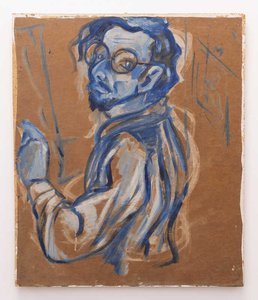
1922 - 2010 , Italy

 实景预览
实景预览
 切换至版画销售渠道
 分享
分享 分享
分享
 详情
详情 指南
指南

 下载作品
下载作品
 相似作品
相似作品 X射线
X射线 幻灯片播放
幻灯片播放 Q&A
Q&A 统计数据
统计数据
 展开全文
展开全文


