
博物馆级艺术微喷或帆布版画,制作高效,并提供多种饰面选择。 ( 购买手绘画作 切换至数字图像销售渠道)





























从与原作比例一致的预设尺寸中进行选择。

您可以输入自定义尺寸,以适配特定的画框或空间。如果您选择的尺寸与原图比例不符,我们将对作品进行裁剪,或通过镜像填充/纯色填充边缘的方式来扩展图像。在开始制作之前,我们会向您发送一份数字效果图供您确认。
请注意,屏幕上的预览并不能反映实际的裁剪或扩展效果。只有效果图才能准确展示最终的构图。
虽然我们提供定制尺寸,但为了保持原图比例,我们建议您从预设列表中选择尺寸。

untitled (4615)
复制品尺寸
Georges Pierre Seurat's *A Sunday Afternoon on the Island of La Grande Jatte*, completed between 1884 and 1886, stands as a monumental achievement not just within Impressionism, but as a foundational work of modern art. More than simply a depiction of a Parisian leisure scene, it’s a meticulously constructed meditation on time, modernity, and the evolving relationship between humanity and its environment – a theme that continues to resonate powerfully today. The painting's scale alone—a colossal 17 feet by 25 feet—immediately commands attention, drawing the viewer into a world of carefully orchestrated observation and scientific precision.
Painted during a period of rapid industrialization and social change in Paris, *A Sunday Afternoon* offers a complex commentary on the burgeoning modern world. The island itself was a popular leisure spot for Parisians escaping the city’s bustle, but Seurat presents a scene that feels strangely detached from everyday life. The figures are posed awkwardly, seemingly unaware of each other, and their activities – boating, sunbathing, picnicking – feel almost ritualistic. This detachment reflects the growing alienation and anonymity experienced by individuals in an increasingly urbanized society.
Symbolism: Some scholars interpret the painting as a critique of bourgeois leisure, suggesting that the figures’ detached behavior represents a superficial enjoyment of wealth and status. The industrial backdrop – the factory chimneys and the boats powered by steam – subtly underscores the impact of technology on human life. The painting's stillness is also significant; it captures a moment frozen in time, reflecting the anxieties surrounding the relentless march of progress.Seurat was deeply influenced by scientific advancements of the late 19th century, particularly those related to optics and color theory. He studied the work of Eugène Delacroix, but rejected his expressive brushwork in favor of a more objective approach. His ambition was not simply to paint what he saw, but to capture the *impression* of light and atmosphere with scientific rigor. This pursuit led him to develop Pointillism as a revolutionary technique that would transform the course of modern art.
Neo-Impressionism: Seurat’s work is considered a cornerstone of Neo-Impressionism, an artistic movement that emerged in response to Impressionism. While Impressionists focused on capturing fleeting moments of light and color, Neo-Impressionists, led by Seurat and Paul Signac, employed scientific principles to create works with a more structured and systematic approach. *A Sunday Afternoon* is arguably the most significant example of this movement.Despite its intellectual rigor, *A Sunday Afternoon on the Island of La Grande Jatte* possesses a profound emotional impact. The painting’s scale, combined with Seurat's masterful use of color and light, creates a sense of immersive beauty that draws the viewer into the scene. It is a work that invites contemplation – about time, modernity, human connection, and the enduring power of art to capture the essence of our experience.

1859 - 1891 , 法国

Explore the scientific brilliance of Seurat and Signac. Discover how Pointillism revolutionized color through optical mixing and light, offering a profound look into the Neo-Impressionist movement for true art connoisseurs and collectors.
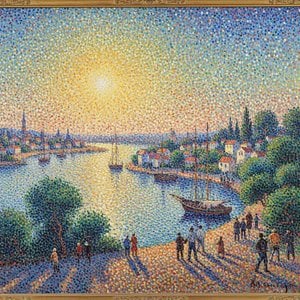
Embark on a sophisticated journey into the luminous world of Neo-Impressionism. Uncover the scientific brilliance of Pointillism, from Georges Seurat’s revolutionary color theory to the mesmerizing magic of the dot. An expert exploration for true art history enthusiasts.

Explore the vibrant evolution of Post-Impressionism. From Seurat's revolutionary Pointillism to the emotional depth of masters, discover how this movement redefined modern art history through color, structure, and unparalleled creative expression.
Discover the mesmerizing world of Pointillism. Explore the revolutionary techniques of Georges Seurat, the science of optical color mixing, and the enduring legacy of Neo-Impressionism in this expert guide for classical art enthusiasts.


 效果预览
效果预览
 分享
分享 分享
分享
 详情
详情

 下载
下载
 相似作品
相似作品 X射线
X射线 幻灯片播放
幻灯片播放 统计数据
统计数据

 展开详情
展开详情









 玻璃选项仅适用于110厘米以下的尺寸。


