
 Acrylic On CanvasWallArtNeo-Impressionism
 31.0 x 23.0 cm
博物馆级艺术微喷或帆布版画,制作高效,并提供多种饰面选择。 ( 购买手绘画作 切换至数字图像销售渠道)





























从与原作比例一致的预设尺寸中进行选择。

您可以输入自定义尺寸,以适配特定的画框或空间。如果您选择的尺寸与原图比例不符,我们将对作品进行裁剪,或通过镜像填充/纯色填充边缘的方式来扩展图像。在开始制作之前,我们会向您发送一份数字效果图供您确认。
请注意,屏幕上的预览并不能反映实际的裁剪或扩展效果。只有效果图才能准确展示最终的构图。
虽然我们提供定制尺寸,但为了保持原图比例,我们建议您从预设列表中选择尺寸。

The black bow
复制品尺寸
Georges Pierre Seurat (1859-1891), a name synonymous with innovation in late 19th-century art, stands as a monumental figure in the transition from Impressionism to Modern Art. His tragically brief life yielded an artistic legacy that fundamentally altered painting practice—specifically through his groundbreaking development of Pointillism, a technique rooted in scientific observation and driven by an unwavering desire for optical realism.
Born in Paris on December 2nd, 1859, Seurat’s formative years were marked by a privileged upbringing fostered by his father, Antoine Chrysostome Seurat—a former legal official who skillfully transitioned into property speculation. This familial stability afforded young Georges access to exceptional artistic education, propelling him towards mastering the foundational skills necessary for his future endeavors.
Before Seurat’s arrival on the art scene, Impressionists wrestled with capturing fleeting moments of light and color. However, Seurat approached this challenge with a radically different perspective—one informed by Henri Poincaré’s theories on optics. Recognizing that human perception is influenced by how our eyes combine colors, Seurat meticulously applied scientific principles to his artistic process.
Instead of blending pigments directly onto the canvas, Seurat employed tiny dots – or “points” – of pure color—typically juxtaposed in complementary hues—to create an illusion of luminosity and depth. This method, dubbed Pointillism by Roger Fry in 1906, demanded painstaking precision and unwavering attention to detail. It represented a decisive break from Impressionistic brushstrokes, prioritizing scientific accuracy over subjective interpretation.
"The Black Bow," created around 1882, exemplifies Seurat’s meticulous approach perfectly. The painting depicts a woman's face alongside a black bow—a seemingly simple subject rendered with extraordinary complexity. As documented in Google Arts & Culture (
The rough surface of the paper serves as a crucial element in conveying the painting’s atmosphere—a deliberate choice reflecting Seurat's belief that texture contributes significantly to the perception of color and form. The composition itself is carefully balanced, guiding the viewer’s gaze across the canvas with subtle directional cues.
Beyond its technical brilliance, “The Black Bow” speaks volumes about Seurat's artistic vision. It embodies his fascination with capturing the essence of modern life—a preoccupation evident in numerous other works exploring urban landscapes and social interactions. Like many Impressionist paintings, it seeks to evoke emotion through color and light—though Seurat achieves this goal not through blending hues but by orchestrating a dazzling interplay of complementary dots.
As showcased on WikiArt (

1859 - 1891 , 法国
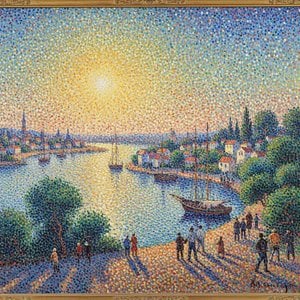
Embark on a sophisticated journey into the luminous world of Neo-Impressionism. Uncover the scientific brilliance of Pointillism, from Georges Seurat’s revolutionary color theory to the mesmerizing magic of the dot. An expert exploration for true art history enthusiasts.
Discover the mesmerizing world of Pointillism. Explore the revolutionary techniques of Georges Seurat, the science of optical color mixing, and the enduring legacy of Neo-Impressionism in this expert guide for classical art enthusiasts.

Explore the vibrant evolution of Post-Impressionism. From Seurat's revolutionary Pointillism to the emotional depth of masters, discover how this movement redefined modern art history through color, structure, and unparalleled creative expression.

Explore the scientific brilliance of Seurat and Signac. Discover how Pointillism revolutionized color through optical mixing and light, offering a profound look into the Neo-Impressionist movement for true art connoisseurs and collectors.


 效果预览
效果预览
 分享
分享 分享
分享
 详情
详情

 下载
下载
 相似作品
相似作品 X射线
X射线 幻灯片播放
幻灯片播放 统计数据
统计数据 展开详情
展开详情









 玻璃选项仅适用于110厘米以下的尺寸。


