































从与原作比例一致的预设尺寸中进行选择。

您可以输入自定义尺寸,以适配特定的画框或空间。如果所选尺寸与原图比例不符,我们将通过裁剪作品或添加手绘元素来扩展画面。数字样稿将在制作开始前发送给您确认。
请注意,屏幕预览无法准确反映实际的裁剪或扩展效果,只有样稿才能真实呈现最终的构图。
虽然我们提供定制尺寸服务,但为了保留原作比例,建议您从预设列表中选择尺寸。

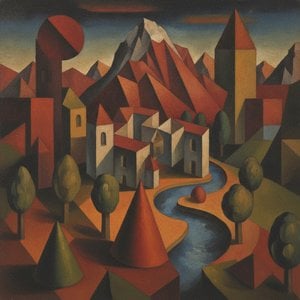
untitled (3820)
复制品尺寸
Georges Braque's "Untitled (3820)" offers a captivating glimpse into the heart of early 20th-century artistic innovation. This landscape, seemingly simple in its depiction of a village nestled within a valley, is profoundly complex beneath the surface – a testament to Braque’s pioneering role in developing Cubism alongside Pablo Picasso. The painting isn't merely a representation of a scene; it’s an exploration of perception, form, and the very nature of seeing. The composition immediately draws the eye towards the central figure, standing near the center of the image, suggesting a human presence within this carefully constructed world. This element subtly anchors the viewer, inviting us to contemplate our own relationship with the depicted space.
Braque’s artistic journey began not in the avant-garde studios of Paris but within the familiar framework of his family's trade as house painters and decorators. This practical grounding—a deep understanding of materials and construction—proved invaluable, providing him with a foundational knowledge that he later brilliantly deconstructed and reimagined through his art. His early work demonstrates an impressionistic sensibility, influenced by artists like Monet and Renoir, but it was the burgeoning Fauvist movement in 1905 that truly ignited his creative spirit. The bold colors and expressive brushstrokes of the Fauves – a group including Matisse and Derain – liberated Braque from traditional representational constraints, encouraging him to prioritize emotional impact over strict adherence to reality.
“Untitled (3820)” is inextricably linked to the birth of Cubism. Following his exposure to Cézanne’s work in 1907, Braque embarked on a rigorous study of the artist's geometric approach to depicting space – a radical departure from traditional perspective. Cézanne’s emphasis on analyzing objects into their fundamental shapes and reconstructing them from multiple viewpoints became the cornerstone of Cubism. Braque, alongside Picasso, began to translate this concept onto canvas, fracturing forms into interlocking planes and presenting them simultaneously from various angles. This technique, known as “simultaneous perspective,” creates a sense of dynamism and spatial ambiguity, challenging the viewer’s assumptions about depth and distance.
Notice how Braque renders the village buildings – not as solid blocks but as fragmented geometric shapes, suggesting multiple viewpoints at once. The bridge, too, is broken down into its constituent parts, creating an intriguing visual puzzle. The muted color palette—primarily blues, browns, and ochres—further enhances this sense of fragmentation, contributing to the painting’s overall atmosphere of intellectual exploration rather than straightforward representation. This deliberate simplification of form reflects a shift in artistic focus from depicting external reality to exploring the underlying structure of perception itself.
While seemingly objective in its depiction, “Untitled (3820)” is rich with symbolic potential. The solitary figure in the foreground invites speculation about their role within this landscape – are they a traveler, a resident, or simply an observer? The village itself could represent a microcosm of society, while the bridge symbolizes connection and transition. The cloudy sky above adds to the painting’s contemplative mood, suggesting a sense of mystery and timelessness.
Braque's work during this period wasn't merely about visual experimentation; it was deeply rooted in philosophical inquiry. He sought to capture not just what he *saw*, but how he *perceived* – a reflection of the broader intellectual currents of the time, including ideas from thinkers like Bergson and Freud. The painting’s quiet intensity invites viewers to engage with their own interpretations, fostering a sense of personal connection to this remarkable work.
WahooArt offers meticulously crafted hand-painted reproductions of Georges Braque's “Untitled (3820),” allowing you to bring this pivotal artwork into your home or office. Our skilled artists faithfully recreate Braque’s distinctive style, capturing the nuances of his color palette and the subtle complexities of his composition. Whether you are an art enthusiast, a collector, or simply seeking a unique piece of décor, our reproduction provides an authentic and beautiful representation of this groundbreaking masterpiece. Explore the collection today and discover how this iconic painting can enrich your space with its intellectual depth and artistic beauty.

1882 - 1963 , 法国

Discover the profound legacy of Georges Braque. Our expert guide explores the evolution of Cubism, from Analytic deconstruction to Synthetic innovation, offering deep insights for discerning art collectors and connoisseurs of modern masterpieces.

Explore the profound beauty of village scene art. From Impressionist light to pastoral realism, discover how timeless landscapes capture nostalgia through expert artistry and historical depth. Perfect for collectors seeking evocative, museum-quality landscape inspirations.
Explore the profound evolution of Cubist landscapes. Discover how masters like Braque and Picasso redefined perspective through geometric mastery, transforming nature into an intellectual mosaic of form and light for the discerning modern art collector.


 效果预览
效果预览
 购买印刷品
购买印刷品 分享
分享 分享
分享
 详情
详情

 下载
下载
 相似作品
相似作品 X射线
X射线 幻灯片播放
幻灯片播放

 展开详情
展开详情









 玻璃选项仅适用于110厘米以下的尺寸。


