
博物馆级艺术微喷或帆布版画,制作高效,并提供多种饰面选择。 ( 购买手绘画作 切换至数字图像销售渠道)





























从与原作比例一致的预设尺寸中进行选择。

您可以输入自定义尺寸,以适配特定的画框或空间。如果您选择的尺寸与原图比例不符,我们将对作品进行裁剪,或通过镜像填充/纯色填充边缘的方式来扩展图像。在开始制作之前,我们会向您发送一份数字效果图供您确认。
请注意,屏幕上的预览并不能反映实际的裁剪或扩展效果。只有效果图才能准确展示最终的构图。
虽然我们提供定制尺寸,但为了保持原图比例,我们建议您从预设列表中选择尺寸。

The Pedesta 3
复制品尺寸
Georges Braque's "The Pedestrian," painted in 1921, isn’t merely a depiction of a man walking down a street; it’s a profound exploration of perception and the fractured nature of modern experience. This pivotal work from his Cubist period embodies the radical shift away from traditional representation, offering instead a meticulously constructed puzzle where form and space are deconstructed and reassembled before the viewer's eyes. The painting immediately draws us in with its complex composition – a seemingly chaotic arrangement of figures and objects that, upon closer inspection, reveals an underlying geometric structure. It’s a testament to Braque’s innovative approach to capturing reality, moving beyond simple imitation towards a more intellectual and analytical representation.
The scene unfolds within a bustling urban environment, though the specifics remain deliberately ambiguous. A man, rendered in fragmented planes of color and shape, dominates the foreground, his suitcase a prominent symbol of travel and perhaps even displacement. Around him, other pedestrians – some carrying bags, others engaged in their own private worlds – contribute to the sense of collective movement within the city’s arteries. The inclusion of a bird in the upper right corner adds an element of unexpected serenity, a fleeting moment of nature amidst the urban sprawl. Braque masterfully uses overlapping planes and multiple viewpoints, mirroring the way we actually perceive the world—not as a unified whole, but as a collection of distinct fragments.
“The Pedestrian” is firmly rooted in the principles of Cubism, an artistic movement pioneered by Braque and Pablo Picasso. Rejecting the Renaissance ideal of creating a realistic illusion of depth and space, Cubists sought to represent objects from multiple perspectives simultaneously. This technique involved breaking down forms into geometric shapes – cubes, cones, cylinders – and reassembling them on the canvas in a way that challenged traditional notions of perspective. Braque’s approach, often referred to as “Analytical Cubism,” is particularly evident here; the figures are dissected and rearranged, their outlines dissolving into a network of intersecting planes. This deliberate fragmentation wasn't intended to be visually jarring but rather to convey a deeper understanding of the subject – an awareness of its constituent parts.
The muted color palette—primarily browns, grays, and ochres—further emphasizes the painting’s intellectual character. Rather than relying on vibrant hues to create visual excitement, Braque employs subtle tonal variations to define form and suggest volume. This restrained approach aligns with the Cubist desire to strip away superficial appearances and focus on the underlying structure of objects. It's a deliberate choice that underscores the painting's conceptual rigor.
Beyond its formal innovations, “The Pedestrian” is rich in symbolic meaning. The suitcase represents not just physical travel but also the journey of life—a constant process of movement and change. The blurred figures in the background suggest the anonymity and isolation that can accompany urban existence. Braque’s decision to depict a single pedestrian amidst a crowd speaks volumes about the individual's place within the larger social fabric. It invites us to contemplate our own roles and experiences as members of a rapidly evolving society.
The painting, created during a period of significant social and political upheaval—the aftermath of World War I—reflects a broader sense of uncertainty and disorientation. Braque’s fragmented style mirrors the shattered state of European civilization at the time, capturing the feeling that traditional values and beliefs had been irrevocably undermined. “The Pedestrian” is not simply a portrait of a man walking down the street; it's a poignant meditation on modernity itself—its complexities, its contradictions, and its profound impact on human experience.
WahooArt offers meticulously crafted hand-painted reproductions of “The Pedestrian,” allowing you to bring this iconic masterpiece into your own space. Our skilled artists faithfully recreate Braque's innovative techniques, capturing the subtle nuances of color and form with exceptional detail. Whether you are an art enthusiast, a collector, or simply seeking to add a touch of intellectual sophistication to your interior design, our reproduction provides an authentic and captivating representation of this seminal work. Experience the power and beauty of Braque’s vision – order your high-quality reproduction today.

1882 - 1963 , 法国

Discover the profound legacy of Georges Braque. Our expert guide explores the evolution of Cubism, from Analytic deconstruction to Synthetic innovation, offering deep insights for discerning art collectors and connoisseurs of modern masterpieces.
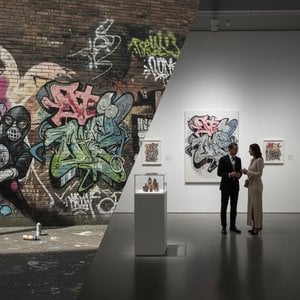
Explore the captivating journey of street art from urban walls to prestigious galleries. Discover how contemporary graffiti has evolved into a high-end collectible movement, redefining modern interior design and global art culture.


 效果预览
效果预览
 分享
分享 分享
分享
 详情
详情

 下载
下载
 相似作品
相似作品 X射线
X射线 幻灯片播放
幻灯片播放 统计数据
统计数据

 展开详情
展开详情









 玻璃选项仅适用于110厘米以下的尺寸。


