
 Acrylic On CanvasWallArtSynthetic Cubism
 1913
1913 65.0 x 92.0 cm
博物馆级艺术微喷或帆布版画,制作高效,并提供多种饰面选择。 ( 购买手绘画作 切换至数字图像销售渠道)





























从与原作比例一致的预设尺寸中进行选择。

您可以输入自定义尺寸,以适配特定的画框或空间。如果您选择的尺寸与原图比例不符,我们将对作品进行裁剪,或通过镜像填充/纯色填充边缘的方式来扩展图像。在开始制作之前,我们会向您发送一份数字效果图供您确认。
请注意,屏幕上的预览并不能反映实际的裁剪或扩展效果。只有效果图才能准确展示最终的构图。
虽然我们提供定制尺寸,但为了保持原图比例,我们建议您从预设列表中选择尺寸。

The musician's table
复制品尺寸
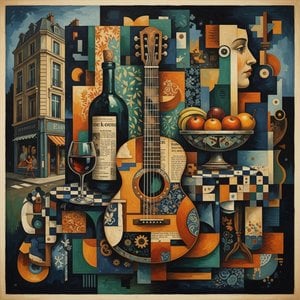
Georges Braque’s “The Musician’s Table” (1913) isn’t merely a depiction of an interior scene; it’s a carefully constructed puzzle, a visual meditation on perception and the nature of representation. Painted in charcoal on canvas during the heart of Synthetic Cubism, this work immediately captivates with its deliberately chaotic yet strangely harmonious arrangement. The painting presents a man seated at a table laden with objects – a book, a bottle, a cup, and two cats – all rendered through Braque’s signature fractured geometry. It's a scene brimming with suggestion, inviting the viewer to actively participate in reconstructing the image, much like deciphering a musical score.
The initial impression is one of disarray, a deliberate rejection of traditional perspective and realistic representation. Objects are broken down into their constituent planes, overlapping and receding simultaneously. This fragmentation isn’t random; it's a key element of Synthetic Cubism, an evolution of the movement that sought to move beyond the analytical deconstruction of form seen in earlier works. Braque employs a muted palette – primarily browns, whites, and blacks – which further emphasizes the geometric shapes and creates a sense of quiet contemplation. The lighting is subtle, casting soft shadows that add depth without sacrificing the painting’s overall flatness.
To understand “The Musician’s Table,” it's crucial to appreciate Braque’s artistic lineage. His early training as a house painter instilled in him a deep understanding of materials and structure, while his academic studies at the École des Beaux-Arts provided a foundation in traditional techniques. However, it was his encounter with Paul Cézanne’s work that proved transformative. Cézanne's late paintings, characterized by their flattened planes, multiple viewpoints, and emphasis on geometric forms, profoundly influenced Braque’s approach to representation.
Braque didn’t simply imitate Cézanne; he absorbed his ideas about seeing the world as a collection of intersecting planes and translating those perceptions onto canvas. This influence is particularly evident in “The Musician’s Table,” where objects are broken down into their basic geometric components, echoing Cézanne's systematic analysis of form. Furthermore, Braque’s exploration of African masks and Iberian sculpture during this period contributed to his interest in simplifying forms and reducing them to essential shapes – a key characteristic of Cubism.
Beyond its formal innovations, “The Musician’s Table” is rich in symbolic meaning. The musician's table itself suggests a space dedicated to creativity, leisure, and perhaps even melancholy. The presence of the books hints at intellectual pursuits, while the bottle and cup evoke moments of conviviality. Crucially, the two cats – often interpreted as symbols of independence and mystery – add an element of intrigue and domesticity to the scene.
The inclusion of musical instruments, though subtly suggested, reinforces the painting’s title and adds another layer of meaning. Braque wasn't simply depicting a still life; he was creating a visual poem about the relationship between art, music, and the human experience. The seemingly random arrangement of objects contributes to this sense of ambiguity, inviting viewers to project their own interpretations onto the scene.
“The Musician’s Table” is more than just a beautiful painting; it's a window into the mind of Georges Braque, one of the most influential artists of the 20th century. It represents a pivotal moment in art history – a transition from the analytical deconstruction of form to the more expressive and fragmented style of Synthetic Cubism. Reproductions of this work offer a remarkable opportunity to experience firsthand the innovative spirit and artistic vision that defined Braque’s career.

1882 - 1963 , 法国

Embark on a journey through the revolutionary world of Cubism. Discover how masters like Picasso redefined perspective through Analytical and Synthetic techniques in this expert-led guide for art enthusiasts and collectors.

Discover the profound legacy of Georges Braque. Our expert guide explores the evolution of Cubism, from Analytic deconstruction to Synthetic innovation, offering deep insights for discerning art collectors and connoisseurs of modern masterpieces.
Master the vibrant world of Synthetic Cubism with our expert guide. Explore the revolutionary techniques of Picasso and Braque, from collage to color, and discover how this movement redefined modern art for collectors and connoisseurs alike.

Elevate your artistic practice with this expert guide to mastering the line. Discover advanced techniques in graphite, charcoal, and contour drawing designed for art students seeking technical precision and expressive depth in their fine art studies.

Elevate your artistry with this definitive expert guide to mastering charcoal. Designed for art students, learn professional techniques for capturing profound depth, intricate textures, and dramatic shadows through advanced blending and chiaroscuro methods.


 效果预览
效果预览
 分享
分享 分享
分享
 详情
详情 指南
指南

 下载
下载
 相似作品
相似作品 X射线
X射线 幻灯片播放
幻灯片播放 统计数据
统计数据 展开详情
展开详情









 玻璃选项仅适用于110厘米以下的尺寸。


