A Cubist Still Life: Deconstructing Form in Braque’s ‘Guitar ''Program statue d'epouvante''’
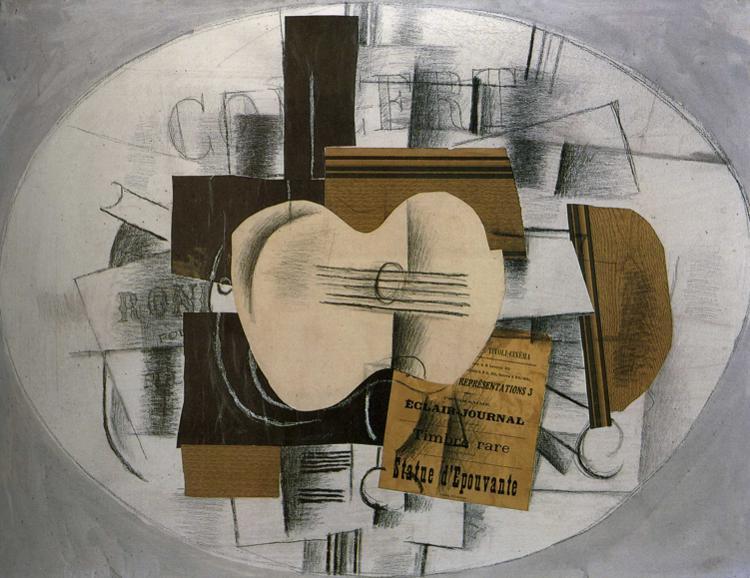
Georges Braque’s *Guitar ''Program statue d'epouvante''* (1913) is a pivotal example of Analytical Cubism, showcasing the artist’s revolutionary approach to representation. Measuring 73 x 100 cm, this work isn’t merely a depiction of objects; it’s an intellectual exploration of form and perception, inviting viewers into a fragmented world where reality is dissected and reassembled.
Subject & Composition: A Dialogue Between Art Forms
The artwork presents a still life featuring an acoustic guitar alongside a stack of books. However, Braque doesn't offer a traditional rendering. Instead, both objects are broken down into geometric shapes – rectangles, triangles, and overlapping planes – creating a dynamic composition within a circular frame. The arrangement isn’t accidental; it suggests a deliberate interplay between musicality (the guitar) and intellectual pursuit (the books), hinting at the interconnectedness of artistic disciplines.
The title itself, translating to “Program statue of fright,” adds an intriguing layer, suggesting a conceptual framework or perhaps even a playful subversion of traditional still life conventions.
Style & Technique: The Essence of Analytical Cubism
*Guitar ''Program statue d'epouvante''* exemplifies the core tenets of Analytical Cubism. Braque, alongside Pablo Picasso, pioneered this style by rejecting traditional perspective and embracing multiple viewpoints simultaneously.
The color palette is deliberately restrained – muted browns, grays, and off-whites dominate – emphasizing form over coloristic expression. The technique relies heavily on layering pencil or charcoal strokes to build up tones and textures, creating a sense of solidity despite the fragmented forms. Lines are sharply defined, further contributing to the geometric abstraction. This isn’t about replicating what the eye sees but rather conveying an object's essential structure through intellectual analysis.
Historical Context: A Revolution in Visual Language
Created during a period of intense artistic experimentation, this work reflects the radical shifts occurring in early 20th-century art. Braque and Picasso were challenging centuries-old conventions of representation, influenced by Paul Cézanne’s emphasis on geometric forms and their own shared explorations. The emergence of Cubism marked a turning point in art history, paving the way for abstract art movements that would follow.
1913 was a crucial year; it saw the full development of Analytical Cubism before Braque began to incorporate collage elements into his work.
Symbolism & Emotional Impact: Beyond Representation
While seemingly abstract, *Guitar ''Program statue d'epouvante''* carries symbolic weight. The guitar, a symbol of artistic expression and harmony, is deconstructed alongside the books, representing knowledge and intellect. This juxtaposition suggests a contemplation on the nature of creativity itself – how ideas are formed, broken down, and reassembled.
The overall effect isn’t necessarily emotional in a traditional sense; rather, it evokes a feeling of intellectual curiosity and invites viewers to actively participate in deciphering the artwork's meaning. The flattened perspective and lack of strong shadows contribute to a sense of ambiguity and spatial disorientation, challenging our perceptions of reality.
For Collectors & Designers
This piece, or a high-quality reproduction, would be a striking addition to any collection focused on modern art. Its muted palette and geometric forms lend themselves well to contemporary interiors, adding a sophisticated touch without overwhelming the space.
- Ideal for: Modern living rooms, studies, or galleries.
- Complements: Minimalist furniture, neutral color schemes, and other abstract artworks.
- Considerations: The artwork’s intellectual nature makes it a conversation starter and a focal point for contemplation.



 效果预览
效果预览
 购买手绘画作
 分享
分享 分享
分享
 详情
详情

 下载
下载
 相似作品
相似作品 X射线
X射线 幻灯片播放
幻灯片播放


 展开详情
展开详情






































 玻璃选项仅适用于110厘米以下的尺寸。





