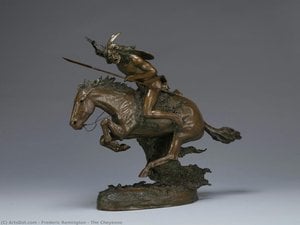
The Cheyenne: A Bronze Chronicle of the American West
Frederic Remington’s “The Cheyenne” stands as more than just a bronze sculpture; it's a powerful testament to a vanishing world, a meticulously crafted narrative frozen in time. Completed in 1906, this iconic piece captures the raw energy and stoic dignity of a Native American warrior on horseback, a subject that would define Remington’s career and solidify his place as one of America’s foremost chroniclers of the late 19th-century West. The sculpture's immediate impact stems from its dynamic composition – a rider in mid-gallop, lance poised for action, embodying the spirit of both fierce combat and profound connection to the land.
- Subject Matter: The central figure is a Cheyenne warrior, representative of the Native American tribes who inhabited the vast territories of the American West. Remington’s intention was not simply to depict a portrait but to capture an archetype – the skilled hunter, the courageous warrior, and ultimately, a symbol of resistance against encroaching civilization.
- Technique: The sculpture's remarkable physicality is rooted in the lost-wax casting process, a technique that allowed Remington unprecedented control over his creation. This method, perfected over centuries, involved creating a wax model, then encasing it in clay to form a mold. Molten bronze was poured into the mold, and once cooled, the resulting cast was carefully removed, revealing the final form. The use of the buffalo robe as a support structure wasn't merely aesthetic; it cleverly facilitated the casting process by providing a conduit for the molten metal, enabling the creation of the horse’s dramatic rearing stance.
A Study in Realism and Detail
Remington’s artistic vision is firmly rooted in Realism, rejecting the romanticized depictions prevalent at the time. He sought an accurate representation of the subject, paying meticulous attention to anatomical detail – particularly evident in the musculature of the horse and the warrior's posture. The rough, granular texture achieved through the sculpting process isn’t a flaw but a deliberate choice, reflecting the harsh realities of frontier life and adding a palpable sense of authenticity to the piece. Subtle lighting enhances these textures, casting delicate shadows that emphasize the contours of the figures and the base, contributing to a dramatic and weighty atmosphere.
Symbolism and Historical Context
“The Cheyenne” is deeply embedded within its historical context – the late 19th century, a period of profound transformation in the American West. The sculpture reflects the complex relationship between Native Americans and the expanding United States, capturing a moment of both conflict and cultural exchange. The straightened right rear fetlock of number 12, a concession made to the foundry due to casting difficulties, subtly highlights the compromises inherent in this era. The choice speaks volumes about the practical constraints Remington faced while striving for artistic perfection.
Emotional Resonance and Artistic Legacy
Beyond its technical brilliance and historical significance, “The Cheyenne” possesses a powerful emotional resonance. The sculpture evokes feelings of power, determination, and perhaps even melancholy – a poignant reminder of a way of life that was rapidly disappearing. Its placement on a simple, dark-colored base further emphasizes the subject matter, creating a focal point that draws the viewer in. Frederic Remington’s “The Cheyenne” remains a seminal work, not just for its technical mastery but for its enduring portrayal of a pivotal moment in American history and the spirit of the West.
常见问题与解答
"The Cheyenne" 的整体色调有多明亮?
就视觉亮度而言,弗雷德里克·雷明顿 的《The Cheyenne》 呈现出 brilliant 的效果。
“The Cheyenne”背后的艺术家与艺术风格是哪些?
"The Cheyenne" 的背后是 弗雷德里克·雷明顿 及其所属的 Realism 流派。
“The Cheyenne”是如何体现 弗雷德里克·雷明顿 的创作主题与艺术风格的?
在弗雷德里克·雷明顿的作品中,"The Cheyenne" 呈现出Realism风格,并延续了western expansion influence, native american portrayal, frontier conflict themes, us cavalry depiction, american mythology", remington's iconic style, documenting the west, bridging art & reportage的主题。


 分享
分享 分享
分享
 详情
详情 指南
指南

 下载作品
下载作品
 相似作品
相似作品 幻灯片播放
幻灯片播放 Q&A
Q&A 统计数据
统计数据


 展开全文
展开全文
 切换至版画销售渠道





































 玻璃选项仅适用于110厘米以下的尺寸。