TemperaWallArtCubist Expressionism
 1914Modern
 46.0 x 58.0 cm
博物馆级艺术微喷或帆布版画,制作高效,并提供多种饰面选择。 ( 订购此收藏品的纯手工复刻画作 切换至数字图像销售渠道)





























您可以从与原作比例一致的预设尺寸中进行选择。

请输入您所需的宽度和高度,以适配您的画框或墙面。由于印刷品只能进行裁剪,无法超出原图尺寸,因此若比例不一致,画面的一部分将会被裁切。在正式印刷之前,我们会为您发送一份数字效果图供您确认。本页面显示的图片并非最终裁剪后的效果——只有效果图才能展示真实的裁剪情况。
Small Composition III
复刻品尺寸说明
In the pantheon of German Expressionism, few works capture the raw, pulsating energy of the early twentieth century quite like Franz Marc’s “Small Composition III.” Painted in 1914, on the precipice of a world about to be transformed by the shadows of war, this masterpiece serves as a profound testament to the artist's quest for spiritual purity. Unlike the Impressionists, who sought to document the fleeting dance of light upon a surface, Marc turned his gaze inward. He utilized the canvas not as a mirror to reality, but as a window into the soul, employing a language of abstraction to communicate truths that words often fail to grasp. Through this work, we encounter a moment of intense chromatic harmony, where the boundaries between object and emotion begin to dissolve.
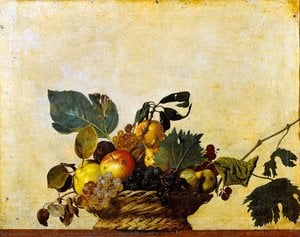
The visual journey begins with an arresting, dominant crimson background—a sea of deep red that immediately envelops the viewer in a sense of primal passion and vital force. This is not merely a backdrop; it is the very heartbeat of the composition. Scattered across this fiery expanse is a rhythmic arrangement of organic forms: apples, oranges, and bananas. While these elements may appear as simple still-life subjects at first glance, they are transformed by Marc’s hand into geometric symbols of life and fertility. The way these shapes interact with the red void creates a dynamic tension, a celestial dance where the weight of the fruit is balanced by the ethereal lightness of the surrounding space.
To appreciate the depth of “Small Composition III,” one must look closely at the meticulous application of tempera paint. Marc’s choice of medium was deliberate, as tempera offers a unique luminosity and a matte, velvety texture that allows colors to appear both saturated and incredibly pure. The artist employed a sophisticated layering technique, building up hues of yellow, orange, and deep red to create a sense of internal glow. This meticulousness results in a surface that feels alive, where the light seems to emanate from within the pigment itself rather than reflecting off it.
The influence of Cubism is subtly woven into the fabric of the piece, visible in the fractured planes and the simplified, almost architectural, arrangement of the fruit. However, Marc avoids the coldness often associated with purely geometric abstraction. Instead, he infuses these shapes with a sense of organic movement. The composition is governed by an underlying mathematical harmony that feels natural rather than forced, guiding the eye in a continuous loop across the canvas. For the collector or interior designer, this creates a piece that is both intellectually stimulating and visually soothing—a focal point that commands attention through its structural integrity and vibrant warmth.
Beyond its formal beauty, “Small Composition III” carries an emotional weight that remains profoundly relevant. As a founding member of Der Blaue Reiter (The Blue Rider), Marc sought to find a universal spiritual language through color. In this painting, the interplay of warm tones evokes a sense of optimism and the enduring cycle of nature. It is a work that celebrates existence in its most fundamental, colorful form. For those looking to curate a space with meaning, this artwork offers more than just decoration; it provides an atmosphere of contemplative energy.
Whether placed in a contemporary gallery setting or as a bold statement piece in a sophisticated residential interior, a high-quality reproduction of this work brings the transformative power of German Expressionism into the home. It invites viewers to pause, to look past the surface, and to reconnect with the primal, beautiful rhythms of the natural world that Marc so passionately sought to immortalize.
鉴于其创作于1914年,作品《Small Composition III》属于马克·弗朗茨的Mature Expressionism时期。
马克·弗朗茨 的创作主题常涉及 der blaue reiter influence, spiritual exploration, nature observation, expressionist vision, movement significance;而《Small Composition III》则聚焦于 color palette, geometric shapes, fruit composition, animal imagery, abstraction, expressionist style, organic forms, red background。
您可以在作品的 幻灯片播放 页面上以幻灯片形式浏览 马克·弗朗茨 的《Small Composition III》。

1880 - 1916 , 德国

Explore the profound spiritual depth of geometric abstraction. From Malevich's Suprematism to modern masters, our expert guide reveals how pure form and color command presence in fine art collections.

Explore the profound legacy of American Modernism. From Geometric Abstraction to Abstract Expressionism, discover how this era redefined art history. Expert insights for elite collectors seeking to curate timeless, museum-quality masterpieces for their private collections.


 实景预览
实景预览
 发送
发送 分享
分享
 详情
详情 指南
指南

 下载图片
下载图片
 相似作品
相似作品 X射线
X射线 幻灯片播放
幻灯片播放 统计数据
统计数据 阅读全文
阅读全文









 玻璃选项仅适用于110厘米以下的尺寸。