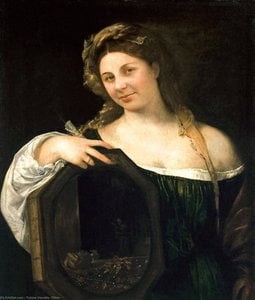
1640
1640 97.0 x 74.0 cm
博物馆级艺术微喷或帆布版画,制作高效,并提供多种饰面选择。 ( 购买手绘画作 切换至数字图像销售渠道)
从与原作比例一致的预设尺寸中进行选择。

您可以输入自定义尺寸,以适配特定的画框或空间。如果您选择的尺寸与原图比例不符,我们将对作品进行裁剪,或通过镜像填充/纯色填充边缘的方式来扩展图像。在开始制作之前,我们会向您发送一份数字效果图供您确认。
请注意,屏幕上的预览并不能反映实际的裁剪或扩展效果。只有效果图才能准确展示最终的构图。
虽然我们提供定制尺寸,但为了保持原图比例,我们建议您从预设列表中选择尺寸。

St Christina
复制品尺寸

Born Pier Francesco Cairo in Milan on September 26, 1607, this Italian master emerged as a profound voice within the Baroque era, weaving together spiritual intensity and dramatic realism. While history often remembers the thunderous impact of Caravaggio or the psychological depth of Rembrandt, Cairo carved out a singular space for himself through a style that balanced mystical fervor with an almost hauntingly beautiful execution. His early works, deeply rooted in the traditions of Lombardy, were characterized by a preoccupation with the macabre and the morbid, yet they were elevated by a technical mastery that transformed grim subjects into profound meditations on mortality and faith.
The foundations of his artistry were laid under the guidance of Morazzone, a mentor whose influence is etched into Cairo’s early palette. From this tutelage, Cairo inherited a sophisticated use of luminous oranges, earthy browns, and deep greens—colors that would become hallmarks of his early devotional pieces. This stylistic lineage is most strikingly evident in his monumental altarpiece, Saint Teresa’s Vision of Saints Peter and Paul, created for the Certosa di Pavia. In this work, one can witness the burgeoning talent of a young artist capable of capturing the divine through light and color, reflecting the intense spiritual currents that defined Milanese Baroque art during the late 1620s.
A transformative chapter in Cairo’s life began in 1633, when he was summoned to Turin to serve as the court painter for Victor Amadeus I, Duke of Savoy. This appointment was not merely a professional milestone but a catalyst for international recognition. As a court painter, his scope expanded from intimate religious commissions to grand, sweeping narratives that captured the majesty and the underlying anxieties of the Savoyard aristocracy. It was during this period that he earned the prestigious title Il Cavalière del Cairo, having been honored with the Order of Saints Maurice and Lazarus in recognition of his immense merit to the state.
His tenure in Turin allowed for a remarkable stylistic evolution. While his early works focused on the intense, shallow pictorial spaces typical of Milanese painting, his later compositions began to embrace a newfound clarity of space and gesture, likely influenced by the burgeoning Bolognese school. This period produced some of his most emotionally charged works, such as Christ in the Garden of Gethsemane and the gripping Herodias with the Head of Saint John the Baptist. In these canvases, Cairo utilized dramatic chiaroscuro to sculpt figures out of shadow, creating a sense of theatrical tension that drew the viewer into the very heart of the biblical drama.
Throughout his nearly four-decade career, Cairo’s ability to navigate between the intimate and the monumental remained his greatest strength. His repertoire was vast, ranging from large-scale altarpieces for religious orders like the Carmelites to exquisite cabinet pictures that explored the darker recesses of the human psyche. Even as his style matured into a more balanced and classical approach, he never lost the ability to evoke the "mystical vision"—that precise moment where the earthly realm intersects with the divine.
The historical significance of Francesco Cairo lies in his role as a bridge between eras. He stood at the conclusion of the pestanti painters' tradition in Milan, yet his work looked forward, embracing the more expansive and structured compositions of the mid-17th century. When he passed away in Milan on July 27, 1665, he left behind a body of work that remains a testament to the power of the Baroque spirit: a legacy defined by:

1607 - 1665


 效果预览
效果预览
 分享
分享 分享
分享
 详情
详情 指南
指南

 下载
下载
 相似作品
相似作品 X射线
X射线 幻灯片播放
幻灯片播放 统计数据
统计数据 展开详情
展开详情






































 玻璃选项仅适用于110厘米以下的尺寸。