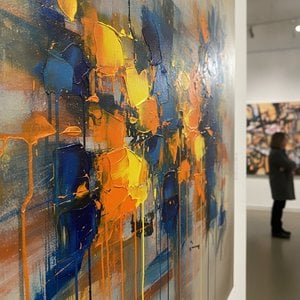
A Vortex of Humanity: Exploring Abstract Expression
This captivating artwork by Fernand Léger presents a powerful and unsettling vision of human interconnectedness. Rather than depicting recognizable figures, Léger constructs a dynamic scene from fragmented bodies and abstracted forms, swirling within a vibrant field of color. The piece evokes a sense of both chaos and unity, prompting contemplation on the complexities of modern life and the human condition.
Stylistic Roots & Artistic Innovation
Executed in Léger’s distinctive style – often described as “tubism,” a personal offshoot of Cubism – this work departs from traditional representation. Geometric shapes, particularly cylinders and rounded forms, dominate the composition, creating a sense of mechanical energy alongside organic fluidity. While influenced by the analytical fragmentation of early Cubism, Léger infuses his work with a bolder palette and a more overtly emotional charge, foreshadowing elements of Abstract Expressionism. This piece exemplifies his move towards a more figurative abstraction, retaining hints of the human form while dismantling conventional notions of anatomy.
Technique & Materiality
The artwork is likely executed in oil or acrylic on canvas, characterized by flat planes of color and minimal shading. Léger’s application appears smooth, emphasizing the purity of hue and form over textural variation. Bold outlines define many shapes, contributing to the work's fragmented aesthetic. This deliberate flatness rejects traditional illusionism, drawing attention to the painting as an object in itself – a carefully constructed arrangement of color and shape.
Historical Context & Léger’s Vision
Fernand Léger was a pivotal figure in 20th-century art, responding to the rapid industrialization and societal shifts of his time. His work often reflects a fascination with machinery, urban life, and the burgeoning modern world. This piece, while abstract, can be interpreted as a response to the anxieties and uncertainties of the interwar period, capturing a sense of collective struggle or perhaps even spiritual yearning. Léger’s art sought to create a new visual language for a new era, one that embraced both technology and humanity.
Symbolism & Emotional Resonance
The swirling arrangement of figures suggests a complex interplay of forces – conflict, collaboration, vulnerability, and resilience. The central figure with outstretched arms could represent leadership, hope, or a desperate plea for connection amidst the surrounding turmoil. The fragmented bodies symbolize brokenness or perhaps the inherent incompleteness of human experience. Emotionally, the artwork evokes feelings of anxiety, tension, and unrest, yet also possesses an undeniable vitality and energy.
A Statement Piece for Modern Interiors
This reproduction offers a striking focal point for any contemporary space. Its bold colors and dynamic composition will inject energy and intrigue into living rooms, offices, or galleries. The abstract nature allows for versatile interpretation, complementing a wide range of décor styles – from minimalist to eclectic. This artwork is not merely a decorative element; it’s a conversation starter, an invitation to contemplation, and a testament to the enduring power of modern art.
问答详情
"untitled (4017)" 的材质是什么,采用了哪种风格?
在“untitled (4017)”中,Oil On Canvas技法与Abstract Expressionism运动完美融合。
在 费尔南·莱热 的《untitled (4017)》 中,艺术流派与时代背景是如何交汇的?
在费尔南·莱热 的《untitled (4017)》中,Abstract Expressionism运动与现代主义时代交相辉映。
"untitled (4017)" 属于哪种艺术风格?
费尔南·莱热 的《untitled (4017)》 所属的艺术流派为 Abstract Expressionism。这一分类将该作品置于相关艺术家及艺术作品的语境之中。