博物馆级艺术微喷或帆布版画,制作高效,并提供多种饰面选择。 ( 订购此收藏品的纯手工复刻画作 切换至数字图像销售渠道)





























您可以从与原作比例一致的预设尺寸中进行选择。

请输入您所需的宽度和高度,以适配您的画框或墙面。由于印刷品只能进行裁剪,无法超出原图尺寸,因此若比例不一致,画面的一部分将会被裁切。在正式印刷之前,我们会为您发送一份数字效果图供您确认。本页面显示的图片并非最终裁剪后的效果——只有效果图才能展示真实的裁剪情况。
The viaduct
复刻品尺寸说明
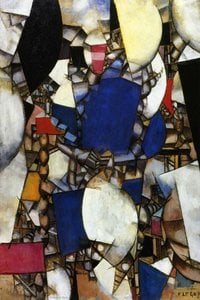
Fernand Léger's The Viaduct isn’t simply a depiction of an industrial scene; it is a bold declaration of faith in the machine age, rendered with his signature “Tubism” – a uniquely powerful evolution of Cubist principles. This painting transforms steel, brick, and the dynamism of transportation into a compelling visual symphony of form and color.
The composition is anchored by a robust, predominantly yellow building dramatically intersected by a viaduct – an elevated railway bridge. A speeding train on the right injects immediate energy and movement. Léger masterfully employs cylindrical forms, breaking down architectural elements and even human figures into simplified geometric shapes. These aren’t merely representations; they are *constructions*, emphasizing the underlying structural logic of the modern world.
Two subtly integrated human figures appear within this mechanical landscape – one positioned near the left edge and another closer to the center. They almost function as components within the larger machine, rather than independent observers, hinting at humanity’s evolving relationship with technology. A clock prominently placed in the top-left corner isn't a mere detail; it symbolizes Léger’s fascination with time, efficiency, and the rhythmic pulse of modern life.
Léger achieves his striking effect through flat planes of color – primarily yellows, reds, blues, and grays – and strong contrasts. He deliberately rejects traditional modeling techniques in favor of a more graphic, almost poster-like approach, enhancing the painting’s visual impact and immediacy.
Born in 1881, Léger lived through a period of rapid industrialization. Unlike many artists who mourned the loss of tradition, he wholeheartedly embraced it. He perceived beauty and heroism within machinery, believing it represented a new aesthetic possibility. Developing his distinctive style around 1910, he moved beyond analytical Cubism towards a more figurative and accessible form – “Tubism” – which focused on the inherent structural qualities of objects.
The Viaduct perfectly exemplifies this artistic evolution. It’s not just *about* industry; it's an attempt to capture its very essence, its underlying structure, and its profound impact on human experience. Léger’s work anticipated the Pop Art movement decades later with its embrace of everyday objects and mass-produced imagery.
The painting evokes a sense of dynamism and optimism, yet also carries an undercurrent of detachment. The anonymized figures suggest the individual’s place within the vast industrial system. It's a powerful statement about modernity – its energy, scale, and potential for both progress *and* alienation.
The Viaduct is more than just a painting; it’s a visual manifesto celebrating the beauty and complexity of the modern world – a testament to Fernand Léger’s visionary artistry. It invites viewers to contemplate not only what we build, but also how those creations shape our lives.
"The viaduct" 属于 费尔南·莱热 的 Cubism 时期作品,其记录的主题包括 cubist abstraction, industrial cityscape, geometric dynamism, modern urban life, leger's machine age, early 20th century, form and movement, simplified reality。
《The viaduct》采用Acrylic On Canvas创作。
关于 费尔南·莱热 的《The viaduct》 的统计数据可在该作品的 统计数据 页面查看:包括作品的每月访问量、艺术家作品的访问量,以及近期访客的国家和语言分布情况。

1881 - 1955 , 法国

Explore the vibrant world of Fernand Léger. Discover how his 'Tubism' and Machine Age aesthetics redefined modern art, offering profound inspiration for discerning collectors seeking geometric beauty and industrial dynamism.

Explore the profound evolution of Cubist still life, from Cézanne's structural foundations to the fragmented brilliance of Braque and Léger. Discover how geometric abstraction redefined reality through a sophisticated lens of form, color, and modern artistic mastery.

Explore the profound intersection of industry and artistry. Discover museum-quality reproductions of Machine Age masterpieces by Léger and Rivera, curated for elite collectors seeking to infuse luxury interiors with the powerful, geometric soul of industrial progress.


 实景预览
实景预览
 发送
发送 分享
分享
 详情
详情 指南
指南

 下载图片
下载图片
 相似作品
相似作品 X射线
X射线 幻灯片播放
幻灯片播放 统计数据
统计数据

 阅读全文
阅读全文









 玻璃选项仅适用于110厘米以下的尺寸。