Fernand Léger’s “The Printer”: A Symphony of Industrial Forms
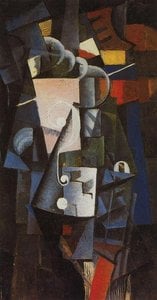
Fernand Léger's "The Printer," painted around 1923, is more than just a still life; it’s a vibrant declaration of the burgeoning modernist movement and a profound meditation on the relationship between humanity and technology. This captivating artwork, brimming with carefully arranged objects – a cup, spoon, bowl, bottle, and a striking clock – transcends mere representation to become an intensely expressive exploration of form and texture. Léger, deeply influenced by the dynamism of the machine age, sought not to reject reality but to re-interpret it through a lens of abstraction, capturing the essence of industrial life with bold strokes and a distinctive visual vocabulary.
- Subject Matter: The seemingly mundane objects within “The Printer” are elevated to symbolic significance. Léger deliberately chose everyday items – remnants of domesticity – to juxtapose them against the burgeoning world of industry, prompting viewers to consider the impact of mechanization on daily life.
- Style & Technique: Léger’s style is immediately recognizable as “Néoplastic,” a movement he co-founded with Jean Metzinger. Characterized by geometric forms, simplified shapes, and a deliberate rejection of illusionistic depth, Néoplastic aimed to express pure feeling through the reduction of form to its essential elements. The painting's surface is built up in thick, layered brushstrokes, creating a tactile quality that invites close inspection and emphasizes the materiality of each object.
A Reflection of the Machine Age
Created during a period of rapid industrialization following World War I, “The Printer” reflects the anxieties and fascinations of its time. Léger was profoundly moved by the rise of factories, the proliferation of machines, and the transformation of society. He wasn’t simply depicting these objects; he was attempting to capture their inherent energy and power. The angularity of the clock, for instance, echoes the precise mechanics of a timepiece, while the rounded forms of the tableware suggest a return to domestic comfort amidst the encroaching industrial landscape. This tension between organic and mechanical shapes is a key element of Léger’s artistic vision.
- Historical Context: Léger's work emerged during a period of immense social and technological change. The war had shattered traditional values, and new technologies were reshaping the world at an unprecedented pace. Léger sought to articulate this transformation through his art, creating works that were both visually arresting and intellectually stimulating.
- Néoplastic Philosophy: Léger’s use of geometric forms was rooted in the philosophical principles of Néoplastic, which aimed to strip away all unnecessary detail and focus on the essential qualities of form. This approach reflected a broader movement within modern art that sought to break free from traditional representational conventions.
Symbolism and Emotional Impact
"The Printer" is not merely an aesthetic exercise; it’s imbued with a subtle emotional resonance. The arrangement of the objects – seemingly haphazard yet carefully considered – creates a sense of dynamism and tension. The clock, particularly prominent in the composition, serves as a potent symbol of time, reminding us of the relentless march forward and the impact of industrial progress on human experience. Léger’s bold use of color—primarily earthy tones punctuated by vibrant accents—further amplifies the painting's emotional intensity. The overall effect is one of both fascination and unease, inviting viewers to contemplate the complex relationship between humanity and technology.
A Masterpiece Reimagined
WahooArt offers a meticulously crafted hand-painted reproduction of Fernand Léger’s “The Printer,” allowing you to experience the full impact of this seminal modernist work. Each reproduction is created by skilled artisans, faithfully capturing the artist's unique style and technique. Whether adorning your walls or serving as a centerpiece in your interior design project, this artwork will undoubtedly become a treasured addition to any collection.
常见问题与解答
我能查看费尔南·莱热 的《The printer》的X光影像吗?
您可以在作品的 X射线透视 页面上逐层探索 “The printer”;该交互式查看器的设计灵感源自修复师使用的光源台,通过十一层光学读数呈现图像细节。
Cubist Abstraction 流派的作品 "The printer" 传达了怎样的情感?
"The printer" 在 Cubist Abstraction 运动中蕴含着 Reflective 的情感基调。
在哪里可以找到关于费尔南·莱热 的《The printer》的数据统计?
"The printer" 拥有专属的 访问统计 页面。该页面通过国家和语言维度的细分,展示了该作品及艺术家其他作品的每月访问量趋势图。