购买高分辨率增强版数字图像,其品质远超在线预览。
每一份文件都由我们的内部专家使用先进工具与专业的后期润色技术精心打造。我们确保每一张图像都具备卓越的清晰度、精准的色彩还原度以及细腻的细节表现。
最终文件将在 72 小时内通过电子邮件交付,并针对专业、编辑及印刷用途进行了优化。其品质与顶级设计工作室、出版社和画廊所信赖的标准完全一致。
下载高分辨率文件,用于个人展示、打印及创意项目。 ( 切换至版画销售渠道 订购此收藏品的纯手工复刻画作)
选择 WahooArt.com,您获得的不仅仅是一张图像——您收到的是经过专业级增强、精雕细琢的数字艺术作品,并享有满意保证。以下是您的订单中自动包含的所有内容:
您的高分辨率数字图像文件将在下单后 72 小时内通过电子邮件发送给您 —— 即可立即使用。
您的艺术品经过专业优化,结合先进的 AI 技术与人工修饰,确保呈现极致的细节、清晰度与色彩准确度。
不小心删除了文件或找不到了?没关系——我们将随时为您免费重发。
即刻拥有您的艺术作品,无需支付任何关税、税费或运费——数字下载始终免税。
我们通过专业工具与色彩管理技术,确保您的数字图像尽可能真实地还原原作色彩。
如果您对所购数字图像不满意,我们将在100天内为您进行修改或提供100%的全额退款——无需任何理由。
不满意?在收到数字文件后的100天内,您可以申请全额退款——无需任何理由。
购买 3 张享 10% 折扣 - 购买 5 张享 15% 折扣 - 购买 10 张以上享 20% 折扣。非常适合创意项目、画廊及机构使用。
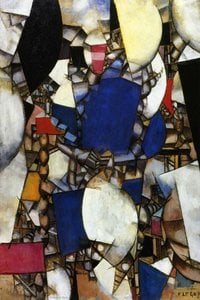
Fernand Léger's "The Level Crossing (Final State)," painted in 1919, isn’t merely a depiction of a railway crossing; it’s a vibrant manifesto of the burgeoning Tubism movement and a bold declaration of modernity. Emerging from the fertile ground of Argentan, Normandy – a region deeply rooted in agricultural tradition – Léger embarked on an artistic journey that propelled him to the heart of Parisian avant-garde circles. Unlike many artists retreating into abstraction as a refuge, Léger sought to actively *integrate* the dynamism and stark forms of the machine age into his visual language. This painting exemplifies that ambition with remarkable force, capturing not just the physical structure of the crossing but also the underlying rhythms and geometries of industrial life.
The work’s genesis lies in Léger's fascination with the burgeoning world of machinery – a subject he viewed as possessing an inherent beauty and power. He meticulously studied locomotives, factories, and other mechanical marvels, translating their angular forms and repetitive patterns into his art. “The Level Crossing” is thus a distillation of this observation, rendered in a strikingly simplified style. The dominant shapes are not organic or representational; instead, they’re cylindrical volumes, interlocking cones, and sharp-edged rectangles – elements that evoke the precision and efficiency of industrial design. This deliberate reduction to essential forms creates a sense of both immediacy and abstraction, drawing the viewer into a world where recognizable objects dissolve into pure geometric relationships.
“The Level Crossing” is a quintessential example of Tubism, a style developed by Léger alongside Robert Delaunay. Unlike Cubism’s fragmentation of form, Tubism sought to capture the *essence* of objects through simplified, cylindrical shapes – often referred to as “tubes.” These tubes aren't merely geometric forms; they possess an inherent sense of movement and energy, mirroring the relentless motion of machinery. Léger employed a bold palette of primary colors—yellows, reds, blues—interspersed with black and white, creating a dynamic visual rhythm that pulsates across the canvas. The use of flat planes and unmodulated color further emphasizes the two-dimensionality of the work, contributing to its overall sense of immediacy and dynamism.
Crucially, Léger wasn’t simply replicating mechanical forms; he was imbuing them with a new kind of beauty. He sought to elevate the mundane – the railway crossing, a symbol of industrial progress – into an object of aesthetic contemplation. The painting's composition is carefully balanced, creating a sense of visual harmony despite its fragmented and geometric nature. The central red pole acts as a focal point, drawing the eye through the complex arrangement of shapes and colors. It’s a deliberate gesture, directing the viewer’s gaze across the scene and reinforcing the painting’s overall message.
Beyond its formal qualities, “The Level Crossing” is rich in symbolic meaning. The railway crossing itself represents the intersection of two worlds: the rural past and the rapidly advancing industrial future. Léger's depiction suggests a transition – a moment of both disruption and potential. The simplified forms and bold colors evoke a sense of excitement and optimism about the possibilities of modernity, while the geometric structure also hints at the underlying order and logic of the machine age. The painting’s emotional impact is surprisingly powerful, conveying not just the visual spectacle of industrial progress but also a feeling of dynamism, energy, and even a touch of alienation.
Furthermore, the work can be interpreted as a commentary on the human condition within this new technological landscape. The figures, though abstracted, retain a sense of humanity, suggesting that individuals are both shaped by and contribute to the forces of industrialization. “The Level Crossing (Final State)” is therefore not just a depiction of a physical space; it’s a profound meditation on the relationship between humans, machines, and the evolving world around us – a timeless masterpiece that continues to resonate with viewers today.
费尔南·莱热 的《The level crossing (final state)》 的创作年份为 1919。
您可以在作品的幻灯片播放页面上观看“The level crossing (final state)”的幻灯片展示。
"The level crossing (final state)" 属于 费尔南·莱热 的 Tubism 时期作品,其记录的主题包括 cubism, machine age, modernity, industrialization, urban life, progress, geometric abstraction, form emphasis。
您可以在 本页 直接订购 费尔南·莱热 的《The level crossing (final state)》 的手绘复制品:亚麻画布手工绘制油画复制品,按需定制。
在费尔南·莱热 的《The level crossing (final state)》中,Tubism运动与现代主义时代交相辉映。
“The level crossing (final state)”倾向于Warm Sunset Tones色调。
“The level crossing (final state)”采用 Acrylic On Canvas 创作,呈现出 Tubism 风格。
费尔南·莱热 的《The level crossing (final state)》 采用了 Earthy 色调。这一色调概括了作品整体的色彩特征。

1881 - 1955 , 法国


 实景预览
实景预览
 发送
发送 分享
分享
 详情
详情 指南
指南

 下载图片
下载图片
 相似作品
相似作品 X射线
X射线 幻灯片播放
幻灯片播放 统计数据
统计数据

 阅读全文
阅读全文