由我们的艺术家按需定制,为您提供您所选尺寸及画框的布面手工油画。 ( 切换至版画销售渠道 切换至数字图像销售渠道)





























您可以从与原作比例一致的预设尺寸中进行选择。

请输入您需要的宽度和高度,以适配您的画框或墙面。由于作品为手工绘制,若您选择不同的尺寸比例,艺术家可能会在画面边缘多画一些或稍作裁剪 —— 由您决定。在开始绘画之前,我们会为您发送一份数字效果图供您确认。本页面上展示的图片并非最终实物 —— 只有效果图才能反映真实结果。
The Baluster
复刻品尺寸说明
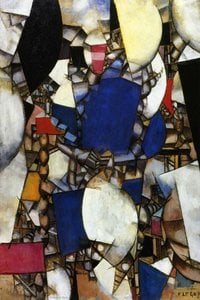
Fernand Léger's "The Baluster," painted in 1925, isn’t merely a depiction of an architectural element; it’s a vibrant manifesto of Cubism’s embrace of the modern world. This oil on canvas, currently residing within the esteemed collection of the Museum of Modern Art (MoMA) in New York City, pulsates with a dynamic energy born from the artist's unique synthesis of geometric abstraction and a fascination with industrial forms. Léger, a pivotal figure in the early 20th century’s artistic revolution, sought to translate the rhythms of the machine age – its angularity, its repetitive patterns, its sense of relentless motion – into a visual language that was both intellectually stimulating and emotionally resonant.
The painting immediately commands attention with its bold palette. A dominant blue background provides a striking contrast to the fiery reds, yellows, and oranges that dominate the central composition. This interplay of cool and warm tones isn’t simply decorative; it establishes a visual tension, mirroring the inherent dynamism within the artwork itself. Léger masterfully employs simplified geometric shapes – interlocking circles, rectangles, and stylized cylinders – to construct the balustrade, the very subject of the piece. These forms aren't rendered with meticulous detail but rather are presented in a deliberately abstracted manner, emphasizing their essential qualities over realistic representation.
“The Baluster” firmly situates itself within the broader context of Cubism, a movement pioneered by Pablo Picasso and Georges Braque. Unlike earlier representational art that prioritized illusionistic depth and perspective, Cubism sought to dismantle traditional notions of space and representation. Léger’s approach, often referred to as “Tubism,” further developed this concept by reducing objects to their fundamental geometric components – cylinders, cones, and spheres – and presenting them from multiple viewpoints simultaneously. This fragmentation creates a sense of disorientation and invites the viewer to actively engage with the artwork, piecing together its meaning through observation.
The influence of Futurism is also palpable in Léger’s work. Like the Italian Futurist movement, which celebrated speed, technology, and dynamism, Léger sought to capture the essence of modern life – particularly the impact of industrialization on human experience. The painting's angular forms and sense of movement evoke the imagery of factories, trains, and other symbols of the machine age. However, unlike the often-aggressive aesthetic of Futurism, Léger’s approach is more restrained and contemplative, suggesting a nuanced understanding of both the promise and the potential anxieties associated with modernity.
The title itself – “The Baluster” – immediately draws our attention to the central element of the composition. Léger doesn’t simply depict a balustrade; he elevates it to a symbolic representation of stability, structure, and order within an increasingly chaotic world. The balustrade, traditionally associated with safety and protection, becomes a visual anchor amidst the swirling forms and vibrant colors. It represents a point of reference, a grounding element that provides a sense of equilibrium in the midst of dynamic energy.
Interestingly, Léger’s choice to depict a balustrade – a relatively mundane architectural feature – is itself significant. By focusing on an everyday object, he invites us to reconsider our perceptions of beauty and value. The painting suggests that even the most ordinary elements of our environment can be transformed into works of art through careful observation and creative interpretation.
“The Baluster” stands as a testament to Fernand Léger's innovative spirit and his profound impact on the development of modern art. His bold use of color, simplified forms, and exploration of industrial themes paved the way for subsequent generations of artists, including Pop Art pioneers like Andy Warhol. The painting’s enduring appeal lies in its ability to capture the energy and dynamism of the 20th century while simultaneously inviting viewers to contemplate the fundamental questions about perception, representation, and the relationship between art and life.
Reproductions of “The Baluster” continue to be highly sought after by collectors and interior designers alike. Its vibrant colors and dynamic composition make it a striking addition to any space, while its historical significance offers a glimpse into the artistic currents that shaped the modern world. A piece like this speaks volumes about the artist's vision and his place in art history.
"The Baluster" 的作者是 费尔南·莱热,创作于 1925 年。
通过兼容设备访问 费尔南·莱热 的《The Baluster》 的 AR 预览 页面,即可利用增强现实技术将艺术品呈现在您自己的空间中。
"The Baluster" 艺术复制品的推荐用途为 Statement。

1881 - 1955 , 法国

Explore the profound spiritual depth of geometric abstraction. From Malevich's Suprematism to modern masters, our expert guide reveals how pure form and color command presence in fine art collections.

Explore the profound evolution of Cubist still life, from Cézanne's structural foundations to the fragmented brilliance of Braque and Léger. Discover how geometric abstraction redefined reality through a sophisticated lens of form, color, and modern artistic mastery.


 实景预览
实景预览
 发送
发送 分享
分享
 详情
详情 指南
指南

 下载图片
下载图片
 相似作品
相似作品 X射线
X射线 幻灯片播放
幻灯片播放 统计数据
统计数据

 阅读全文
阅读全文









 玻璃选项仅适用于110厘米以下的尺寸。