由我们的艺术家按需定制,为您提供您所选尺寸及画框的布面手工油画。 ( 切换至版画销售渠道 切换至数字图像销售渠道)





























从与原作比例一致的预设尺寸中进行选择。

您可以输入自定义尺寸,以适配特定的画框或空间。如果所选尺寸与原图比例不符,我们将通过裁剪作品或添加手绘元素来扩展画面。数字样稿将在制作开始前发送给您确认。
请注意,屏幕预览无法准确反映实际的裁剪或扩展效果,只有样稿才能真实呈现最终的构图。
虽然我们提供定制尺寸服务,但为了保留原作比例,建议您从预设列表中选择尺寸。

'The album ''Circus''' (32)
复制品尺寸
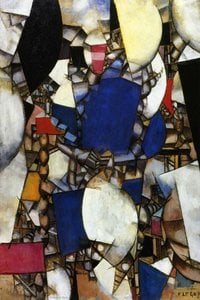
Fernand Léger's "The Album ‘Circus’," painted in 1950, isn’t merely a depiction of a carnival; it’s an arresting distillation of modern anxieties and the allure of chance itself. This vibrant work, rendered with characteristic boldness and geometric precision, embodies the core tenets of Léger’s unique artistic vision – a synthesis of Cubist principles with a deeply rooted fascination for the machine age and its impact on human experience. Born Joseph Fernand Henri Léger in Argentan, Normandy, in 1881, Léger initially pursued architecture before finding his true voice through painting, a path irrevocably shaped by his early life amidst the physicality of rural labor. This grounding in tangible reality would later inform his exploration of abstract forms and their relationship to industrial design.
The composition immediately commands attention. A dominant circular form, clearly referencing a roulette wheel or similar game element, anchors the lower portion of the canvas. Above it, a smaller, mirrored circle suggests an echo, a doubling of the potential for both fortune and misfortune inherent in gambling. Surrounding this central vortex are stylized green leaf-like shapes – reminiscent of foliage but rendered with sharp angles and simplified forms – that radiate outwards, creating a dynamic sense of expansion or even explosive energy. Angular white forms punctuate the scene, acting as counterpoints to the vibrant colors and adding a layer of controlled chaos. The overall effect is one of contained movement, a visual representation of the unpredictable nature of games and the human desire for control within an inherently random system.
Léger’s approach to painting during this period – often referred to as his “Purist” phase – is characterized by a deliberate simplification of forms, a rejection of illusionistic depth, and a preference for bold, primary colors. "The Album ‘Circus’," executed likely in gouache or tempera on paper or canvas, exemplifies these techniques perfectly. The stark black outlines that define nearly every shape contribute to the artwork's graphic quality, lending it a distinctly modernist aesthetic. Circles, triangles, and rectangles – fundamental geometric shapes – are arranged with an almost mathematical precision, yet they’re imbued with a surprising sense of vitality. Notably, Léger eschewed traditional shading or textural representation; instead, he relied on flat planes of color and sharp lines to create the illusion of form and depth, prioritizing clarity and visual impact over realistic depiction.
Beyond its purely formal qualities, “The Album ‘Circus’” is rich in symbolic meaning. The circular forms themselves are potent symbols – representing cycles, repetition, and the unpredictable nature of chance. The roulette wheel, a quintessential emblem of gambling, immediately evokes themes of risk, reward, and the allure of the unknown. However, Léger doesn't present this as a purely negative experience. The vibrant colors, particularly the reds, yellows, and blues, inject an element of excitement and energy into the scene, suggesting that even within the realm of chance, there’s a certain exhilaration to be found. The geometric precision of the shapes hints at an underlying order – a desire to impose structure onto the chaotic nature of the game, mirroring Léger's own fascination with the mechanics of modern life.
To fully appreciate “The Album ‘Circus’,” it’s crucial to understand its historical context. Painted in 1950, the artwork reflects the profound impact of industrialization and technological advancements on European society. Léger was deeply influenced by the dynamism and efficiency of machines, viewing them as both a source of progress and a potential threat to traditional ways of life. His work often explored themes of mechanization, urban landscapes, and the relationship between humans and technology – subjects that resonated powerfully with the anxieties and aspirations of the mid-20th century. Considering this, “The Album ‘Circus’” can be seen as a visual meditation on the complexities of modernity, capturing both its promise and its inherent uncertainties. It's a testament to Léger's ability to translate the spirit of the machine age into a uniquely expressive and visually arresting artistic language.

1881 - 1955 , 法国

Explore the profound spiritual depth of geometric abstraction. From Malevich's Suprematism to modern masters, our expert guide reveals how pure form and color command presence in fine art collections.


 效果预览
效果预览
 分享
分享 分享
分享
 详情
详情 指南
指南

 下载
下载
 相似作品
相似作品 X射线
X射线 幻灯片播放
幻灯片播放 统计数据
统计数据

 展开详情
展开详情









 玻璃选项仅适用于110厘米以下的尺寸。