藏品详情
A Symphony in Clay: Exploring Fernand Léger’s Rockefeller Branch
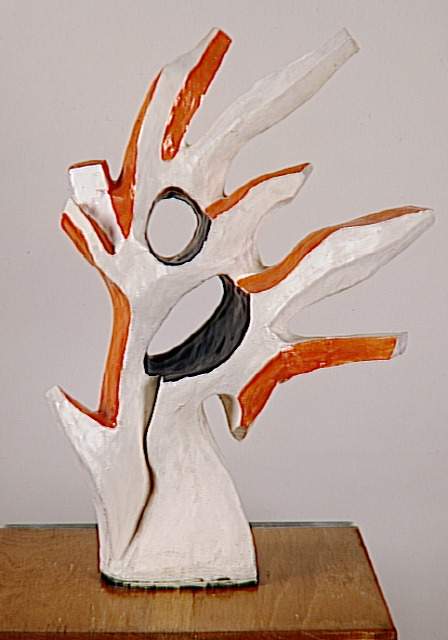
Fernand Léger's "Rockefeller Branch," sculpted in 1952, stands as an arresting emblem of Surrealism and a masterful distillation of Léger’s singular artistic philosophy. Situated within Biot’s Musée National Fernand Leger – Léger’s own hometown – the sculpture invites contemplation not merely as an object of beauty but as a conduit to understanding Léger's profound engagement with the anxieties and aspirations of his era.
The Genesis of Form: Léger’s Early Influences
Born Joseph Fernand Henri Léger in 1881, Léger emerged from the pastoral landscapes of Normandy into the burgeoning dynamism of Parisian artistic life. Initially drawn to architecture, he swiftly transitioned to painting, fueled by an instinctive fascination with geometric abstraction – a movement championed by artists like Piet Mondrian and Kazimir Malevich. However, Léger refused to abandon the tangible world entirely; his formative experiences in rural labor instilled within him a deep appreciation for physicality and craftsmanship—qualities that would subsequently permeate his sculptural oeuvre. This duality—the embrace of pure form alongside an unwavering connection to material substance—became the cornerstone of Léger’s artistic vision.
Surrealist Resonance: Embracing Paradox
Léger's foray into Surrealism wasn’t driven by a desire for purely aesthetic experimentation but rather by a conviction that art could illuminate the subconscious mind and expose hidden truths. Unlike many Surrealists who sought to conjure dreamlike imagery, Léger deliberately confronted viewers with recognizable forms—a hand clutching a ring—rendered in an unsettlingly simplified style. This paradoxical juxtaposition – the familiar rendered alien – reflects Léger’s belief that true artistic innovation resided not in escaping reality but in interrogating it from unexpected angles. The sculpture's deliberate distortion of anatomical proportions underscores this conceptual ambition, prompting viewers to reconsider conventional notions of representation and perception.
Technique and Material: Clay as Medium
The Rockefeller Branch is executed primarily in clay – a material Léger favored throughout his career—demonstrating an exceptional command of sculptural technique. Léger’s meticulous approach involved layering clay meticulously, achieving remarkable textural complexity through controlled manipulation and polishing. The resulting surface possesses a subtly mottled appearance, hinting at the artist's deliberate consideration of materiality as expressive element. This tactile quality invites viewers to engage with the sculpture on a sensory level, fostering an appreciation for the craftmanship inherent in its creation. Furthermore, Léger’s use of clay aligns perfectly with Surrealist ideals—a rejection of polished surfaces and idealized forms—emphasizing instead the inherent imperfections and irregularities that contribute to artistic authenticity.
Symbolism Beyond Representation
The hand itself – a motif recurrent throughout Léger's work – carries significant symbolic weight. Representing human agency, labor, and connection to the natural world, it embodies Léger’s humanist convictions. The ring symbolizes commitment, continuity, and perhaps even an unspoken acknowledgment of tradition—a subtle counterpoint to Léger’s radical embrace of abstraction. Collectively, these elements contribute to a layered narrative that transcends mere visual depiction, prompting viewers to contemplate themes of identity, purpose, and the enduring influence of formative experiences.
Emotional Impact: A Quiet Revelation
Despite its unsettling distortions, "Rockefeller Branch" possesses an understated emotional resonance. The sculpture’s stillness encourages contemplation—a deliberate antithesis to the frenetic pace of modern life—inviting viewers to slow down and consider the profound implications of Léger's artistic vision. Ultimately, Léger’s masterpiece serves as a reminder that art can communicate complex ideas with remarkable subtlety, prompting us to confront our preconceptions and embrace the transformative power of imaginative engagement.



 效果预览
效果预览
 购买手绘画作
 分享
分享 分享
分享
 详情
详情

 下载
下载
 相似作品
相似作品 X射线
X射线 幻灯片播放
幻灯片播放

 展开详情
展开详情






































 玻璃选项仅适用于110厘米以下的尺寸。